New Semester
Started
Get
50% OFF
Study Help!
--h --m --s
Claim Now
Question Answers
Textbooks
Find textbooks, questions and answers
Oops, something went wrong!
Change your search query and then try again
S
Books
FREE
Study Help
Expert Questions
Accounting
General Management
Mathematics
Finance
Organizational Behaviour
Law
Physics
Operating System
Management Leadership
Sociology
Programming
Marketing
Database
Computer Network
Economics
Textbooks Solutions
Accounting
Managerial Accounting
Management Leadership
Cost Accounting
Statistics
Business Law
Corporate Finance
Finance
Economics
Auditing
Tutors
Online Tutors
Find a Tutor
Hire a Tutor
Become a Tutor
AI Tutor
AI Study Planner
NEW
Sell Books
Search
Search
Sign In
Register
study help
mathematics
pearson edexcel a level mathematics
Pearson Edexcel A Level Mathematics Pure Mathematics Year 2 1st Edition Greg Attwood, Jack Barraclough, Ian Bettison, David Goldberg, Alistair Macpherson, Joe Petran - Solutions
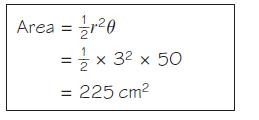
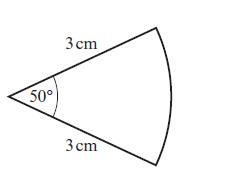
A teacher asks a student to find the area of the following sector. The attempt is shown below.a. Identify the mistake made by the student.b. Calculate the correct area of the sector. Area = ²0 = = x 3² x 50 = = 225 cm²
A sector of a circle of radius 28 cm has perimeter P cm and area A cm2. Given that A = 4P, find the value of P.
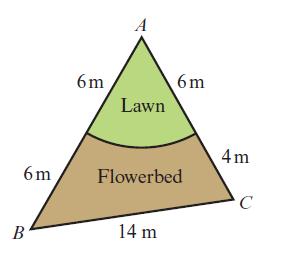
The diagram shows a triangular plot of land. The sides AB, BC and CA have lengths 12 m, 14 m and 10 m respectively. The lawn is a sector of a circle, centre A and radius 6 m.a. Show that ∠BAC = 1.37 radians, correct to 3 significant figures.b. Calculate the area of the flowerbed.
The diagram above shows a triangular garden, PQR, with PQ = 12 m, PR = 7 m and ∠QPR = 0.5 radians. The curve SR is a small path separating the shaded patio area and the lawn, and is an arc of a circle with center at P and radius of 7 m.Find:a. The length of the path SR.b. The perimeter of the
When θ is small, find the approximate values of: a cos - 1 0 tan20 b 2(1-cos) - 1 tan - 1
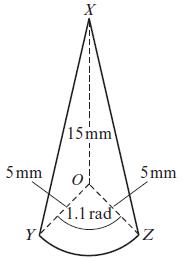
The shape XYZ shown is a design for an earring.The straight lines XY and XZ are equal in length. The curve YZ is an arc of a circle with center O and radius 5 mm. The size of ∠YOZ is 1.1 radians and XO = 15 mm.a. Find the size of ∠XOZ, in radians, to 3 significant figures.b. Find the total
In the triangle ABC, AB = 5 cm, AC = 12 cm, ∠ABC = 0.5 radians and ∠ACB = x radians.a. Use the sine rule to find the value of sin x, giving your answer to 3 decimal places. Given that there are two possible values of x,b. Find these values of x, giving your answers to 2 decimal places.
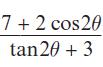
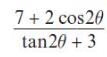
a. When θ is small, show that the equationcan be written as 3 − 2θ.b. Hence write down the value ofwhen θ is small. 7 + 2 cos20 tan 20 + 3
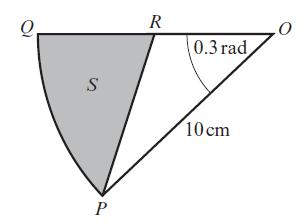
The diagram shows OPQ, a sector of a circle with centre O, radius 10 cm, with ∠POQ = 0.3 radians.The point R is on OQ such that the ratio OR : RQ is 1 : 3. The region S, shown shaded in the diagram, is bounded by QR, RP and the arc PQ.Find:a. The perimeter of S, giving your answer to 3
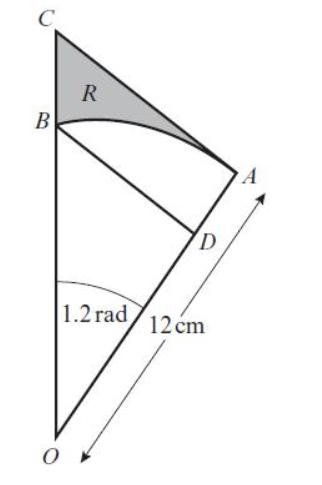
The diagram shows the sector OAB of a circle with centre O, radius 12 cm and angle 1.2 radians. The line AC is a tangent to the circle with centre O, and OBC is a straight line. The region R is bounded by the arc AB and the lines AC and CB.a. Find the area of R, giving your answer to 2 decimal
a. When θ is small, show that the equation 32 cos 5θ + 203 tan 10θ = 182 can be written as 40θ2 − 203θ + 15 = 0b. Hence, find the solutions of the equation 32 cos 5θ + 203 tan 10θ = 182c. Comment on the validity of your solutions.
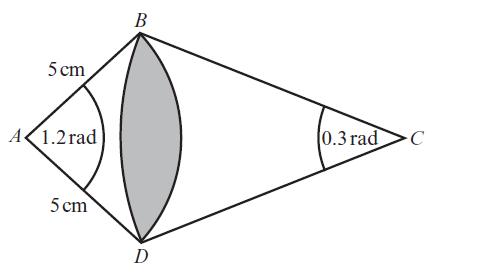
The diagram shows two intersecting sectors: ABD, with radius 5 cm and angle 1.2 radians, and CBD,with radius 12 cm and angle 0.3 radians. Find the area of the overlapping section. 5 cm A1.2 rad 5 cm B D 0.3 rad C
Solve the following equations for θ, giving your answers to 3 significant figures where appropriate, in the intervals indicated. a 3 sin0 = 2,0 ≤0 ≤ T 1 tan c tan + = 2,0 ≤0 ≤ 2π b sin-cos0, π ≤ 0 ≤ T d 2 sin20 sin 0 - 1 = sin²0, π ≤0 ≤ T
When θ is small, find the approximate value of cos4 θ − sin4 θ.
a. Sketch the graphs of y = 5 sin x and y = 3 cos x on the same axes (0 ≤ x ≤ 2π), marking on all the points where the graphs cross the axes.b. Write down how many solutions there are in the given range for the equation 5 sin x = 3 cos x.c. Solve the equation 5 sin x = 3 cos x algebraically,
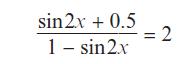
Find the values of x in the interval 0 < x < 3π/2 which satisfy the equation sin 2x + 0.5 1 - sin2x = 2
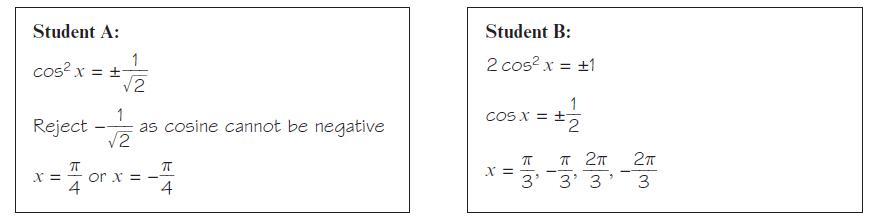
A teacher asks two students to solve the equation 2 cos2 x = 1 for −π < x < π. The attempts are shown below.a. Identify the mistake made by Student A.b. Identify the mistake made by Student B.c. Calculate the correct solutions to the equation. Student A: cos²x = ± Reject 1 π X x =
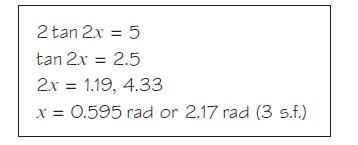
A teacher asks two students to solve the equation 2 tan 2x = 5 for 0 < x < 2π. The attempt is shown below.a. Identify the mistake made by the student. b. Calculate the correct solutions to the equation. 2 tan 2x = 5 tan 2x = 2.5 2x = 1.19, 4.33 x = 0.595 rad or 2.17 rad (3 5.f.)
g: x ↦ cos x, −360° ≤ x ≤ 360°a. Sketch the graph of y = g(x).b. Sketch the graph of y = |g(x)|.c. Sketch the graph of y = g(|x|).
Carol starts a new job on a salary of £20,000. She is given an annual wage rise of £500 at the end of every year until she reaches her maximum salary of £25,000. Find the total amount she earns (assuming no other rises), a in the first 10 years, b over 15 years and c state one reason why this
The sum of the first three terms of an arithmetic series is 12. If the 20th term is −32, find the first term and the common difference.
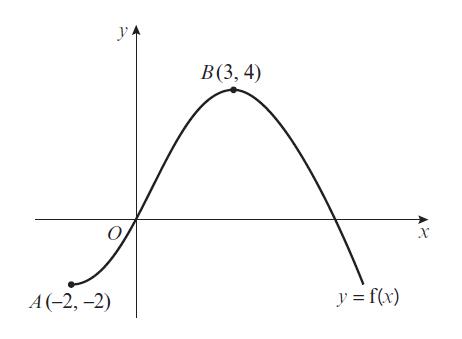
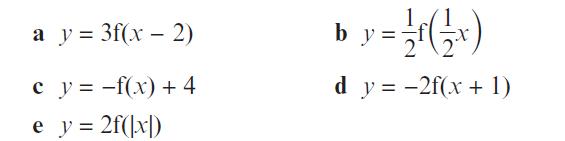
The diagram shows a sketch of the graph y = f(x). The curve passes through the origin O, the point A(−2, −2) and the point B(3, 4). On separate axes, sketch the graphs of:In each case find the coordinates of the images of the points O, A and B. a y = 3f(x) + 2 c y = -f(x + e y = f(x)| + 1) by =
f(x) = x2 − 7x − 8a. Sketch the graph of y = f(x).b. Sketch the graph of y = |f(x)|.c. Sketch the graph of y = f(|x|).
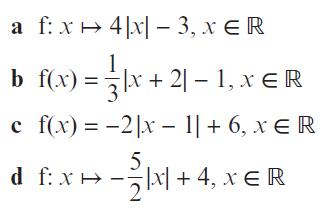
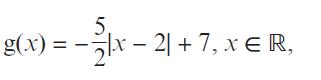
For each function.i. Sketch the graph of y = f(x)ii. State the range of the function. a f: x4|x - 3, x ER b f(x) = x + 2-1, x ER f(x) = -2|x1| + 6, x € R d f: x 5 -x + 4, x ER
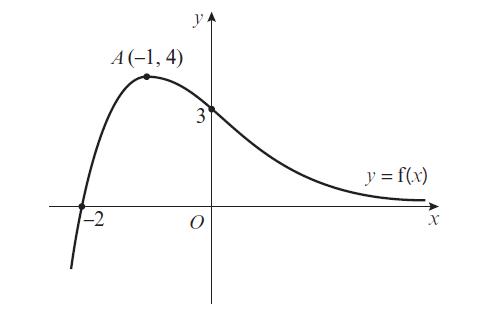
The diagram shows a sketch of the graph y = f(x). The curve has a maximum at the point A(−1, 4) and crosses the axes at the points (0, 3) and (−2, 0).For each graph, find, where possible, the coordinates of the maximum or minimum and the coordinates of the intersection points with the axes. a y
a. On the same axes, sketch the graphs of y = 2 − x and y = 2|x + 1|.b. Hence, or otherwise, find the values of x for which 2 − x = 2|x + 1|.
h(x) = 2 sin x, −180° ≤ x ≤ 180°.a. Sketch the graph of y = h(x).b. Write down the coordinates of the minimum, A, and the maximum, B.c. Sketch the graphs of:In each case find the coordinates of the images of the points O, A and B. i h(x - 90°) + 1 ii iii|h(-x)
Explain why the function g: x ↦ 4 − x, {x ∈ ℝ, x > 0} is not identical to its inverse.
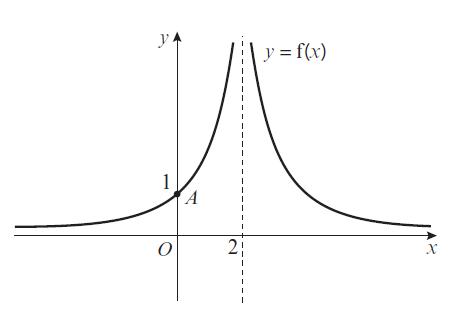
The diagram shows a sketch of the graph y = f(x). The lines x = 2 and y = 0 (the x-axis) are asymptotes to the curve. On separate axes, sketch the graphs of:For each part, state the equations of the asymptotes and the new coordinates of the point A. a y = 3f(x) - 1 c y = -f(2x) b y=f(x + 2) + 4 d y
The equation |2x - 11 = 1/2 x + k has exactly two distinct solutions. Find the range of possible values of k.
Given that p(x) = 2|x + 4| − 5, x ∈ ℝ,a. Sketch the graph of y = p(x).b. Shade the region of the graph that satisfies y ≥ p(x).
h: x ↦x (x − 1)(x − 2)(x + 3)a. Sketch the graph of y = h(x).b. Sketch the graph of y = |h(x)|.c. Sketch the graph of y = h(|x|).
For each of the following functions g(x) with a restricted domain:i. State the range of g(x)ii. Determine the equation of the inverse function g−1(x)iii. State the domain and range of g−1(x)iv. Sketch the graphs of y = g(x) and y = g−1(x) on the same set of axes. 1 a g(x) = \, {x ≤ R, x ≥
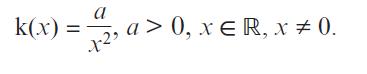
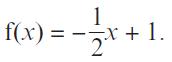
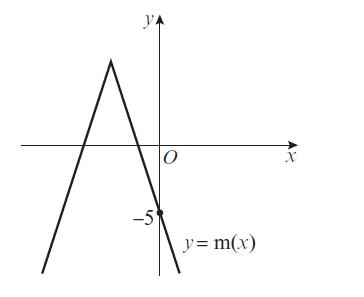
The function k is defined bya. Sketch the graph of y = k(x).b. Explain why it is not necessary to sketch y = |k(x)| and y = k(|x|).The function m is defined byc. Sketch the graph of y = m(x).d. State with a reason whether the following statements are true or false.i. |k(x)| = |m(x)|ii. k(|x|) =
Given that q(x) = −3|x| + 6, x ∈ ℝ,a. Sketch the graph of y = q(x)b. Shade the region of the graph that satisfies y < q(x).
The function g is defined by g: x ↦ (x − 2)2 − 9, x ∈ ℝ.a. Draw a sketch of the graph of y = g(x), labelling the turning points and the x- and y-intercepts.b. Write down the coordinates of the turning point when the curve is transformed as follows:i. 2g(x − 4)ii. g(2x)iii. |g(x)|c.
The function f is defined as f: x ↦ 4|x + 6| + 1, x ∈ ℝ.a. Sketch the graph of y = f(x).b. State the range of the function.c. Solve the equation f(x) = -1/2-1 2.x² + 1.
a. On the same set of axes, sketch y = |12 − 5x| and y = −2x + 3.b. State with a reason whether there are any solutions to the equation |12 − 5x| = −2x + 3
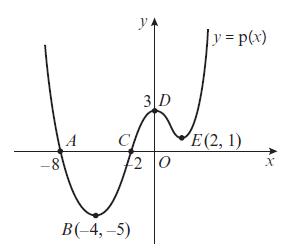
The diagram shows the graph of y = p(x) with 5 points labeled. Sketch each of the following graphs, labeling the points corresponding to A, B, C, D and E, and any points of intersection with the coordinate axes.a. y = |p(x)|b. y = p(|x|) -8) A B-4, -5) y 3D 20 y = p(x) E(21) X
Given thata. Sketch the graph of y = g(x)b. State the range of the functionc. Solve the equation g(x) = x + 1. 5. g(x)=x2 + 7, x ER,
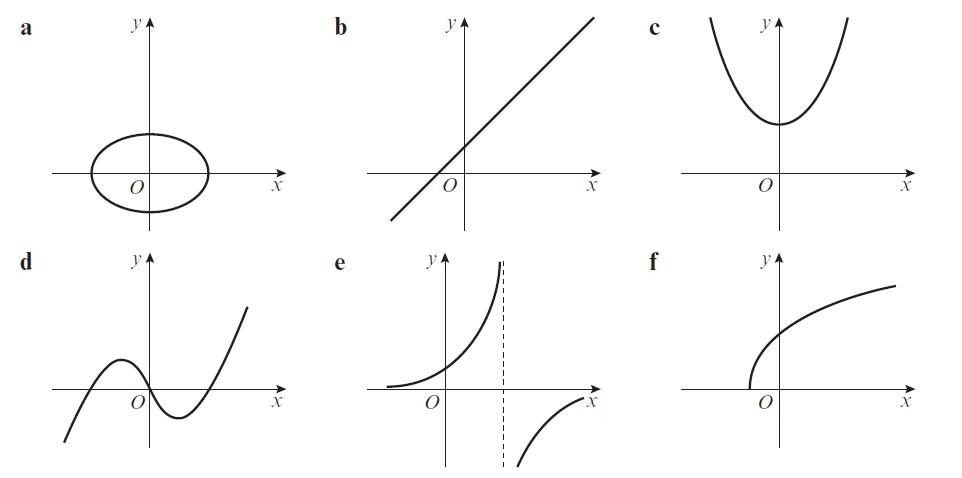
For each of the following mappings:i. State whether the mapping is one-to-one, many-to-one or one-to-manyii. State whether the mapping could represent a function. a d X b K X f w y
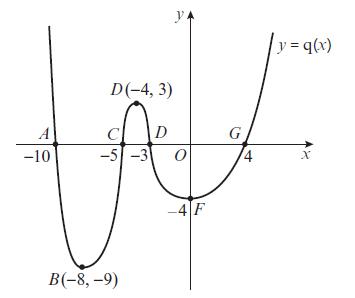
The diagram shows the graph of y = q(x) with 7 points labelled. Sketch each of the following graphs, labelling the points corresponding to A, B, C, D and E, and any points of intersection with the coordinate axes.a. y = |q(x)|b. y = q(|x|) -10 y D(-4, 3) C D -5-31 0 B(-8,-9) -4 F G 4 y = q (x)
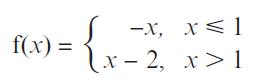
The function of f(x) is defined asa. Sketch the graph of f(x) for −2 < x < 6.b Find the values of x for which f(x) = - 1/2 f(x) = -x, x≤ 1 x-2, x>1
The function t(x) is defined by t(x) = x2 − 6x + 5, x ∈ ℝ, x ≥ 5 Find t −1(x).
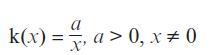
a. Sketch the graph of y = k(x).b. Sketch the graph of y = |k(x)|.c. Sketch the graph of y = k(|x|). (x) = 7, a > 0, x ± 0
The functions m and n are defined as m(x) = −2x + k, x ∈ ℝ, n(x) = 3|x − 4| + 6, x ∈ ℝ, where k is a constant. The equation m(x) = n(x) has no real roots. Find the range of possible values for the constant k.
The function m(x) is defined by m(x) = x2 + 4x + 9, x ∈ ℝ, x > a, for some constant a.a. State the least value of a for which m−1(x) exists.b. Determine the equation of m−1(x).c. State the domain of m−1(x).
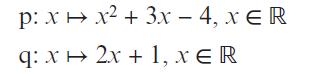
The functions p and q are defined bya. Find an expression for pq(x).b. Solve pq(x) = qq(x). p: x + q: x + x² + 3x - 4, x ER 2x + 1, XER
The function h(x) is defined bya. What happens to the function as x approaches 2?b. Find h−1(3).c. Find h−1(x), stating clearly its domain.d. Find the elements of the domain that get mapped to themselves by the function. h(x) = 2x + 1 x-2 {xER, x = 2}.
The functions s and t are defined as s(x) = −10 − x, x ∈ ℝ, t(x) = 2|x + b| − 8, x ∈ ℝ, where b is a constant. The equation s(x) = t(x) has exactly one real root. Find the value of b.
a. Sketch the graph of y = m(x).b. Describe the relationship between y = |m(x)| and y = m(|x|). m(x) = =, a < 0, x ±0
The function g(x) is defined as g(x) = 2x + 7, {x ∈ ℝ, x > 0}.a. Sketch y = g(x) and find the range.b. Determine y = g−1(x), stating its range.c. Sketch y = g−1(x) on the same axes as y = g(x), stating the relationship between the two graphs.
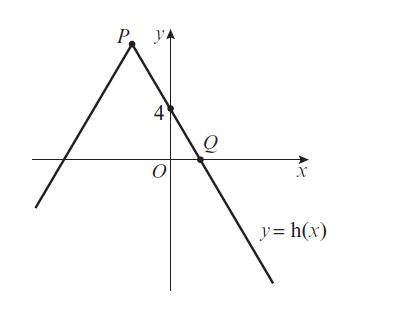
The diagram shows a sketch of part of the graph y = h(x), where h(x) = a − 2|x + 3|, x ∈ ℝ. The graph intercepts the y-axis at (0, 4). a. Find the value of a.b. Find the coordinates of P and Q.c. Solve h(x) = 1/3 x + 6 P. Y O X y=h(x)
f(x) = ex and g(x) = e−xa. Sketch the graphs of y = f(x) and y = g(x) on the same axes.b. Explain why it is not necessary to sketch y = |f(x)| and y = |g(x)|.c. Sketch the graphs of y = f(|x|) and y = g(|x|) on the same axes.
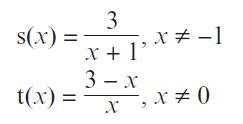
The functions s and t are defined byShow that the functions are inverses of each other. s(x): = t(x) = 3 -1 X + 1 ³ X * −1 3-x XX , x ±0
The function f(x) is defined by f(x) = 2x2 − 3, {x ∈ ℝ, x < 0}.Determine:a. f−1(x) clearly stating its domainb. The values of a for which f(a) = f−1(a).
The diagram shows a sketch of part of the graph y = m(x), where m(x) = −4|x + 3| + 7, x ∈ ℝ.a. State the range of m.b. Solve the equation m(x) = 3/5 x + 2. Given that m(x) = k, where k is a constant, has two distinct rootsc. State the set of possible values for k. YA A -5 y = m(x)
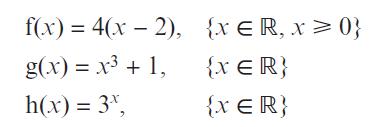
The following functions f(x), g(x) and h(x) are defined by a. Find f(7), g(3) and h(−2).b. Find the range of f(x) and the range of g(x).c. Find g−1(x).d. Find the composite function fg(x).e. Solve gh(a) = 244. f(x) = 4(x - 2), g(x) = x³ + 1, h(x) = 3%, {x ER, x>0} {x ER} {X ER}
g(x) = tan x, −180° < x < 180°a. Sketch the graph of y = g(x).b. Sketch the graph of y = |g(x)|.c. Sketch the graph of y = g(|x|).
An investor puts £4000 in an account. Every month thereafter she deposits another £200. How much money in total will she have invested at the start of the 10th month and b the nth month?
Find the sums of the following series.a. 3 + 7 + 11 + 14 + … (20 terms)b. 2 + 6 + 10 + 14 + … (15 terms)c. 30 + 27 + 24 + 21 + … (40 terms)d. 5 + 1 + −3 + −7 + … (14 terms)e. 5 + 7 + 9 + … + 75f. 4 + 7 + 10 + … + 91g. 34 + 29 + 24 + 19 + … + −111h. (x + 1) + (2x +
For each of the following geometric series:i. State, with a reason, whether the series is convergent.ii. If the series is convergent, find the sum to infinity. a 1 + 0.1 +0.01 +0.001 + ... d 2 + 6 + 10 + 14 + ... g 0.4+0.8+ 1.2 + 1.6 + ... b 1+2 +4 + 8 + 16 + ... e 1+1+1+ 1 + 1 + ... h 9+8.1 +7.29
Find the first four terms of the following recurrence relationships. a Un+1=U₁+3, C U₁+1=2U₁ e un +1 = ₁ = 1 = 3 2,₁ = 10 bun+1=un-5, Uu₁ = 9 d un+1=2u, +1, ₁ = 2 fun+1 = (u)²-1, ₁ = 2
A geometric series has third term 27 and sixth term 8.a. Show that the common ratio of the series is 2/3 b. Find the first term of the series.c. Find the sum to infinity of the series.d. Find the difference between the sum of the first 10 terms of the series and the sum to infinity. Give your
For each sequence:i. Write down the first 4 terms of the sequenceii. Write down a and d a un= 5n + 2 b u₁= 9 - 2n c un = 7+0.5n d un= n - 10
Find how many terms of the following series are needed to make the given sums.a. 5 + 8 + 11 + 14 + … = 670b. 3 + 8 + 13 + 18 + … = 1575c. 64 + 62 + 60 + … = 0d. 34 + 30 + 26 + 22 + … = 112
A geometric series has first term 10 and sum to infinity 30. Find the common ratio.
For each series:i. Write the series using sigma notationii. Evaluate the sum.a. 2 + 4 + 6 + 8b. 2 + 6 + 18 + 54 + 162c. 6 + 4.5 + 3 + 1.5 + 0 − 1.5
Find the nth terms and the 10th terms in the following arithmetic progressions:a. 5, 7, 9, 11, …b. 5, 8, 11, 14, …c. 24, 21, 18, 15, …d. −1, 3, 7, 11, …e. x, 2x, 3x, 4x, … f. a, a + d, a + 2d, a + 3d, …
Find the sum of the first 50 even numbers.
James decides to save some money during the six-week holiday. He saves 1p on the first day, 2p on the second, 3p on the third and so on.a. How much will he have at the end of the holiday (42 days)?b. If he carried on, how long would it be before he has saved £100?
A geometric series has first term −5 and sum to infinity −3. Find the common ratio.
Continue the following geometric sequences for three more terms.a. 5, 15, 45, …b. 4, −8, 16, …c. 60, 30, 15, …d. 1, 1/4, 1/16,.....e. 1, p, p2, …f. x, −2x2, 4x3, …
Calculate the number of terms in each of the following arithmetic sequences.a. 3, 7, 11, …, 83, 87b. 5, 8, 11, …, 119, 122c. 90, 88, 86, …, 16, 14d. 4, 9, 14, …, 224, 229e. x, 3x, 5x, …, 35xf. a, a + d, a + 2d, …, a + (n − 1)d
Find the least number of terms for the sum of 7 + 12 + 17 + 22 + 27 +… to exceed 1000.
A population of ants is growing at a rate of 10% a year. If there were 200 ants in the initial population, write down the number of ants after:a. 1 yearb. 2 yearsc. 3 yearsd. 10 years.
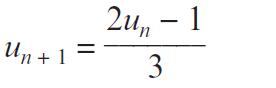
A sequence of terms is defined for n ≥ 1 by the recurrence relation un + 1 = kun + 2, where k is a constant. Given that u1 = 3,a. Find an expression in terms of k for u2b. Hence find an expression for u3 Given that u3 = 42:c. Find the possible values of k.
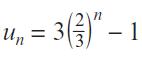
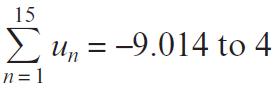
A sequence of numbers u1, u2, … , un, … is given by the formulawhere n is a positive integer.a. Find the values of u1, u2 and u3.b. Show thatc. Prove that Un = 3 (13)" - 1 3(3)″ =
A geometric series has sum to infinity 60 and common ratio 2/3. Find the first term.
Find the least number of terms for the sum of 7 + 12 + 17 + 22 + 27 +… to exceed 1000.
The first term of an arithmetic sequence is 14. The fourth term is 32. Find the common difference.
The first term of an arithmetic series is 4. The sum to 20 terms is −15. Find, in any order, the common difference and the 20th term.
A geometric series has common ratio -1/3 and S∞ = 10. Find the first term.
A motorcycle has four gears. The maximum speed in bottom gear is 40 km h−1 and the maximum speed in top gear is 120 km h−1. Given that the maximum speeds in each successive gear form a geometric progression, calculate, in km h−1 to one decimal place, the maximum speeds in the two intermediate
A sequence is defined for n > 1 by the recurrence relation un + 1 = pun + q, u1 = 2. Given that u2 = −1 and u3 = 11, find the values of p and q.
The nth term of a geometric sequence is 2 × 5n. Find the first and 5th terms.
A sequence is generated by the formula un = pn + q where p and q are constants to be found. Given that u6 = 9 and u9 =11, find the constants p and q.
The third and fourth terms of a geometric series are 6.4 and 5.12 respectively. Find:a. The common ratio of the series.b. The first term of the series.c. The sum to infinity of the series.d. Calculate the difference between the sum to infinity of the series and the sum of the first 25 terms of the
The price of a car depreciates by 15% per annum. Its price when new is £20 000.a. Find the value of the car after 5 years.b. Find when the value will be less than £4000.
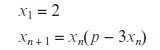
A sequence is given bywhere p is an integer.a. Show that x3 = −10p2 + 132p − 432.b. Given that x3 = −288 find the value of p.c. Hence find the value of x4. x₁ = 2 Xn+1=Xn(P-3x)
The sum of the first three terms of an arithmetic series is 12. If the 20th term is −32, find the first term and the common difference.
A car depreciates in value by 15% a year. After 3 years it is worth £11 054.25.a. What was the car’s initial price?b. When will the car’s value first be less than £5000?
For an arithmetic sequence u3 = 30 and u9 = 9. Find the first negative term in the sequence.
The first three terms of a geometric series are p(3q + 1), p(2q + 2) and p(2q − 1), where p and q are non-zero constants.a. Show that one possible value of q is 5 and find the other possible value.b. Given that q = 5, and the sum to infinity of the series is 896, find the sum of the first 12
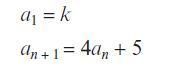
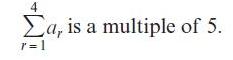
A sequence a1, a2, a3, … is defined bya. Find a3 in terms of k.b. Show that a₁ = k an+1=4an + 5
For a geometric series a + ar + ar2 + …, S3 = 9 and S∞ = 8 , find the values of a and r.
A salesman is paid commission of £10 per week for each life insurance policy that he has sold. Each week he sells one new policy so that he is paid £10 commission in the first week, £20 commission in the second week, £30 commission in the third week and so on.a. Find his total commission in the
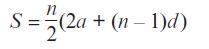
a. Prove that the sum of the first n terms in an arithmetic series iswhere a = first term and d = common difference.b. Use this to find the sum of the first 100 natural numbers. n S = 27/(2a + (n − 1)d)
A geometric sequence has first term 4 and third term 1. Find the two possible values of the 6th term.
The 20th term of an arithmetic sequence is 14. The 40th term is −6. Find the value of the 10th term.
Showing 500 - 600
of 749
1
2
3
4
5
6
7
8
Step by Step Answers

 Get 50% OFF
Claim Now
Get 50% OFF
Claim Now