New Semester
Started
Get
50% OFF
Study Help!
--h --m --s
Claim Now
Question Answers
Textbooks
Find textbooks, questions and answers
Oops, something went wrong!
Change your search query and then try again
S
Books
FREE
Study Help
Expert Questions
Accounting
General Management
Mathematics
Finance
Organizational Behaviour
Law
Physics
Operating System
Management Leadership
Sociology
Programming
Marketing
Database
Computer Network
Economics
Textbooks Solutions
Accounting
Managerial Accounting
Management Leadership
Cost Accounting
Statistics
Business Law
Corporate Finance
Finance
Economics
Auditing
Tutors
Online Tutors
Find a Tutor
Hire a Tutor
Become a Tutor
AI Tutor
AI Study Planner
NEW
Sell Books
Search
Search
Sign In
Register
study help
mathematics
pearson edexcel a level mathematics
Pearson Edexcel A Level Mathematics Pure Mathematics Year 2 1st Edition Greg Attwood, Jack Barraclough, Ian Bettison, David Goldberg, Alistair Macpherson, Joe Petran - Solutions
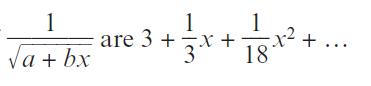
The first three terms in the binomial expansion ofa. Find the values of the constants a and b.b. Find the coefficient of the x3 term in the expansion. 1 √a + bx 1 + = √x + √/ 8²x1² X are 3 + 5.x² + ...
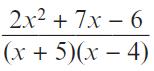
a. Expressin partial fractions.b. Hence, or otherwise, expandin ascending powers of x as far as the term in x2.c. State the set of values of x for which the expansion is valid. 2x² + 7x - 6 (x + 5)(x-4)
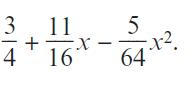
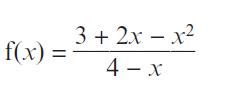
Prove that if x is sufficiently small, f(x) may be approximated by 3 11 + X 4 16 5 64 x².
In the expansion of (1 + ax)1/2 the coefficient of x2 is −2.a. Find the possible values of a.b. Find the corresponding coefficients of the x3 term.
a. Expand f(x) in ascending powers of x up to and including the term in x3.b. Hence show that, for small x:c. Taking a suitable value for x, which should be stated, use the series expansion in part b to find an approximate value for 101/103, giving your answer to 5 decimal places. f(x) = (1 +
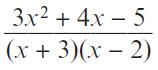
a. Find the values of the constants A, B and C.b. Hence, or otherwise, expand in ascending powers of x, as far as the term in x2.Give each coefficient as a simplified fraction. 3x² + 4x - 5 (x+3)(x - 2)
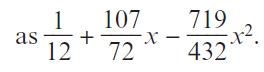
a. Find the values of A, B and C.b. Hence or otherwise, find the series expansion of f(x), in ascending powers of x, up to and including the term in x2. Simplify each term.c. Find the percentage error made in using the series expansion in part b to estimate the value of f(0.05). Give your answer to
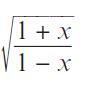
Show that if x is small, the expression is approximated by 1 + x + 1/2 x2. 1 + x 1-x
In the expansion of (1 + ax)- 1/2 the coefficient of x2 is 24.a. Find the possible values of a.b. Find the corresponding coefficient of the x3 term.
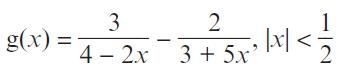
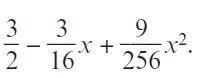
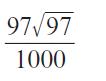
a. Show that the first three terms in the series expansion of g(x) can be written b. Find the exact value of g(0.01). Round your answer to 7 decimal places.c. Find the percentage error made in using the series expansion in part a to estimate the value of g(0.01). Give your answer to 2
Show that if x is sufficiently small then 3/√4 + x can be approximated by 3 2 3 16 X + 9 256 Fx²
When (1 + ax)n is expanded as a series in ascending powers of x, the coefficients of x and x2 are −6 and 27 respectively.a. Find the values of a and n.b. Find the coefficient of x3.c. State the values of x for which the expansion is valid.
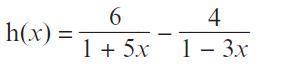
a. Find the series expansion of h(x), in ascending powers of x, up to and including the x2 term. Simplify each term.b. Find the percentage error made in using the series expansion in part a to estimate the value of h(0.01). Give your answer to 2 significant figures.c. Explain why it is not valid to
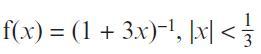
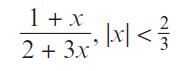
a. Find the first four terms of the expansion, in ascending powers of x, ofb. Hence or otherwise, find the first four non-zero terms of the expansion, in ascending powers of x, of : (2 + 3x)-¹, |x|< // -1
a. Find the binomial expansion of (1 − 3x)3/2 in ascending powers of x up to and including the x3 term, simplifying each term.b. Show that, when x = 1/100, the exact value of (1 − 3x)3/2 is c. Substitute x =1/100 into the binomial expansion in part a and hence obtain an approximation to
Find the binomial expansion of f(x) in ascending powers of x, up to and including the term in the x2. Give each coefficient as a simplified fraction. q(x) = (3 + 4x)-³, [x] <
a. Find the values of A, B and C.b. Hence, or otherwise, find the series expansion of g(x), in ascending powers of x, up to and including the x2 term. Simplify each term. g(x) = 39x + 12 (x + 1)(x + 4)(x - 8)' , ]x] < 1 g(x) can be expressed in the form g(x) = A B x + 1' x + 4 + C x-8
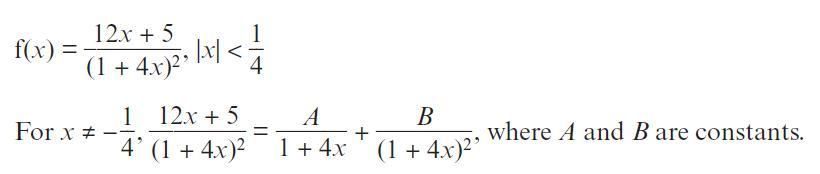
a. Find the values of A and B.b. Hence, or otherwise, find the series expansion of f(x), in ascending powers of x, up to and including the term x2, simplifying each term. f(x) = - 12x + 5 (1 +4x)²³ For x- • √x | < 1/1/1 1 12x + 5 4' (1 +4x)² 11 = A + 1 + 4x B (1 + 4x)²¹ where A and B are
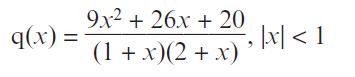
a. Show that the expansion of q(x) in ascending powers of x can be approximated to 10 − 2x + Bx2 + Cx3 where B and C are constants to be found. b. Find the percentage error made in using the series expansion in part b to estimate the value of q(0.1). Give your answer to 2 significant
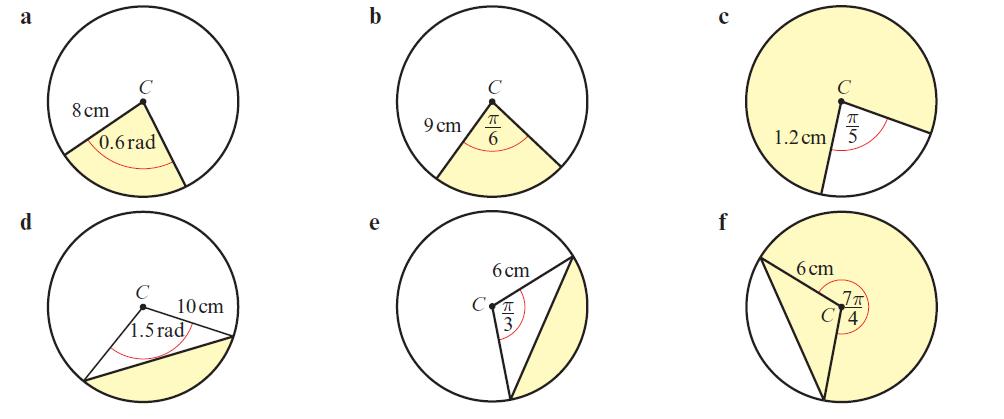
Find the shaded area in each of the following circles. Leave your answers in terms of π where appropriate. a d 8 cm 0.6 rad C 1.5 rad 10 cm e 9 cm 6 6 cm f 1.2 cm 6 cm T
Convert the following angles in radians to degrees. a T 20 b ㅠ 15 C d e f 3
An arc AB of a circle, centre O and radius r cm, subtends an angle θ radians at O. The length of AB is l cm. a Find / when: ir= 6,0 = 0.45 b Find when: i 1 = 10, 0 = 0.6 e Find when: i /= 10, r = 7.5 ii r = 4.5, 0 = 0.45 ii / 1.26, 0 = 0.7 ii = 4.5, r = 5.625 3 iii r = 20, 0 = ㅠ 8 5 iii 1 =
Triangle ABC is such that AB = 5 cm, AC = 10 cm and ∠ABC = 90°. An arc of a circle, centre A and radius 5 cm, cuts AC at D.a. State, in radians, the value of ∠BAC.b. Calculate the area of the region enclosed by BC, DC and the arc BD.
When θ is small, find the approximate values of: a sin 40 tan 20 30 b 1 - cos20 tan 20 sin с 3 tan0 - 0 sin 20
Solve the following equations for θ, in the interval 0 ≤ θ ≤ 2π, giving your answers to 3 significant figures where they are not exact.a. Cos θ = 0.7b. Sin θ = −0.2c. Tan θ = 5d. Cos θ = −1
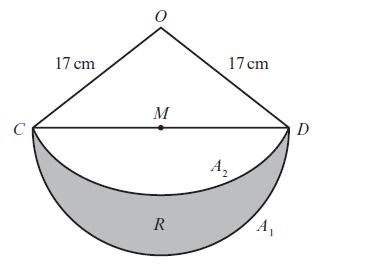
The diagram shows the triangle OCD with OC = OD = 17 cm and CD = 30 cm. The midpoint of CD is M. A semicircular arc A1, with centre M is drawn, with CD as diameter. A circular arc A2 with centre O and radius 17 cm, is drawn from C to D. The shaded region R is bounded by the arcs A1 and A2.
Solve the following equations for θ, in the interval 0 ≤ θ ≤ 2π, giving your answers to 3 significant figures where they are not exact.a. 4 sin θ = 3b. 7 tan θ = 1c. 8 tan θ = 15d. √5 cosθ = √2
Convert the following angles to degrees, giving your answer to 1 d.p.a. 0.46 radb. 1 radc. 1.135 radd. √3 rad
a. Sketch the graph of y = 1 + 2 sec θ in the interval −π ≤ θ ≤ 2π.b. Write down the θ-coordinates of points at which the gradient is zero.c. Deduce the maximum and minimum values of 1/1 + 2 sec Ø, and give the smallest positive values of θ at which they occur.
a. Describe the relationships between the graphs of:b. By considering the graphs ofstate which pairs of functions are equal. and y = tan 0 iy=tan(0 + 2 iii y = cosec (0+ 7) and y = cosec ii y = cot(-0) and y = cot y = sec (0-7) and y = sec 0 4 iv
Sketch on separate axes, in the interval 0 ≤ θ ≤ 360°, the graphs of:In each case show the coordinates of any maximum and minimum points, and of any points at which the curve meets the axes. a y = sec 20 d y = cosec(0 - 30°) g y=-cot (20) by = -cosec 0 e y = 2 sec (0-60°) hy = 1-2 sec ( c y
a. Sketch, in the interval −2π ≤ x ≤ 2π, the graph of y = 3 + 5 cosec x. b. Hence deduce the range of values of k for which the equation 3 + 5 cosec x = k has no solutions.
Write down the periods of the following functions. Give your answers in terms of π.a. sec 3θb. cosec 1/2 θc. 2 cot θd. sec(−θ)
a. Sketch on separate axes, in the interval 0 ≤ θ ≤ 360°, the graphs of y = tan θ and y = cot(θ + 90°).b. Hence, state a relationship between tan θ and cot(θ + 90°).
a. Sketch, on the same set of axes, in the interval 0 ≤ θ ≤ 360°, the graphs of y = cot θ and y = sin 2θ.b. Deduce the number of solutions of the equation cot θ = sin 2θ in the interval 0 ≤ θ ≤ 360°.
a. Sketch, on the same set of axes, in the interval 0 ≤ θ ≤ 360°, the graphs of y = sec θ and y = −cos θ.b. Explain how your graphs show that sec θ = −cos θ has no solutions.
a. Sketch, on the same set of axes, in the interval −π ≤ x ≤ π, the graphs of y = cot x and y = −x.b. Deduce the number of solutions of the equation cot x + x = 0 in the interval −π ≤ x ≤ π.
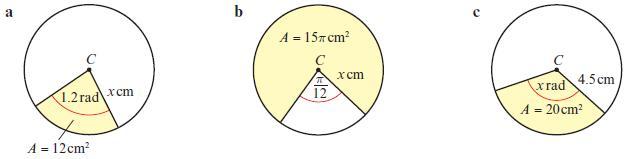
The chord AB of a circle, centre O and radius 10 cm, has length 18.65 cm and subtends an angle of θ radians at O.a. Show that θ = 0.739 radians (to 3 significant figures).b. Find the area of the minor sector AOB. a 1.2 rad xcm A = 12cm² b A = 157 cm² 12 x cm 4.5cm xrad A = 20cm²
The points A and B lie on the circumference of a circle with centre O and radius 8.5 cm. The point C lies on the major arc AB. Given that ∠ACB = 0.4 radians, calculate the length of the minor arc AB.
Convert the following angles to radians, giving your answers to 3 significant figures.a. 50°b. 75°c. 100°d. 160°e. 230°f. 320°
Evaluate the following, giving your answers to 3 significant figures.a. sin (0.5 rad)b. cos (√2 rad)c. tan (1.05 rad)d. sin (2 rad)e. sin (3.6 rad) a 1.2 rad xcm A = 12cm² b A = 157 cm² 12 x cm 4.5cm xrad A = 20cm²
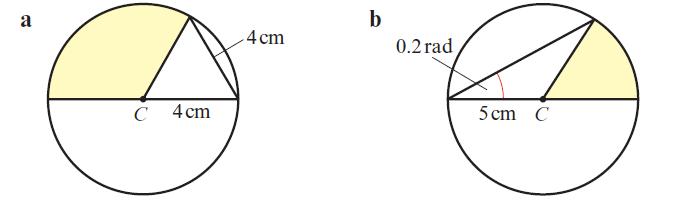
Find the shaded area in each of the following circles with centre C. a C 4 cm 4 cm b 0.2 rad 5 cm C
A minor arc AB of a circle, centre O and radius 10 cm, subtends an angle x at O. The major arc AB subtends an angle 5x at O. Find, in terms of π, the length of the minor arc AB.
When θ is small, show that: a sin 30 3 0 sin40 40 - b cose - 1 tan 20 0 4 с tan40 + 0² 30 - sin20 = 4 + 0
Without using a calculator, find the exact values of the following trigonometric ratios a sin d cos ㅠ 3 11개 4 b sin 5 e tan- 3 ST C COS f tan T 6 (-)
Solve the following equations for θ, in the interval 0 ≤ θ ≤ 2π, giving your answers to 3 significant figures where they are not exact. a 5 cos 0 + 1 = 3 b √5 sin 0 + 2 = 1 c 8 tan 0-5=5 d √7 cos 0-1 = √2
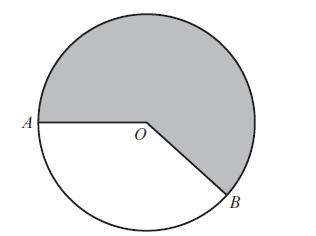
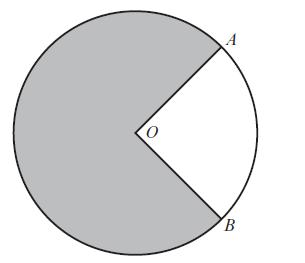
The diagram shows a circle, centre O, of radius 6 cm. The points A and B are on the circumference of the circle. The area of the shaded major sector is 80 cm2. Given that ∠AOB = θ radians, where 0 < θ < π, calculate:a. The value, to 3 decimal places, of θ.b. The length in cm, to 2
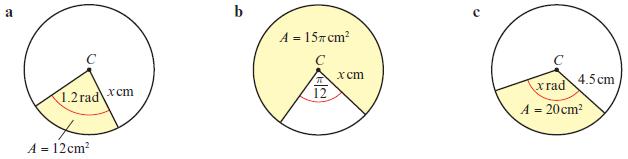
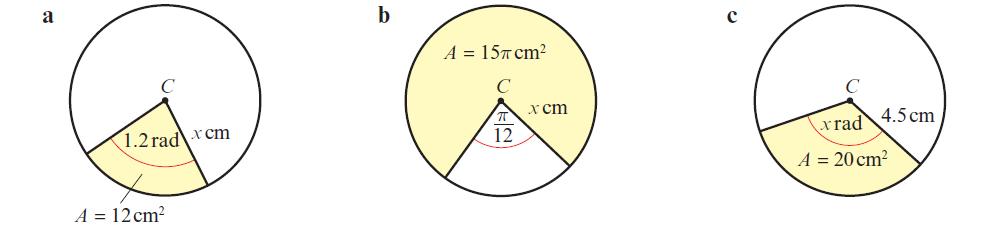
For the following circles with centre C, the area A of the shaded sector is given. Find the value of x in each case. a 1.2 rad xcm A = 12cm² b A = 15π cm² C ㅠ 12 x cm 4.5 cm xrad A = 20 cm²
An arc AB of a circle, centre O and radius 6 cm, has length l cm. Given that the chord AB has length 6 cm, find the value of l, giving your answer in terms of π.
Solve the following equations for θ, in the interval 0 < θ < 2π, giving your answers to 3 significant figures where they are not exact. a 5 cos 20 = 4 c √√√3 tan 40-5=-4 b 5 sin 30 + 3 = 1 d√10 cos 20 + √√2 = 3√2
The percentage error for sin θ for a given value of θ is 1%. Show that 100θ = 101 sin θ.
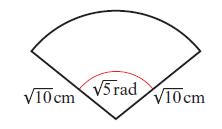
The sector of a circle of radius √10 cm contains an angle of √5 radians, as shown in the diagram. Find the length of the arc, giving your answer in the form p√q cm, where p and q are integers. √10 cm √5 rad √10cm
Convert the following angles to radians, giving your answers as multiples of π.a. 8°b. 10°c. 22.5°d. 30°e. 112.5°f. 240°g. 270°h. 315°i. 330°
The arc AB of a circle, centre O and radius 6 cm, has length 4 cm. Find the area of the minor sector AOB.
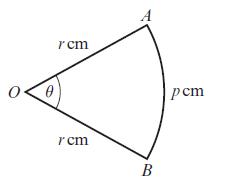
The diagram shows a sector OAB of a circle, centre O and radius r cm. The length of the arc AB is p cm and ∠AOB is θ radians.a. Find θ in terms of p and r.b. Deduce that the area of the sector is 1/2 prcm2.Given that r = 4.7 and p = 5.3, where each has been measured to 1 decimal place, find,
Solve the following equations for θ, giving your answers to 3 significant figures where appropriate, in the intervals indicated: a √√3 tan 0-1=0,-π ≤ 0 ≤ T c 8 cos 0 = 5, -2π ≤ 0 ≤ 2π e 0.4 tan 0-5=-7, 0≤ 0 ≤ 4T b 5 sin 01, -TT ≤ 0 ≤ 2T d 3 cos 0 1 = 0.02, - f
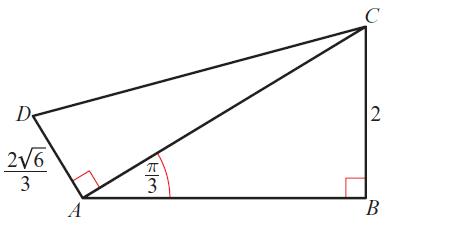
The diagram shows a right-angled triangle ACD on another right-angled triangle ABC with AD = 2√6/3 and BC = 2. Show that DC = k√2, where k is a constant to be determined. 26 3 П 3 C 2 B
a. Find cos (0.244 rad) correct to 6 decimal places.b. Use the approximation for cos θ to find an approximate value for cos (0.244 rad).c. Calculate the percentage error in your approximation.d. Calculate the percentage error in the approximation for cos 0.75 rad.e. Explain the difference between
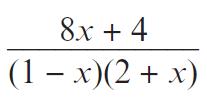
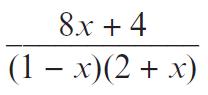
a. Expressas partial fractionsb. Hence or otherwise expandin ascending powers of x as far as the term in x2.c. State the set of values of x for which the expansion is valid. 8x + 4 (1-x)(2 + x)
For each of the following,i. Find the binomial expansion up to and including the x3 term.ii. State the range of values of x for which the expansion is valid. a (1-4x)³ 4 √4-x b √16 + x f 1 + x 1 + 3x € 6.0 g 1 1 - 2x (1 + x)² d h st 4 2 + 3x x-3 (1-x)(1-2x)
The diagram shows a circle center O and a radius 5 cm. The length of the minor arc AB is 6.4 cm.a. Calculate, in radians, the size of the acute angle AOB. The area of the minor sector AOB is R1 cm2 and the area of the shaded major sector is R2 cm2.b. Calculate the value of R1.c. Calculate R1 :
Solve the following equations for θ, giving your answers to 3 significant figures where appropriate, in the intervals indicated. a √2 sin 30 -1 = 0, c 8 tan 20 = 7, ≤ ≤T -2π ≤ 0 ≤ 2π -π b 2 cos 40-1, d 6 cos 201=0.2, -T≤0 ≤ 2T -≤ 0 ≤ 3T
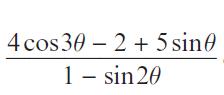
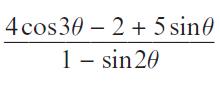
a. When θ is small, show that the equationcan be written as 9θ + 2.b. Hence write down the value ofwhen θ is small. 4 cos 302 + 5 sin 1 - sin 20
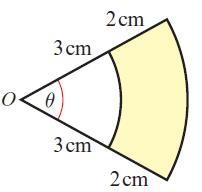
Referring to the diagram, find:a. The perimeter of the shaded region when θ = 0.8 radians.b. The value of θ when the perimeter of the shaded region is 14 cm. 3 cm 0 3 cm 2 cm 2cm
Solve the following equations for θ, in the interval 0 < θ < 2π, giving your answers to 3 significant figures where they are not exact.a. Cos θ + 2 sin2 θ + 1 = 0b. 10 sin2 θ = 3 cos2 θc. 4 cos2 θ + 8 sin2 θ = 2 sin2 θ − 2 cos2 θd. 2 sin2 θ − 7 + 12 cos θ = 0
A sector of a circle of radius 15 cm contains an angle of θ radians. Given that the perimeter of the sector is 42 cm, find the value of θ. A O k 2 cm B
a. Solve, for −π < θ < π, (1 + tan θ) (5 sin θ − 2) = 0.b. Solve, for 0 < x < 2π, 4 tan x = 5 sin x.
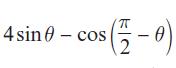
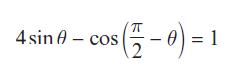
a. Expressas a single trigonometric function.b. Hence solve in the interval 0 ≤ θ ≤ 2π. Give your answers to 3 significant figures. $ ( 712 - 0) 4 sin cos
In the diagram, AB is the diameter of a circle of radius r cm and ∠BOC = θ radians. Given that the area of ΔCOB is equal to that of the shaded segment, show that θ + 2 sin θ = π. 0 0 C B
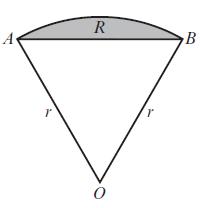
The diagram shows the sector OAB of a circle of radius r cm. The area of the sector is 15 cm2 and ∠AOB = 1.5 radians.a. Prove that r = 2√5.b. Find, in cm, the perimeter of the sector OAB. The segment R, shaded in the diagram, is enclosed by the arc AB and the straight line AB.c.
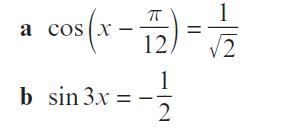
Solve, for 0 < x < 2π, a cos (x - 2) = /2 12 b sin 3x = 2
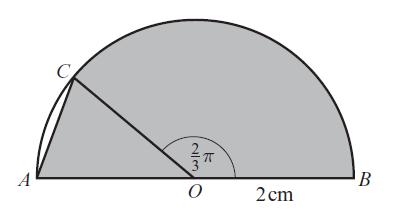
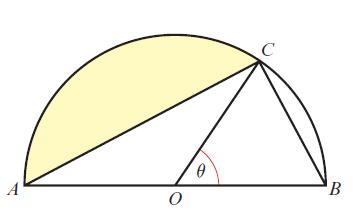
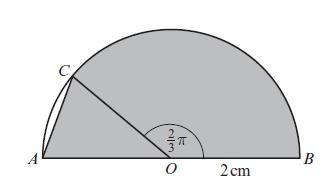
In the diagram AB is the diameter of a circle, center O and radius 2 cm. The point C is on the circumference such that ∠COB = 2/3a. State the value, in radians, of ∠COA. The shaded region enclosed by the chord AC, arc CB and AB is the template for a brooch.b. Find the exact value of the
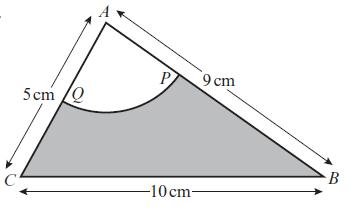
Triangle ABC has AB = 9 cm, BC = 10 cm and CA = 5 cm. A circle, center A and radius 3 cm, intersects AB and AC at P and Q respectively, as shown in the diagram.a. Show that, to 3 decimal places, ∠BAC = 1.504 radians.b. Calculate:i. The area, in cm2, of the sector APQii. The area, in cm2, of the
The arc AB of a circle, center O and radius x cm, is such that angle AOB = π/12 radians. Given that the arc length AB is l cm,a. Show that the area of the sector can be written as -6l2/πb. Find the arc length of AB.c. Calculate the value of x.
Sketch the following graphs for the given ranges, marking any points where the graphs cut the coordinate axes. a y = sin(x-7) for -π ≤ x ≤ T c y=tan(x + 2) for -7 < x < t с by = cos 2x for 0 < x < 2π 6π d y = sin x + 1 for 0 ≤ x ≤ 6m
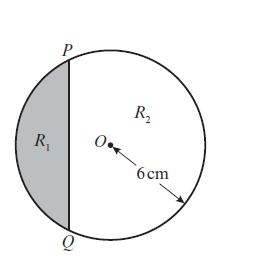
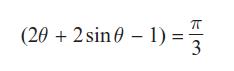
The diagram shows a circle centre O and radius 6 cm. The chord PQ divides the circle into a minor segment R1 of area A1 cm2 and a major segment R2 of area A2 cm2. The chord PQ subtends an angle θ radians at O.a. Show that A1 = 18(θ − sin θ). Given that A2 = 3A1,b. show that sin θ = θ - π/2.
The arc AB of a circle, centre O and radius r cm, is such that ∠AOB = 0.5 radians. Given that the perimeter of the minor sector AOB is 30 cm,a. Calculate the value of r.b. Show that the area of the minor sector AOB is 36 cm2c. Calculate the area of the segment enclosed by the chord AB and the
Solve the following equations for θ, in the interval 0 < θ < 2π, giving your answers to 3 significant figures where they are not exact.a. 4 cos2 θ = 2b. 3 tan2 θ + tan θ = 0c. cos2 θ − 2 cos θ = 3d. 2 sin2 2θ − 5 cos 2θ = −2
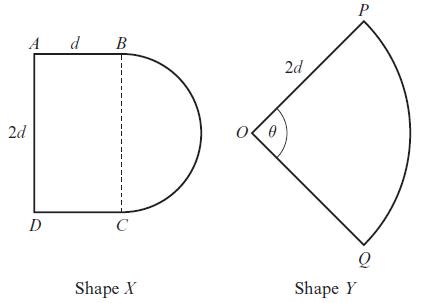
The diagrams show the cross-sections of two drawer handles. Shape X is a rectangle ABCD joined to a semicircle with BC as diameter. The length AB = d cm and BC = 2d cm. Shape Y is a sector OPQ of a circle with centre O and radius 2d cm. Angle POQ is θ radians. Given that the areas of shapes X and
A sector of a circle of radius r cm contains an angle of 1.2 radians. Given that the sector has the same perimeter as a square of area 36 cm2, find the value of r.
The area of a sector of a circle of radius 12 cm is 100 cm2. Find the perimeter of the sector.
Prove that cosec (π − x) ≡ cosec x.
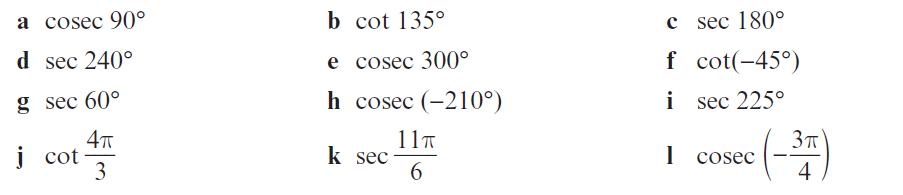
Find the exact values (in surd form where appropriate) of the following: a cosec 90° d sec 240° g sec 60° 4π 3 i cot- b cot 135° e cosec 300° h cosec (-210°) k sec 11T 6 sec 180° cot(-45°) с f i sec 225° c(-3) 1 cosec
Use your calculator to find, to 3 significant figures, the values of: a sec 100° d cot 550° g cosec 11 T 10 b cosec 260° 4π 3 h sec 6 rad e cot c cosec 280° f sec 2.4 rad
Sketch, in the interval −540° ≤ θ ≤ 540°, the graphs of:i. y = sec θii. y = cosec θiii. y = cot θ
Without using your calculator, write down the sign of the following trigonometric ratios.a. sec 300°b. cosec 190°c. cot 110°d. cot 200°e. sec 95°
a. Show that the equation tan2 x − 2 tan x − 6 = 0 can be written as tan x = p + √q where p and q are numbers to be found.b. Hence solve, for 0 ≤ x ≤ 3π, the equation tan2 x − 2 tan x − 6 = 0 giving your answers to 1 decimal place where appropriate.
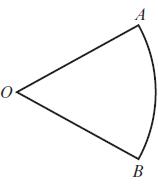
The diagram shows a sector AOB. The perimeter of the sector is twice the length of the arc AB. Find the size of angle AOB. A B
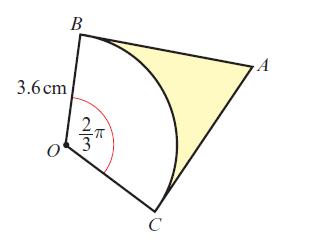
In the diagram, AB and AC are tangents to a circle, centre O and radius 3.6 cm. Calculate the area of the shaded region, given that ∠BOC =2π/3 radians. 3.6cm O ca B 2/3 K C A
There is a straight path of length 70 m from the point A to the point B. The points are joined also by a railway track in the form of an arc of the circle whose centre is C and whose radius is 44 m, as shown in the diagram.a. Show that the size, to 2 decimal places, of ∠ACB is 1.84 radians.b.
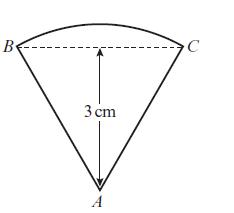
The shape of a badge is a sector ABC of a circle with centre A and radius AB, as shown in the diagram. The triangle ABC is equilateral and has perpendicular height 3 cm.a. Find, in surd form, the length of AB.b. Find, in terms of π, the area of the badge.c. Prove that the perimeter of the badge is
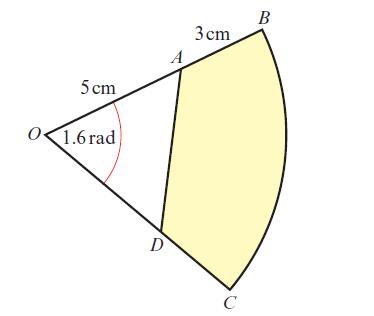
In the diagram, BC is the arc of a circle, centre O and radius 8 cm. The points A and D are such thatOA = OD = 5 cm. Given that ∠BOC = 1.6 radians, calculate the area of the shaded region. 5cm 1.6 rad D 3 cm C B
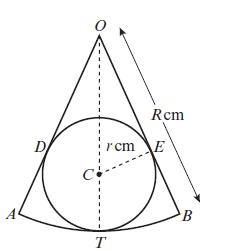
In the diagram OAB is a sector of a circle, centre O and radius R cm, and ∠AOB = 2θ radians. A circle, centre C and radius r cm, touches the arc AB at T, and touches OA and OB at D and E respectively, as shown.a. Write down, in terms of R and r, the length of OC.b. Using △OCE, show that R sin
Find all the solutions, in the interval 0 ≤ x ≤ 2π, to the equation 8 cos2 x + 6 sin x − 6 = 3 giving each solution to one decimal place.
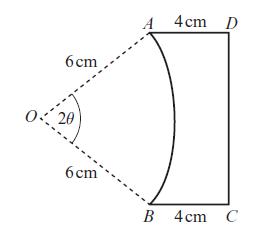
The diagram shows the cross-section ABCD of a glass prism. AD = BC = 4 cm and both are at right angles to DC. AB is the arc of a circle, center O and radius 6 cm. Given that ∠AOB = 2θ radians, and that the perimeter of the cross-section is 2(7 + π) cm,a. b. Verify that θ = π/6.c. Find
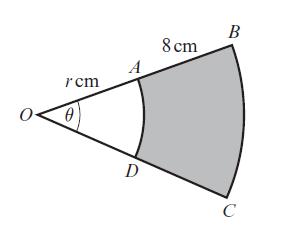
In the diagram, AD and BC are arcs of circles with centre O, such that OA = OD = r cm, AB = DC = 8 cm and ∠BOC = θ radians.a. Given that the area of the shaded region is 48 cm2, show that r = 6/θ - 4.b. Given also that r = 10θ, calculate the perimeter of the shaded region. rcm 0 D 8 cm B C
Find, for 0 ≤ x ≤ 2π, all the solutions of cos2 x -1 = 7/2 sin2 x − 2 giving each solution to one decimal place.
A circular Ferris wheel has 24 pods equally spaced on its circumference. Given the arc length between each pod is 3π/2 m, and modelling each pod as a particle,a. Calculate the diameter of the Ferris wheel. Given that it takes approximately 30 seconds for a pod to complete one revolution,b.
Two circles C1 and C2, both of radius 12 cm have centres O1 and O2 respectively. O1 lies on the circumference of C2; O2 lies on the circumference of C1. The circles intersect at A and B, and enclose the region R.a. Show that ∠AO1B = 2π/3.b. Hence write down, in terms of π, the perimeter of R.c.
Show that the equation 8 sin2 x + 4 sin x − 20 = 4 has no solutions.
Showing 400 - 500
of 749
1
2
3
4
5
6
7
8
Step by Step Answers

 Get 50% OFF
Claim Now
Get 50% OFF
Claim Now