New Semester
Started
Get
50% OFF
Study Help!
--h --m --s
Claim Now
Question Answers
Textbooks
Find textbooks, questions and answers
Oops, something went wrong!
Change your search query and then try again
S
Books
FREE
Study Help
Expert Questions
Accounting
General Management
Mathematics
Finance
Organizational Behaviour
Law
Physics
Operating System
Management Leadership
Sociology
Programming
Marketing
Database
Computer Network
Economics
Textbooks Solutions
Accounting
Managerial Accounting
Management Leadership
Cost Accounting
Statistics
Business Law
Corporate Finance
Finance
Economics
Auditing
Tutors
Online Tutors
Find a Tutor
Hire a Tutor
Become a Tutor
AI Tutor
AI Study Planner
NEW
Sell Books
Search
Search
Sign In
Register
study help
mathematics
pearson edexcel a level mathematics
Pearson Edexcel A Level Mathematics Pure Mathematics Year 2 1st Edition Greg Attwood, Jack Barraclough, Ian Bettison, David Goldberg, Alistair Macpherson, Joe Petran - Solutions
The curve C has parametric equations x = 3 − t, y = t2 − 2, −2 < t < 3a. Find a Cartesian equation of C in the form y = f(x).b. Sketch the curve C on the appropriate domain.
The curves C1 and C2 are defined by the following parametric equations.a. Show that both curves are segments of the same straight line.b. Find the length of each line segment. C₁: x= 1 + 2t, y=2+ 3t 2
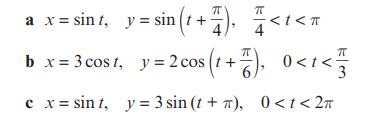
Find the Cartesian equation of the curves given by the following parametric equations. a x = sint, y=sin(t+),
A curve has parametric equations x = b(2t − 3), y = b(1 − t2), where b is a constant. The curve passes through the point (0, −5). Find the value of b.
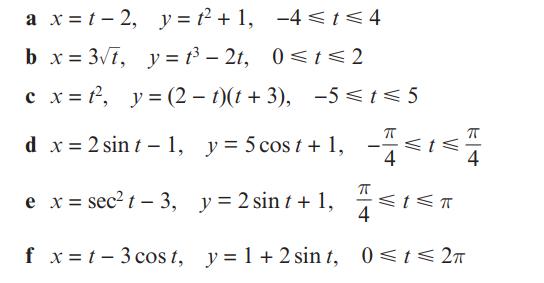
Sketch the curves given by these parametric equations: a x=t-2, y = ²+1, -4≤ t ≤4 b x= 3√t, y = t³ - 2t, 0≤t≤ 2 c x=t², y = (2-t)(t + 3), -5≤t≤5 ㅠ d x=2 sint -1, y = 5 cost+1, -4
For each of the following parametric curves:i. Find a Cartesian equation for the curve in the form y = f(x)ii. Find the domain and range of f(x)iii. Sketch the curve within the given domain of t. a x = 2t²-3, y=9-1², t>0 1 t-1 y = t - 2, t
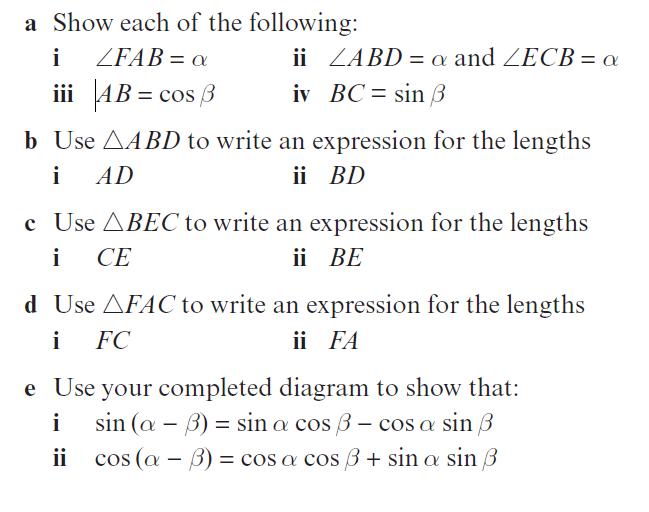
In the diagram ∠BAC = β, ∠CAF = α − β and AC = 1. Additionally lines AB and BC are perpendicular. a Show each of the following: LFAB=a i iii AB = cos 3 ii ZABD = a and ZECB = a iv BC = sin 3 b Use AABD to write an expression for the lengths i AD ii BD c Use ABEC to write an expression for
Solve, in the interval 0 ≤ θ < 360°, the following equations. Give your answers to 1 d.p.a. 3 cos θ = 2 sin (θ + 60°)b. sin (θ + 30°) + 2 sin θ = 0c. cos (θ + 25°) + sin (θ + 65°) = 1d. cos θ = cos (θ + 60°)
The height, h, of a buoy on a boating lake can be modelled by h = 0.25 sin (1800t)°, where h is the height in metres above the buoy’s resting position and t is the time in minutes.a. State the maximum height the buoy reaches above its resting position according to this model.b. Calculate the
Without using your calculator, find the exact value of:a. cos 15°b. sin 75°c. sin (120° + 45°)d. tan 165°
Use the formulae for sin (A − B) and cos (A − B) to show that tan (AB) = tan A- tan B 1 + tan A tan B
Use the expansion of sin (A + B) to show that sin 2A ≡ 2 sin A cos A.
Given that 5 sin θ + 12 cos θ ≡ R sin (θ + α), find the value of R, R > 0, and the value of tan α.
The angle of displacement of a pendulum, θ, at time t seconds after it is released is modelled as θ = 0.03 cos (25t), where all angles are measured in radians.a. State the maximum displacement of the pendulum according to this model.b. Calculate the angle of displacement of the pendulum after 0.2
Without using your calculator, find the exact value of: a sin 30° cos 60° + cos 30° sin 60° c sin 33° cos 27° + cos 33° sin 27° e sin 60° cos 15° - cos 60° sin 15° tan 45° + tan 15⁰ 1 tan 45° tan 15° g i tan 7π 12 tan ㅠ 3 7π ㅠ 12 3 1 + tan tan b cos 110° cos 20° + sin 110°
a. Using the identity cos (A + B) ≡ cos A cos B − sin A sin B, show that cos 2A ≡ cos2 A − sin2 A.b. Hence show that:i. cos 2A ≡ 2 cos2 A − 1ii. cos 2A ≡ 1 − 2 sin2 A
Given that √3sin θ + √6 cos θ ≡ 3 cos (θ − α), where 0 < α < 90°, find the value of α.
a. Show that tan θ + cot θ ≡ 2 cosec 2θ. b. Hence find the value of tan 75° + cot 75°.
The price, P, of stock in pounds during a 9-hour trading window can be modelled by P = 17.4 + 2 sin (0.7t − 3), where t is the time in hours after the stock market opens, and angles are measured in radians.a. State the beginning and end price of the stock.b. Calculate the maximum price of the
a. Solve the equation cos θ cos 30° − sin θ sin 30° = 0.5, for 0 ≤ θ ≤ 360°.b. Hence write down, in the same interval, the solutions of √3 cos θ − sin θ = 1.
By substituting A = P and B = −Q into the addition formula for sin (A + B), show that sin (P − Q) ≡ sin P cos Q − cos P sin Q.
Use the expansion of tan (A + B) to express tan 2A in terms of tan A.
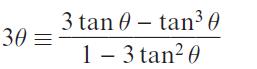
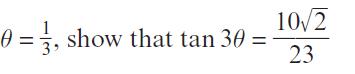
a. Show that sin 3θ ≡ 3 sin θ cos2 θ − sin3 θ.b. Show that cos 3θ ≡ cos3 θ − 3 sin2 θ cos θ.c. Hence, or otherwise, show that tand. Given that θ is acute and that cos 30= 3 tan 0 tan³0 1 - 3 tan²0 -
a. Express tan (45° + 30°) in terms of tan 45° and tan 30°.b. Hence show that tan 75° = 2 + √3.
Given that 2 sin θ − √5 cos θ ≡ −3 cos (θ + α), where 0 < α < 90°, find the value of α.
Given that cot A = 1/4 and cot (A + B) = 2, find the value of cot B.
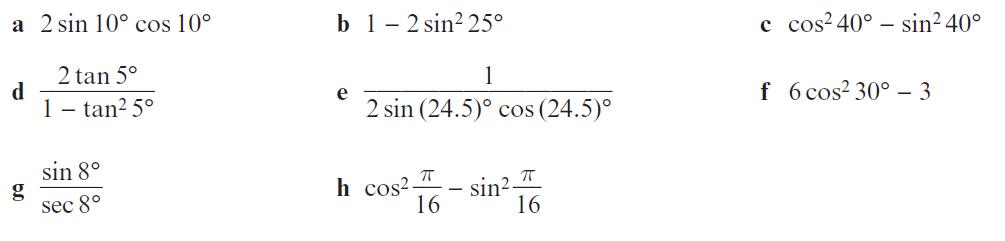
Write each of the following expressions as a single trigonometric ratio. a 2 sin 10° cos 10° d 2 tan 5° 1 - tan²5° sin 8° sec 8° b 1-2 sin² 25° 1 2 sin (24.5)° cos (24.5)° e ㅠ 16 h cos². sin²_ 16 c cos² 40° sin² 40° f 6 cos² 30° - 3
The temperature of an oven can be modelled by the equation T = 225 − 0.3 sin (2x − 3), where T is the temperate in Celsius and x is the time in minutes after the oven first reaches the desired temperature, and angles are measured in radians.a. State the minimum temperature of the oven.b. Find
a. Given that 3 sin (x − y) − sin (x + y) = 0, show that tan x = 2 tan y.b. Solve 3 sin (x − 45°) − sin (x + 45°) = 0, for 0 ≤ x ≤ 360°.
A student makes the mistake of thinking that sin (A + B) ≡ sin A + sin B. Choose non-zero values of A and B to show that this identity is not true.
a. Using cos 2A ≡ 2 cos2 A − 1 ≡ 1 − 2 sin2 A, show that:b. Given that cos θ = 0.6, and that θ is acute, write down the values of:c. Show that i cos² ||| = 1 + cos x 2 ii sin². sin²- ||| 1 - cos x 2
a. Show that cos θ − √3 sin θ can be written in the form R cos (θ − α), with R > 0 and 0 < α / π/2.b. Hence sketch the graph of y = cos θ − √3 sin θ, 0 < α < 2π, giving the coordinates of points of intersection with the axes.
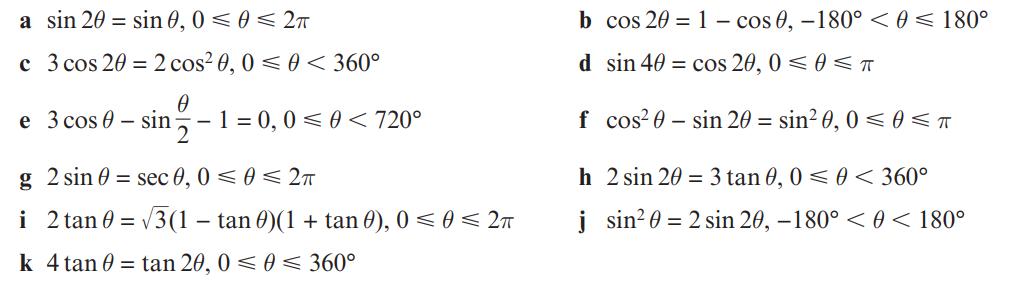
Solve the following equations, in the intervals given. a sin 20 = sin 0, 0≤0 ≤ 2π c 3 cos 20 = 2 cos² 0, 0≤ 0 < 360° 0 e 3 cos 0 -sin-1 = 0, 0≤ 0 < 720° g 2 sin = sec 0,0 ≤ 0 ≤ 2π i 2 tan 0 = √3(1 − tan 0)(1 + tan ), 0≤ 0 ≤ 2π k 4 tan 0 tan 20, 0≤ 0 ≤ 360° b cos 20 1-
a. Using cos (θ + α) ≡ cos θ cos α − sin θ sin α, or otherwise, show that cos 105° = √2 - √6/4.b. Hence, or otherwise, show that sec 105° = −√a(1 + √b), where a and b are constants to be found.
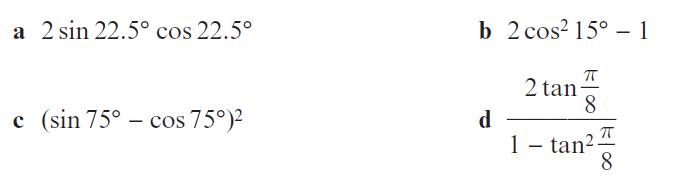
Without using your calculator find the exact values of: a 2 sin 22.5° cos 22.5° c (sin 75° cos 75°)² - b 2 cos² 15° - 1 d 1 2 tan 8 - tan². 8
a. Express 0.3 sin θ − 0.4 cos θ in the form R sin (θ − α)°, where R > 0 and 0 < α < 90°. Give the value of α to 2 decimal places.b.i. Find the maximum value of 0.3 sin θ − 0.4 cos θ.ii. Find the value of θ, for 0 < θ < 180 at which the maximum occurs.
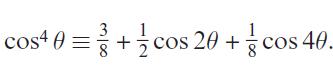
Show thatYou must show each stage of your working. cos40 = +cos 20 + cos 40.
a. Express 7 cos θ − 24 sin θ in the form R cos (θ + α), with R > 0 and 0 < α < 90°.b. The graph of y = 7 cos θ − 24 sin θ meets the y-axis at P. State the coordinates of P.c. Write down the maximum and minimum values of 7 cos θ − 24 sin θ.d. Deduce the number of solutions,
Given that sin A = - 4/5, and A is an obtuse angle measured in radians, find the exact value of:a. sin (A + B)b. cos (A − B)c. sec (A − B)
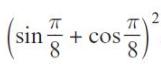
a. Show that (sin A + cos A)2 ≡ 1 + sin 2A.b. Hence find the exact value of (sin ㅠ 8 7 8 + cos-
a. Use the expansion of sin (A − B) to show that sin(π/2 - θ) = cos θ.b. Use the expansion of cos (A − B) to show that cos(π/2 - θ) = sinθ.
In △ABC, AB = 4 cm, AC = 5 cm, ∠ABC = 2θ and ∠ACB = θ. Find the value of θ, giving your answer, in degrees, to 1 decimal place.
f(θ ) = sin θ + 3 cos θGiven f(θ) = R sin (θ + α), where R > 0 and 0 < α < 90°.a. Find the value of R and the value of α.b. Hence, or otherwise, solve f(x) = 2 for 0 < θ , 360°.
Given that cos A = − 4/5, and A is an obtuse angle measured in radians, find the exact value of:a. sin Ab. cos (π + A)c. sin (π/3 + A)d. tan (π/4 + A)
Prove that sin2 (x + y) − sin2 (x − y) ≡ sin 2x sin 2y.
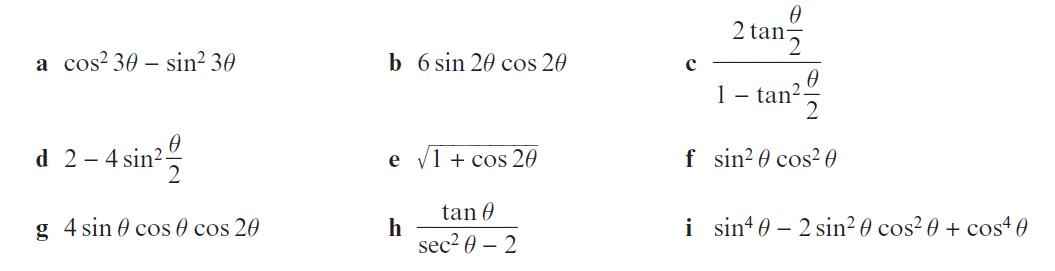
Write the following in their simplest form, involving only one trigonometric function: a cos² 30 sin² 30 d 2-4 sin² g 4 sin cos cos 20 b 6 sin 20 cos 20 e √1 + cos20 h tan 0 sec² 0 - 2 2 tan 1 - tan²- f sin²0 cos² 0 i sin 0-2 sin² 0 cos² 0 + cos²0
Prove that 20-√3 sin 20 = 2 cos (20+).
a. Show that 5 sin 2θ + 4 sin θ = 0 can be written in the form a sin θ (b cos θ + c) = 0, stating the values of a, b and c.b. Hence solve, for 0 ≤ θ , 360°, the equation 5 sin 2θ + 4 sin θ = 0.
Write sin(x + π/6) in the form p sin x + q cos x where p and q are constants to be found.
a. Express cos 2θ − 2 sin 2θ in the form R cos (2θ + α), where R > 0 and 0 < α < π/2. Give the value of α to 3 decimal places. b. Hence, or otherwise, solve for 0 ≤ θ < π, cos 2θ − 2 sin 2θ = −1.5, rounding your answers to 2 decimal places.
Given that sin A = 8/17, where A is acute, and cos B = − 4/5, where B is obtuse, calculate the exact value of:a. sin (A − B)b. cos (A − B)c. cot (A − B)
Solve the following equations, in the intervals given in brackets. a 6 sin x + 8 cos x = 5√3, [0, 360°] c 8 cos 0 + 15 sin 0 = 10, [0, 360°] b 2 cos 30- 3 sin 30 = -1, [0, 90°] d 5 sin-12 cos=-6.5, [−360°, 360°]
Given that p = 2 cos θ and q = cos 2θ, express q in terms of p.
a. Given that sin 2θ + cos 2θ = 1, show that 2 sin θ (cos θ − sin θ) = 0.b. Hence, or otherwise, solve the equation sin 2θ + cos 2θ = 1 for 0 ≤ θ < 360°.
Write cos (x + π/3) in the form a cos x + b sin x where a and b are constants to be found.
Given that tan A = 7/24, where A is reflex, and sin B = 5/13, where B is obtuse, calculate the exact value of:a. sin (A + B)b. tan (A − B)c. cosec (A + B)
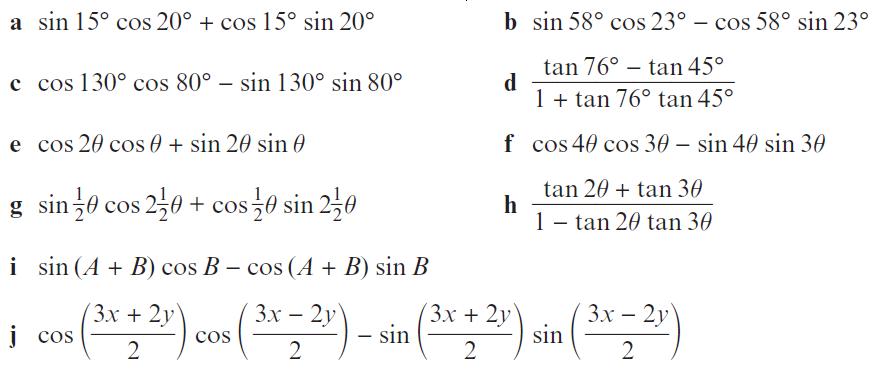
Express the following as a single sine, cosine or tangent: a sin 15° cos 20° + cos 15° sin 20° c cos 130° cos 80° - sin 130° sin 80° e cos 20 cos 0 + sin 20 sin g sin 10 cos 20 + cos sin 2-10 i sin (A + B) cos B - cos (A + B) sin B 2y 3x - 2y i cos (3x +2¹) cos (³x = 2¹) - 2 sin b sin
Eliminate θ from the following pairs of equations:a. x = cos2 θ, y = 1 − cos 2θb. x = tan θ, y = cot 2θc. x = sin θ, y = sin 2θd. x = 3 cos 2θ + 1, y = 2 sin θ
a. Prove that (cos 2θ − sin 2θ)2 ≡ 1 − sin 4θ. b. Use the result to solve, for 0 ≤ θ < π, the equation cos 2θ − sin 2θ = 1/√2. Give your answers in terms of π.
a. Express 3 sin 3θ − 4 cos 3θ in the form R sin (3θ − α), with R > 0 and 0 < α < 90°.b. Hence write down the minimum value of 3 sin 3θ − 4 cos 3θ and the value of θ at which it occurs.c. Solve, for 0 ≤ θ < 180°, the equation 3 sin 3θ − 4 cos 3θ = 1.
Use the addition formulae for sine or cosine to write each of the following as a single trigonometric function in the form sin (x ± θ ) or cos (x ± θ), where 0 < θ < π/2 a √2 (sin x + cos x) b √2 (cos x - sin x) с (sin x + √3 cos.x) d √2 (sin x cos x)
Given that tan A = 1/5 and tan B = 2/3, calculate, without using your calculator, the value of A + B in degrees, where:a. A and B are both acute,b. A is reflex and B is acute.
a. Express 5 sin2 θ − 3 cos2 θ + 6 sin θ cos θ in the form a sin 2θ + b cos 2θ + c, where a, b and c are constants to be found.b. Hence find the maximum and minimum values of 5 sin2 θ − 3 cos2 θ + 6 sin θ cos θ.c. Solve 5 sin2 θ − 3 cos2 θ + 6 sin θ cos θ = −1 for 0
Given that cos x = 1/4, find the exact value of cos 2x.
a. Show that 3 cos2 x − sin2 x ≡ 1 + 2 cos 2x.b. Hence sketch, for −π < x < π, the graph of y = 3 cos2 x − sin2 x, showing the coordinates of points where the curve meets the axes.
Find the possible values of sin θ when cos 2θ = 23/25.
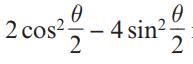
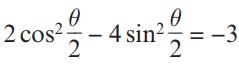
a. Expressin the form a cos θ + b, where a and b are constants.b. Hence solvein the interval 0 < θ , 360°. 0 22/2-4 2 cos² - 4 sin² 0 2
A class was asked to solve 3 cos θ = 2 − sin θ for 0 < θ, 360°. One student expressed the equation in the form R cos (θ − α) = 2, with R > 0 and 0 < α < 90°, and correctly solved the equation.a. Find the values of R and α and hence find her solutions. Another student
Given that cos y = sin (x + y), show that tan y = sec x − tan x.
Given that tan θ = 3/4, and that θ is acute,a. Find the exact value of: i. Tan 2θii. Sin 2θiii. Cos 2θb. Deduce the value of sin 4θ.
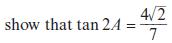
Given that cos A = − 1/3, and that A is obtuse,a. Find the exact value of:i. cos 2Aii. sin Aiii. cosec 2Ab. show that tan 24 = 4√2 7
Given that tan (x − y) = 3, express tan y in terms of tan x.
a. Given cot θ + 2 = cosec θ, show that 2 sin θ + cos θ = 1.b. Solve cot θ + 2 = cosec θ for 0 < θ , 360°.
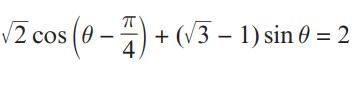
a. Givenshow that cos θ + √3 sin θ = 2.b. Solvefor 0 < θ < 2π. √2 cos (0-)+(√3-1) sin 0 = 2,
a. Use the identity sin2 A + cos2 A ≡ 1 to show that sin4 A + cos4 A ≡ 1/2 (2 − sin2 2A)b. Deduce that sin4 A + cos4 A ≡ 1/4 (3 + cos 4A).c. Hence solve 8 sin4 θ + 8 cos4 θ = 7, for 0 < θ < π.
Given that sin x (cos y + 2 sin y) = cos x (2 cos y − sin y), find the value of tan (x + y).
a. By writing 3θ as 2θ + θ, show that cos 3θ ≡ 4 cos3 θ − 3 cos θ.b. Hence, or otherwise, for 0 < θ < π, solve 6 cos θ − 8 cos3 θ + 1 = 0 giving your answer in terms of π.
a. Express 9 cos θ + 40 sin θ in the form R cos (θ − α), where R > 0 and 0 < α < 90°. Give the value of α to 3 decimal places.b. Calculate:i. The minimum value of g(θ)ii. The smallest positive value of θ at which the minimum occurs. g(0) = 18 50+ 9 cos 0 + 40 sin
In each of the following, calculate the exact value of tan x.a. tan (x − 45°) = 1/4b. sin (x − 60°) = 3 cos (x + 30°)c. tan (x − 60°) = 2
Given that p(x) = R cos (2θ + α), where R > 0 and 0 < α < 90°, p(x) = 12 cos 2θ − 5 sin 2θ.a. Find the value of R and the value of α.b. Hence solve the equation 12 cos2 θ − 5 sin 2θ = −6.5 for 0 ≤ α < 180°. c. Express 24 cos2 θ − 10 sin θ cos θ in the
Given that cos x + sin x = m and cos x − sin x = n, where m and n are constants, write down, in terms of m and n, the value of cos 2x.
The line l, with equation y = 3/4 x, bisects the angle between the x-axis and the line y = mx, m > 0. Given that the scales on each axis are the same, and that l makes an angle θ with the x-axis,a. Write down the value of tan θ.b. Show that m = 24/7
In △PQR, PQ = 3 cm, PR = 6 cm, QR = 5 cm and ∠QPR = 2θ.a. Use the cosine rule to show that cos 2θ = 5/9b. Hence find the exact value of sin θ.
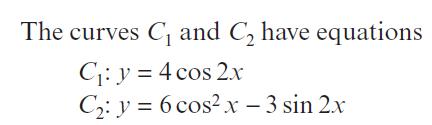
a. Use the identity cos (A + B) ≡ cos A cos B − sin A sin B, to show that cos 2A ≡ 2 cos2 A − 1b. Show that the x-coordinates of the points where C1 and C2 intersect satisfy the equation cos 2x + 3 sin 2x − 3 = 0 The curves C₁ and C₂ have equations C₁: y = 4 cos 2x C₂: y = 6
Use the fact that tan 2A ≡ sin 2A/cos 2A to derive the formula for tan 2A in terms of tan A.
Using the expansion of cos (A − B) with A = B = θ, show that sin2 θ + cos2 θ ≡ 1.
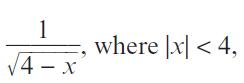
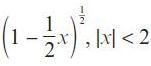
a. Expandin ascending powers of x up to and including the term in x2. Simplify each term.b. Hence, or otherwise, find the first 3 terms in the expansion ofas a series in ascending powers of x. 1 4-x where x < 4,
For each of the following,i. Find the binomial expansion up to and including the x3 termii. State the range of values of x for which the expansion is valid. a (1 + x)-4 (x + 1) P b (1+x)-6 -(x + 1) ə c (1 + x) ² Z(X+1) J
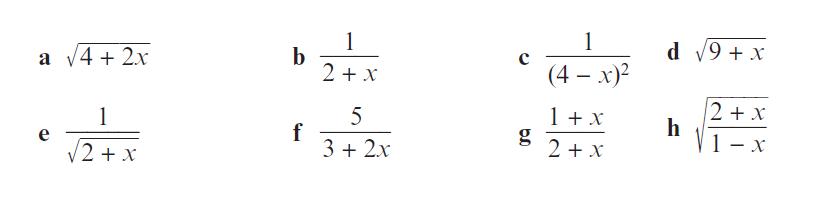
For each of the following.i. Find the binomial expansion up to and including the x3 term.ii. State the range of values of x for which the expansion is valid. a √4 + 2x e 1 2 + x b f 1 2 + x 5 3 + 2x с g 1 (4 - x)² 1 + x 2 + x d √9+ x h 2 + x 1- X
Use the binomial expansion to expandin ascending powers of x, up to and including the term in x3, simplifying each term. (1- 1 2 2 x, x
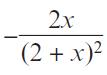
a. Expressas partial fractions.b. Hence provedcan be expressed in the form - 1/2 x + Bx2 + Cx3 where constants B and C are to be determined.c. State the set of values of x for which the expansion is valid. 2x (2 + x)²
For each of the following,i. Find the binomial expansion up to and including the x3 term.ii. State the range of values of x for which the expansion is valid. a (1 + 3x)-3 d (1 - 5x) b (1+x) e (1 + 6x) - c (1 + 2x)²/ f (1 3 4-X
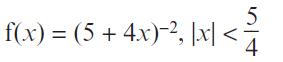
Find the binomial expansion of f(x) in ascending powers of x, up to and including the term in x3. Give each coefficient as a simplified fraction. f(x) = (5+4x)-², |x| < 5 4
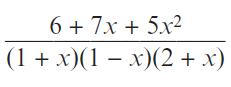
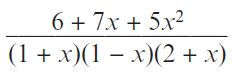
a. Express as partial fractions.b. Hence or otherwise expandin ascending powers of x as far as the term in x3.c. State the set of values of x for which the expansion is valid. 6 + 7x + 5x² (1+x)(1-x)(2 + x)
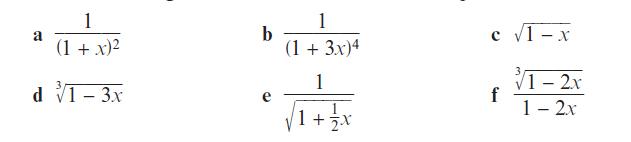
For each of the following,i. Find the binomial expansion up to and including the x3 term.ii. State the range of values of x for which the expansion is valid. 1 (1 + x)² d √1 - 3x a b 1 (1 + 3x)4 1 √1 + ½ x c √1 - x f √1 - 2x 1 - 2x
a. Give the binomial expansion of (1 + x)1/2 up to and including the term in x3.b. By substituting x = 1/4, find an approximation to √5 as a fraction.
a. Find the series expansion of m(x), in ascending powers of x, up to and including the x2 term. Simplify each term.b. Show that, when x = 1/9, the exact value of m(x) is √35/3.c. Use your answer to part a to find an approximate value for √35, and calculate the percentage error in your
The binomial expansion of (1 + 9x)2/3 in ascending powers of x up to and including the term ina. Find the value of c and the value of d.b. Use this expansion with your values of c and d together with an appropriate value of x to obtain an estimate of (1.45)2/3.c. Obtain (1.45)2/3 from your
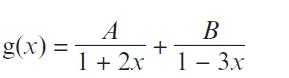
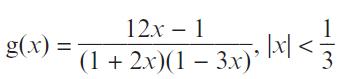
Given that g(x) can be expressed in the forma. Find the values of A and B.b. Hence, or otherwise, find the series expansion of f(x), in ascending powers of x, up to and including the x2 term. Simplify each term. g(x) = A 1 + 2x + B 1 - 3x
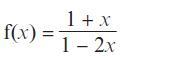
a. Show that the series expansion of f(x) up to and including the x3 term is 1 + 3x + 6x2 + 12x3.b. State the range of values of x for which the expansion is valid. 1 + x 1 - 2x f(x) = -
Showing 300 - 400
of 749
1
2
3
4
5
6
7
8
Step by Step Answers

 Get 50% OFF
Claim Now
Get 50% OFF
Claim Now