New Semester
Started
Get
50% OFF
Study Help!
--h --m --s
Claim Now
Question Answers
Textbooks
Find textbooks, questions and answers
Oops, something went wrong!
Change your search query and then try again
S
Books
FREE
Study Help
Expert Questions
Accounting
General Management
Mathematics
Finance
Organizational Behaviour
Law
Physics
Operating System
Management Leadership
Sociology
Programming
Marketing
Database
Computer Network
Economics
Textbooks Solutions
Accounting
Managerial Accounting
Management Leadership
Cost Accounting
Statistics
Business Law
Corporate Finance
Finance
Economics
Auditing
Tutors
Online Tutors
Find a Tutor
Hire a Tutor
Become a Tutor
AI Tutor
AI Study Planner
NEW
Sell Books
Search
Search
Sign In
Register
study help
mathematics
precalculus 1st
Precalculus 1st Edition Jay Abramson - Solutions
For the following exercises, find the area of each triangle. Round each answer to the nearest tenth.Two search teams spot a stranded climber on a mountain. The first search team is 0.5 miles from the second search team, and both teams are at an altitude of 1 mile. The angle of elevation from the
For the following exercises, find all answers rounded to the nearest hundredth.Use the rectangular to polar feature on the graphing calculator to change 3 − 2i to polar form.
For the following exercises, suppose that x2 = 25 + 36 − 60 cos(52) represents the relationship of three sides of a triangle and the cosine of an angle.Draw the triangle.
For the following exercises, use a graphing utility to graph each pair of polar equations on a domain of [0,4π] and then explain the differences shown in the graphs.r = 2sin (θ/2), r = θsin (θ/2)
For the following exercises, convert the equation from rectangular to polar form and graph on the polar axis.x2 +(y − 1)2 = 1
For the following exercises, find the magnitude and direction of the vector. 〈6, −2〉
For the following exercises, use the given magnitude and direction in standard position, write the vector in component form.Find the magnitude of the horizontal and vertical components of the vector with magnitude 4 pounds pointed in a direction of 127° above the horizontal. Round to the nearest
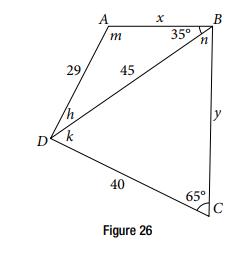
For the following exercises, find the area of each triangle. Round each answer to the nearest tenth.In Figure 26, ABCD is not a parallelogram. ∠m is obtuse. Solve both triangles. Round each answer to the nearest tenth. 29, M k A m 45 40 Figure 26 35° n 65° B
For the following exercises, find all answers rounded to the nearest hundredth.Use the rectangular to polar feature on the graphing calculator to change −3 − 8i to polar form.
For the following exercises, suppose that x2 = 25 + 36 − 60 cos(52) represents the relationship of three sides of a triangle and the cosine of an angle.Find the length of the third side.
For the following exercises, convert the equation from rectangular to polar form and graph on the polar axis.(x + 2)2 +(y + 3)2 = 13
For the following exercises, find the magnitude and direction of the vector.〈−3, −3〉
For the following exercises, use the given magnitude and direction in standard position, write the vector in component form.Find the magnitude of the horizontal and vertical components of a vector with magnitude 5 pounds pointed in a direction of 55° above the horizontal. Round to the nearest
For the following exercises, find all answers rounded to the nearest hundredth.Use the polar to rectangular feature on the graphing calculator to change 4cis(120°) to rectangular form.
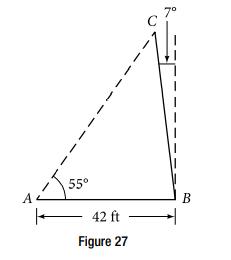
For the following exercises, find the area of each triangle. Round each answer to the nearest tenth.A pole leans away from the sun at an angle of 7° to the vertical, as shown in Figure 27. When the elevation of the sun is 55°, the pole casts a shadow 42 feet long on the level ground. How long is
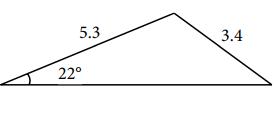
For the following exercises, find the area of the triangle. 5.3 22° 3.4
For the following exercises, use a graphing utility to graph each pair of polar equations on a domain of [0,4π] and then explain the differences shown in the graphs.On a graphing utility, graph r = sin (16/5 θ) on [0,4π], [0,8π], [0,12π], and [0,16π]. Describe the effect of increasing the
For the following exercises, convert the equation from rectangular to polar form and graph on the polar axis.x = 2
For the following exercises, calculate u ⋅ v. u = −2i + j and v = 3i + 7j
For the following exercises, use the given magnitude and direction in standard position, write the vector in component form.Find the magnitude of the horizontal and vertical components of the vector with magnitude 1 pound pointed in a direction of 8° above the horizontal. Round to the nearest
For the following exercises, find all answers rounded to the nearest hundredth.Use the polar to rectangular feature on the graphing calculator to change 2cis(45°) to rectangular form.
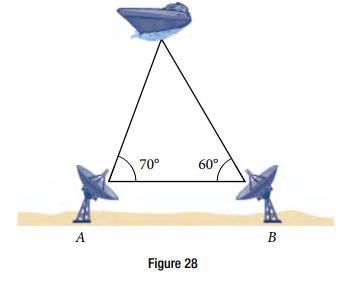
For the following exercises, find the area of each triangle. Round each answer to the nearest tenth.To determine how far a boat is from shore, two radar stations 500 feet apart find the angles out to the boat, as shown in Figure 28. Determine the distance of the boat from station A and the distance
For the following exercises, use a graphing utility to graph each pair of polar equations on a domain of [0,4π] and then explain the differences shown in the graphs.On a graphing utility, graph and sketch r = sin θ + (sin (5/2 θ))3 on [0,4π].
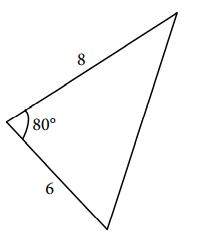
For the following exercises, find the area of the triangle. 80° 6 8
For the following exercises, convert the equation from rectangular to polar form and graph on the polar axis.x2 + y2 = 5y
For the following exercises, calculate u ⋅ v.u = i + 4j and v = 4i + 3j
For the following exercises, use the given magnitude and direction in standard position, write the vector in component form.A woman leaves home and walks 3 miles west, then 2 miles southwest. How far from home is she, and in what direction must she walk to head directly home?
For the following exercises, find all answers rounded to the nearest hundredth.Use the polar to rectangular feature on the graphing calculator to change 5cis(210°) to rectangular form.
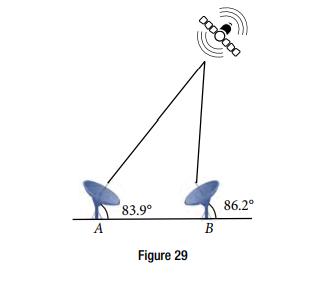
For the following exercises, find the area of each triangle. Round each answer to the nearest tenth.Figure 29 shows a satellite orbiting Earth. The satellite passes directly over two tracking stations A and B, which are 69 miles apart. When the satellite is on one side of the two stations, the
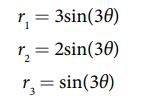
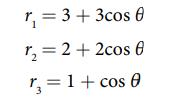
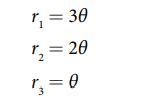
For the following exercises, use a graphing utility to graph each pair of polar equations on a domain of [0,4π] and then explain the differences shown in the graphs.On a graphing utility, graph each polar equation. Explain the similarities and differences you observe in the graphs. r₁ =
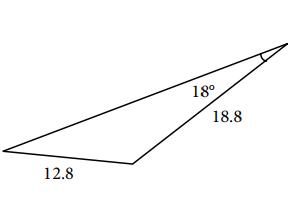
For the following exercises, find the area of the triangle. 12.8 18⁰ 18.8
For the following exercises, convert the equation from rectangular to polar form and graph on the polar axis.x2 + y2 = 3x
For the following exercises, calculate u ⋅ v.Given v = 〈−3, 4〉 draw v, 2v, and 1/2 v.
For the following exercises, use the given magnitude and direction in standard position, write the vector in component form.A boat leaves the marina and sails 6 miles north, then 2 miles northeast. How far from the marina is the boat, and in what direction must it sail to head directly back to the
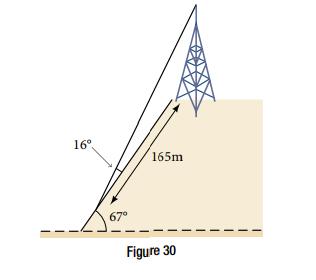
For the following exercises, find the area of each triangle. Round each answer to the nearest tenth.A communications tower is located at the top of a steep hill, as shown in Figure 30. The angle of inclination of the hill is 67°. A guy wire is to be attached to the top of the tower and to the
For the following exercises, use a graphing utility to graph each pair of polar equations on a domain of [0,4π] and then explain the differences shown in the graphs.On a graphing utility, graph each polar equation. Explain the similarities and differences you observe in the graphs. r₁ = 3
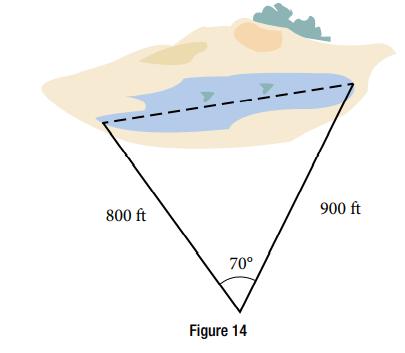
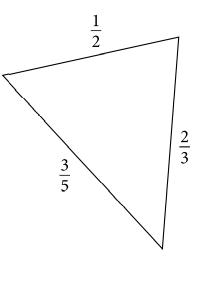
For the following exercises, find the area of the triangle.A surveyor has taken the measurements shown in Figure 14. Find the distance across the lake. Round answers to the nearest tenth. 800 ft 70° Figure 14 900 ft
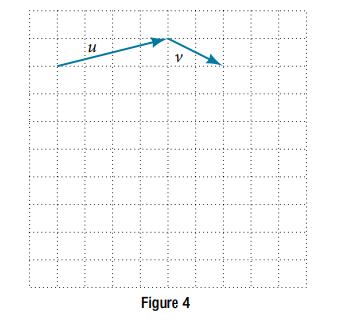
For the following exercises, calculate u ⋅ v.Given the vectors shown in Figure 4, sketch u + v, u − v and 3v. U # V H Figure 4
For the following exercises, convert the equation from polar to rectangular form and graph on the rectangular plane. r = 6
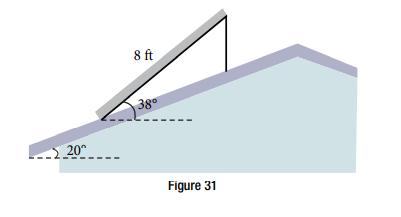
For the following exercises, find the area of each triangle. Round each answer to the nearest tenth.The roof of a house is at a 20° angle. An 8-foot solar panel is to be mounted on the roof and should be angled 38° relative to the horizontal for optimal results. (See Figure 31). How long does the
For the following exercises, use the given magnitude and direction in standard position, write the vector in component form.A man starts walking from home and walks 4 miles east, 2 miles southeast, 5 miles south, 4 miles southwest, and 2 miles east. How far has he walked? If he walked straight
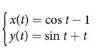
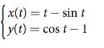
For the following exercises, use a graphing utility to graph the given parametric equations.a.b.c.An object is thrown in the air with vertical velocity of 20 ft/s and horizontal velocity of 15 ft/s. The object’s height can be described by the equation y(t) = − 16t2 + 20t, while the
For the following exercises, use a graphing utility to graph each pair of polar equations on a domain of [0,4π] and then explain the differences shown in the graphs.On a graphing utility, graph each polar equation. Explain the similarities and differences you observe in the graphs. r₁ =
For the following exercises, plot the complex number in the complex plane. 2 + 4i
For the following exercises, find the area of the triangle. Round to the nearest hundredth. ن
For the following exercises, plot the complex number in the complex plane.5 − 4i
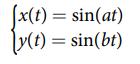
For the following exercises, use a graphing utility to graph on the window [−3,3] by [−3,3] on the domain [0,2π) for the following values of a and b , and include the orientation.a = 2, b = 5 [x(t) = sin(at) y(t) = sin(bt)
For the following exercises, use a graphing calculator to sketch the graph of the polar equation.r = θ + 1
For the following exercises, plot the points.(3, 5π/6)
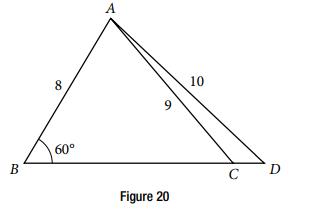
For the following exercises, find the area of each triangle. Round each answer to the nearest tenth.Find m ∠ADC in Figure 20. Round to the nearest tenth. B 8 60° 9 Figure 20 10 C D
For the following exercises, determine whether the two vectors, u and v, are equal, where u has an initial point P1 and a terminal point P2 , and v has an initial point P3 and a terminal point P4 .P1 = (−1, 4), P2 = (3, 1), P3 = (5, 5) and P4 = (9, 2)
For the following exercises, use the given magnitude and direction in standard position, write the vector in component form.|v| = 8, θ = 220°
For the following exercises, plot the complex number in the complex plane.−4
For the following exercises, find the area of the triangle. Round to the nearest hundredth.A parallelogram has sides of length 16 units and 10 units. The shorter diagonal is 12 units. Find the measure of the longer diagonal.
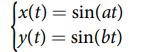
For the following exercises, use a graphing utility to graph on the window [−3,3] by [−3,3] on the domain [0,2π) for the following values of a and b , and include the orientation.a = 5, b = 2 [x(t) = sin(at) y(t) = sin(bt)
For the following exercises, use a graphing calculator to sketch the graph of the polar equation.r = θsin θ
For the following exercises, plot the points.(−1.5, 7π/6)
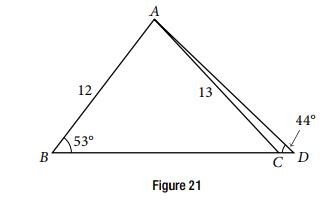
For the following exercises, find the area of each triangle. Round each answer to the nearest tenth.Find AD in Figure 21. Round to the nearest tenth. B 12, 53 A 13 Figure 21 C 44 D
For the following exercises, determine whether the two vectors, u and v, are equal, where u has an initial point P1 and a terminal point P2 , and v has an initial point P3 and a terminal point P4 .P1 = (6, 11), P2 = (−2, 8), P3 = (0, − 1) and P4 = (−8, 2)
For the following exercises, use the given magnitude and direction in standard position, write the vector in component form.|v| = 2, θ = 300°
For the following exercises, plot the complex number in the complex plane.6 − 2i
For the following exercises, find the area of the triangle. Round to the nearest hundredth.The sides of a parallelogram are 11 feet and 17 feet. The longer diagonal is 22 feet. Find the length of the shorter diagonal.
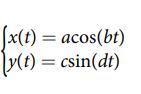
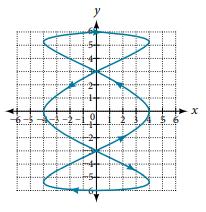
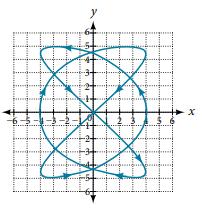
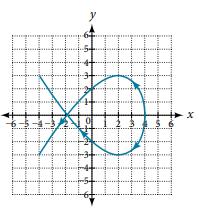
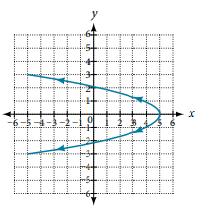
For the following exercises, look at the graphs that were created by parametric equations of the form Use the parametric mode on the graphing calculator to find the values of a, b, c, and d to achieve each graph. [x(t) = acos(bt) [y(t) = csin(dt)
For the following exercises, use a graphing calculator to sketch the graph of the polar equation.r = θcos θ
For the following exercises, plot the points.(−2, π/4)
For the following exercises, use the vectors u = 2i − j, v = 4i − 3j, and w = −2i + 5j to evaluate the expression. u − v
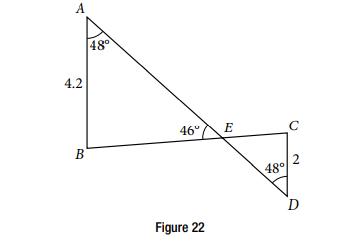
For the following exercises, find the area of each triangle. Round each answer to the nearest tenth.Solve both triangles in Figure 22. Round each answer to the nearest tenth. A 4.2 B 48⁰ 46° Figure 22 E 48° с 2 D
For the following exercises, use the given magnitude and direction in standard position, write the vector in component form.|v| = 5, θ = 135°
For the following exercises, plot the complex number in the complex plane.−2 + i
For the following exercises, look at the graphs that were created by parametric equations of the form Use the parametric mode on the graphing calculator to find the values of a, b, c, and d to achieve each graph. [x(t) = acos(bt) [y(t) = csin(dt)
For the following exercises, find the area of the triangle. Round to the nearest hundredth.The sides of a parallelogram are 28 centimeters and 40 centimeters. The measure of the larger angle is 100°. Find the length of the shorter diagonal.
For the following exercises, use a graphing utility to graph each pair of polar equations on a domain of [0,4π] and then explain the differences shown in the graphs.r = θ, r = −θ
For the following exercises, plot the points.(1, 3π/2)
For the following exercises, use the vectors u = 2i − j, v = 4i − 3j, and w = −2i + 5j to evaluate the expression.2v − u + w
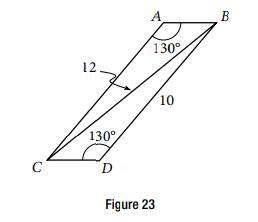
For the following exercises, find the area of each triangle. Round each answer to the nearest tenth.Find AB in the parallelogram shown in Figure 23. C 12 130° D A 130° 10 Figure 23 B
For the following exercises, use the given magnitude and direction in standard position, write the vector in component form.A 60-pound box is resting on a ramp that is inclined 12°. Rounding to the nearest tenth,a. Find the magnitude of the normal (perpendicular) component of the force.b. Find the
For the following exercises, plot the complex number in the complex plane.1 − 4i
For the following exercises, look at the graphs that were created by parametric equations of the form Use the parametric mode on the graphing calculator to find the values of a, b, c, and d to achieve each graph. [x(t) = acos(bt) [y(t) = csin(dt)
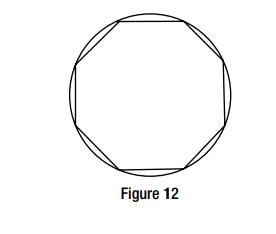
For the following exercises, find the area of the triangle. Round to the nearest hundredth.A regular octagon is inscribed in a circle with a radius of 8 inches. (See Figure 12.) Find the perimeter of the octagon. o Figure 12
For the following exercises, use a graphing utility to graph each pair of polar equations on a domain of [0,4π] and then explain the differences shown in the graphs.r = θ, r = θ + sin θ
For the following exercises, convert the equation from rectangular to polar form and graph on the polar axis. 5x − y = 6
For the following exercises, find a unit vector in the same direction as the given vector.a = 8i − 6j
For the following exercises, use the given magnitude and direction in standard position, write the vector in component form.A 25-pound box is resting on a ramp that is inclined 8°. Rounding to the nearest tenth,a. Find the magnitude of the normal (perpendicular) component of the force.b. Find the
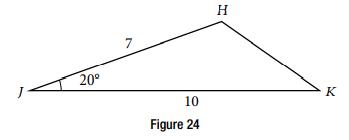
For the following exercises, find the area of each triangle. Round each answer to the nearest tenth.Solve the triangle in Figure 24. Round each answer to the nearest tenth. 20º 10 Figure 24 H K
For the following exercises, find all answers rounded to the nearest hundredth. Use the rectangular to polar feature on the graphing calculator to change 5 + 5i to polar form.
For the following exercises, look at the graphs that were created by parametric equations of the form Use the parametric mode on the graphing calculator to find the values of a, b, c, and d to achieve each graph. [x(t) = acos(bt) [y(t) = csin(dt)
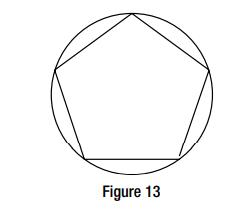
For the following exercises, find the area of the triangle. Round to the nearest hundredth.A regular pentagon is inscribed in a circle of radius 12 cm. (See Figure 13.) Find the perimeter of the pentagon. Round to the nearest tenth of a centimeter. Figure 13
For the following exercises, use a graphing utility to graph each pair of polar equations on a domain of [0,4π] and then explain the differences shown in the graphs.r = sin θ + θ, r = sin θ − θ
For the following exercises, convert the equation from rectangular to polar form and graph on the polar axis. 2x + 7y = −3
For the following exercises, find a unit vector in the same direction as the given vector.b = −3i − j
For the following exercises, use the given magnitude and direction in standard position, write the vector in component form.Find the magnitude of the horizontal and vertical components of a vector with magnitude 8 pounds pointed in a direction of 27° above the horizontal. Round to the nearest
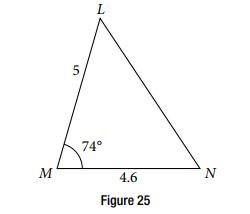
For the following exercises, find the area of each triangle. Round each answer to the nearest tenth.Solve the triangle in Figure 25. Round each answer to the nearest tenth. M 5 L 74° 4.6 Figure 25 N
For the following exercises, plot the complex number in the complex plane.2i
For the following exercises, describe the graph of the set of parametric equations.Write the parametric equations of a circle with center (0,0), radius 5, and a counterclockwise orientation.
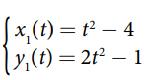
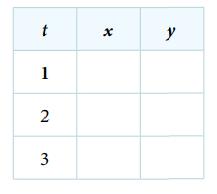
For the following exercises, use a graphing calculator to complete the table of values for each set of parametric equations. [x₂(t) = t² - 4 y₁ (t)=2t²-1
For the following exercises, plot the points. (−2, π/3)
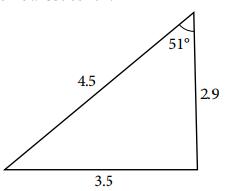
For the following exercises, find the area of each triangle. Round each answer to the nearest tenth. 4.5 3.5 51° 29
For the following exercises, eliminate the parameter t to rewrite the parametric equation as a Cartesian equation.Parameterize (write a parametric equation for) each Cartesian equation by using x(t) = acos t and y(t) = bsin t for x2 /25 + y2 /16 = 1.
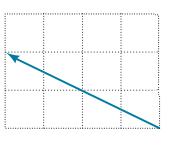
For the following exercises, write the vector shown in component form. commina
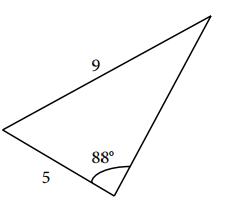
For the following exercises, solve for the unknown side. Round to the nearest tenth. 5 88⁰
Showing 4700 - 4800
of 8578
First
41
42
43
44
45
46
47
48
49
50
51
52
53
54
55
Last
Step by Step Answers

 Get 50% OFF
Claim Now
Get 50% OFF
Claim Now