New Semester
Started
Get
50% OFF
Study Help!
--h --m --s
Claim Now
Question Answers
Textbooks
Find textbooks, questions and answers
Oops, something went wrong!
Change your search query and then try again
S
Books
FREE
Study Help
Expert Questions
Accounting
General Management
Mathematics
Finance
Organizational Behaviour
Law
Physics
Operating System
Management Leadership
Sociology
Programming
Marketing
Database
Computer Network
Economics
Textbooks Solutions
Accounting
Managerial Accounting
Management Leadership
Cost Accounting
Statistics
Business Law
Corporate Finance
Finance
Economics
Auditing
Tutors
Online Tutors
Find a Tutor
Hire a Tutor
Become a Tutor
AI Tutor
AI Study Planner
NEW
Sell Books
Search
Search
Sign In
Register
study help
mathematics
precalculus 1st
Precalculus 1st Edition Jay Abramson - Solutions
For the following exercises, find all exact solutions on the interval [0, 2π). tan x + 1 = 0
For the following exercises, find all exact solutions on the interval [0, 2π). 2sin(2x) + √2 = 0
For the following exercises, find all exact solutions on the interval [0, 2π). 2sin2 x − sin x = 0
For the following exercises, find all exact solutions on the interval [0, 2π).cos2 x − cos x − 1 = 0
For the following exercises, find all exact solutions on the interval [0, 2π).2sin2 x + 5 sin x + 3 = 0
For the following exercises, find all exact solutions on the interval [0, 2π).cos x − 5sin(2x) = 0
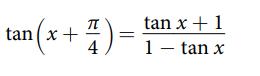
For the following exercises, prove the identities provided. tan (x+4) = tan x + 1 1 - tan x
For the following exercises, find all exact solutions on the interval [0, 2π).1/sec2 x + 2 + sin2 x + 4cos2 x = 0
For the following exercises, simplify the equation algebraically as much as possible. Then use a calculator to find the solutions on the interval [0, 2π). Round to four decimal places. √3 cot2 x + cot x = 1
For the following exercises, simplify the equation algebraically as much as possible. Then use a calculator to find the solutions on the interval [0, 2π). Round to four decimal places.csc2 x − 3csc x − 4 = 0
For the following exercises, reduce the equations to powers of one, and then check the answer graphically.tan2 x sin x
For the following exercises, solve exactly on the interval [0, 2π).Use the quadratic formula if the equations do not factor.cot2 x = −cot x
For the following exercises, graph each side of the equation to find the zeroes on the interval [0,2π).20cos2 x + 21cos x + 1 = 0
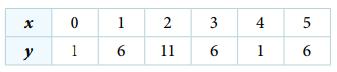
For the following exercises, graph the points and find a possible formula for the trigonometric values in the given table. Х У 0 1 1 6 2 11 3 6 4 1 5 6
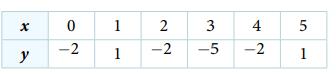
For the following exercises, graph the points and find a possible formula for the trigonometric values in the given table. X y 0 1 1 -2 2 -2 3 4 -5 -2 I 5 1
For the following exercises, graph the points and find a possible formula for the trigonometric values in the given table. x y -3 3+2√2 -2 3 -1 2√2-1 0 1 1 3-2√2 2 1 3 -1-2V/2
For the following exercises, graph each side of the equation to find the zeroes on the interval [0,2π).sec2 x − 2sec x = 15
For the following exercises, reduce the equations to powers of one, and then check the answer graphically.cos2 x sin(2x)
For the following exercises, find exact solutions on the interval [0,2π).Look for opportunities to use trigonometric identities.sin2 x + cos2 x = 0
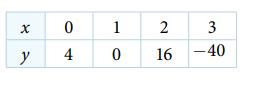
For the following exercises, find a function of the form y = abx + csin (π/2 x) that fits the given data. x 0 y 4 1 0 2 16 3 -40
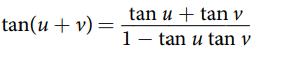
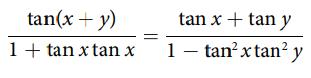
For the following exercises, prove or disprove the statements. tan(u + v) = tan u + tan v 1 tan u tan v
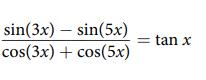
For the following exercises, simplify the expression to one term, then graph the original function and your simplified version to verify they are identical.sin(3x) − sinx/sin x
For the following exercises, reduce the equations to powers of one, and then check the answer graphically.tan2 (x/2) sin x
For the following exercises, find exact solutions on the interval [0,2π).Look for opportunities to use trigonometric identities.sin(2x) − sin x = 0
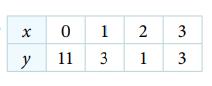
For the following exercises, find a function of the form y = abx cos (π/2 x) + c that fits the given data. X y 0 11 1 2 3 1 3 3 دیا
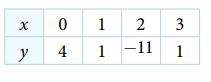
For the following exercises, find a function of the form y = abx cos (π/2 x) + c that fits the given data. ४ y 0 4 1 2 1 -11 3 1
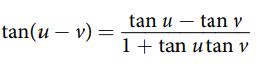
For the following exercises, prove or disprove the statements. tan(u - v) = tan u - tan v 1 + tan utan v
For the following exercises, algebraically find an equivalent function, only in terms of sin x and/or cos x, and then check the answer by graphing both equations.sin(4x)
For the following exercises, prove or disprove the statements. tan(x + y) 1 + tan x tan x tan x + tan y 1 - tan² xtan² y
For the following exercises, find exact solutions on the interval [0,2π).Look for opportunities to use trigonometric identities.cos(2x) − cos x = 0
For the following exercises, graph the points and find a possible formula for the trigonometric values in the given table.A man with his eye level 6 feet above the ground is standing 3 feet away from the base of a 15-foot vertical ladder. If he looks to the top of the ladder, at what angle above
For the following exercises, simplify the expression to one term, then graph the original function and your simplified version to verify they are identical.sin x cos(15x) − cos x sin(15x)
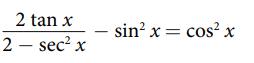
For the following exercises, find exact solutions on the interval [0,2π).Look for opportunities to use trigonometric identities. 2 tan x 2 - sec² x sin² x cos² x
For the following exercises, algebraically find an equivalent function, only in terms of sin x and/or cos x, and then check the answer by graphing both equations.cos(4x)
For the following exercises, graph the points and find a possible formula for the trigonometric values in the given table.Using the ladder from the previous exercise, if a 6-foot-tall construction worker standing at the top of the ladder looks down at the feet of the man standing at the bottom,
For the following exercises, prove the following sum-to-product formulas.sin x − sin y = 2 sin (x − y/2) cos ( x + y/2)
For the following exercises, prove or disprove the statements.If α, β, and γ are angles in the same triangle, then prove or disprove sin(α + β) = sin γ.
For the following exercises, create a function modeling the described behavior. Then, calculate the desired result using a calculator.A spring attached to a ceiling is pulled down 11 cm from equilibrium and released. After 2 seconds, the amplitude has decreased to 6 cm. The spring oscillates 8
For the following exercises, rewrite the expression with an exponent no higher than 1.cos4 x sin2 x
For the following exercises, find the exact value algebraically, and then confirm the answer with a calculator to the fourth decimal point.sin(195°)
For the following exercises, find the exact value algebraically, and then confirm the answer with a calculator to the fourth decimal point.cos(165°)
For the following exercises, solve exactly on the interval [0, 2π).Use the quadratic formula if the equations do not factor.5cos2 x + 3cos x−1 = 0
For the following exercises, algebraically determine whether each of the given expressions is a true identity. If it is not an identity, replace the right-hand side with an expression equivalent to the left side. Verify the results by graphing both expressions on a calculator.2sin(2x)sin(3x) = cos
For the following exercises, find all solutions exactly on the interval 0 ≤ θ < 2π.2cos θ = 1
For the following exercises, find the amplitude, period, and frequency of the given function.The displacement h(t) in centimeters of a mass suspended by a spring is modeled by the function h(t) = 4cos (π/2 t), where t is measured in seconds. Find the amplitude, period, and frequency of this
For the following exercises, rewrite the sum as a product of two functions or the product as a sum of two functions. Give your answer in terms of sines and cosines. Then evaluate the final answer numerically, rounded to four decimal places.sin(−14°)sin(85°)
For the following exercises, create a function modeling the described behavior. Then, calculate the desired result using a calculator.A spring attached to a ceiling is pulled down 21 cm from equilibrium and released. After 6 seconds, the amplitude has decreased to 4 cm. The spring oscillates 20
For the following exercises, algebraically determine whether each of the given expressions is a true identity. If it is not an identity, replace the right-hand side with an expression equivalent to the left side. Verify the results by graphing both expressions on a calculator.cos(10θ) +
For the following exercises, reduce the equations to powers of one, and then check the answer graphically.tan4 x
For the following exercises, rewrite the expression with an exponent no higher than 1.tan2 x sin2 x
For the following exercises, find the exact value algebraically, and then confirm the answer with a calculator to the fourth decimal point.cos(345°)
For the following exercises, solve exactly on the interval [0, 2π).Use the quadratic formula if the equations do not factor.3cos2 x − 2cos x − 2 = 0
For the following exercises, create a function modeling the described behavior. Then, calculate the desired result using a calculator.Two springs are pulled down from the ceiling and released at the same time. The first spring, which oscillates 8 times per second, was initially pulled down 32 cm
For the following exercises, reduce the equations to powers of one, and then check the answer graphically.sin2 (2x)
For the following exercises, algebraically determine whether each of the given expressions is a true identity. If it is not an identity, replace the right-hand side with an expression equivalent to the left side. Verify the results by graphing both expressions on a calculator. sin(3x) -
For the following exercises, find the exact value algebraically, and then confirm the answer with a calculator to the fourth decimal point.tan(−15°)
For the following exercises, solve exactly on the interval [0, 2π).Use the quadratic formula if the equations do not factor.5sin2 x + 2sin x − 1 = 0
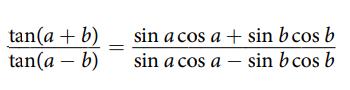
For the following exercises, prove the identities provided. tan(a + b) tan(a - b) sin a cos a + sin bcos b sin a cos a sin bcos b
For the following exercises, create a function modeling the described behavior. Then, calculate the desired result using a calculator.Two springs are pulled down from the ceiling and released at the same time. The first spring, which oscillates 14 times per second, was initially pulled down 2 cm
For the following exercises, reduce the equations to powers of one, and then check the answer graphically.sin2 x cos2 x
For the following exercises, solve exactly on the interval [0, 2π).Use the quadratic formula if the equations do not factor.tan2 x + 5tan x − 1 = 0
For the following exercises, algebraically determine whether each of the given expressions is a true identity. If it is not an identity, replace the right-hand side with an expression equivalent to the left side. Verify the results by graphing both expressions on a calculator.
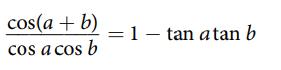
For the following exercises, prove the identities provided. cos(a + b) cos a cos b 1 tan atan b -
For the following exercises, algebraically determine whether each of the given expressions is a true identity. If it is not an identity, replace the right-hand side with an expression equivalent to the left side. Verify the results by graphing both expressions on a calculator.2cos(2x)cos x +
For the following exercises, create a function modeling the described behavior. Then, calculate the desired result using a calculator.A plane flies 1 hour at 150 mph at 22° east of north, then continues to fly for 1.5 hours at 120 mph, this time at a bearing of 112° east of north. Find the total
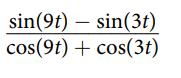
For the following exercises, simplify the expression to one term, then graph the original function and your simplified version to verify they are identical. sin(9t) sin(3t) cos(9t) cos(3t)
For the following exercises, create a function modeling the described behavior. Then, calculate the desired result using a calculator.A plane flies 2 hours at 200 mph at a bearing of 60°, then continues to fly for 1.5 hours at the same speed, this time at a bearing of 150°. Find the distance from
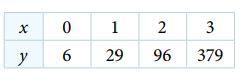
For the following exercises, find a function of the form y = abx + csin (π/2 x) that fits the given data. x 0 1 y 6 29 2 96 3 379
For the following exercises, reduce the equations to powers of one, and then check the answer graphically.tan4 x cos2 x
For the following exercises, solve exactly on the interval [0, 2π).Use the quadratic formula if the equations do not factor.−tan2 x − tan x − 2 = 0
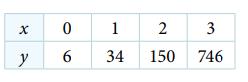
For the following exercises, find a function of the form y = abx + csin (π/2 x) that fits the given data. X 0 y 6 1 2 34 150 3 746
For the following exercises, prove the identities provided.cos(x + y)cos(x − y) = cos2 x − sin2 y
For the following exercises, prove the identities provided. cos(x + h) - cos x h = cos x cos h - 1 h sin h h sin x-
For the following exercises, find exact solutions on the interval [0,2π).Look for opportunities to use trigonometric identities.sin2 x − cos2 x − sin x = 0
For the following exercises, simplify the expression to one term, then graph the original function and your simplified version to verify they are identical.2sin(8x)cos(6x) − sin(2x)
For the following exercises, reduce the equations to powers of one, and then check the answer graphically.cos2 (2x)sin x
For the following exercises, construct an equation that models the described behavior.A rabbit population oscillates 15 above and below average during the year, reaching the lowest value in January. The average population starts at 650 rabbits and increases by 110 each year. Find a function that
For the following exercises, solve with the methods shown in this section exactly on the interval [0, 2π).cos(2x)cos x + sin(2x)sin x = 1
For the following exercises, prove the identity.sin x + sin(3x) = 4sin x cos2 x
For the following exercises, prove or disprove the identity.csc2 x(1 + sin2 x) = cot2 x
For the following exercises, prove the identity given.sin(2x) = −2 sin(−x) cos(−x)
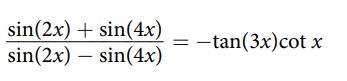
For the following exercises, prove or disprove the identity. sec²(-x) tan² x - tan x 2 + 2 tan x 2+2 cot x 2 sin² x cos 2x
For the following exercises, use a graph to determine whether the functions are the same or different. If they are the same, show why. If they are different, replace the second function with one that is identical to the first.f(x) = sin(3x)cos(6x), g(x) = −sin(3x)cos(6x)
For the following exercises, construct an equation that models the described behavior.A muskrat population oscillates 33 above and below average during the year, reaching the lowest value in January. The average population starts at 900 muskrats and increases by 7% each month. Find a function that
For the following exercises, solve with the methods shown in this section exactly on the interval [0, 2π).6sin(2t) + 9sin t = 0
For the following exercises, prove the identity.2(cos3 x − cos x sin2 x)= cos(3x) + cos x
For the following exercises, prove the identity given.cot x − tan x = 2 cot(2x)
For the following exercises, use a graph to determine whether the functions are the same or different. If they are the same, show why. If they are different, replace the second function with one that is identical to the first.f(x) = sin(4x), g(x) = sin(5x)cos x − cos(5x)sin x
For the following exercises, construct an equation that models the described behavior.A fish population oscillates 40 above and below average during the year, reaching the lowest value in January. The average population starts at 800 fish and increases by 4% each month. Find a function that models
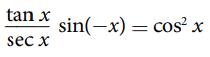
For the following exercises, prove or disprove the identity. tan x sec x sin(-x) = cos² x
For the following exercises, solve with the methods shown in this section exactly on the interval [0, 2π).9cos(2θ) = 9cos2 θ − 4
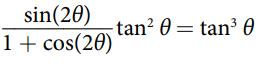
For the following exercises, prove the identity given. sin (20) 1 + cos(20) -tan²0 tan³ 0 =
For the following exercises, prove the identity.2 tan x cos(3x) = sec x(sin(4x) − sin(2x))
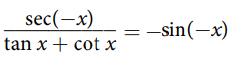
For the following exercises, prove or disprove the identity. sec(-x) tan x + cotx = -sin(-x)
For the following exercises, construct an equation that models the described behavior.A spring attached to the ceiling is pulled 10 cm down from equilibrium and released. The amplitude decreases by 15% each second. The spring oscillates 18 times each second. Find a function that models the
For the following exercises, use a graph to determine whether the functions are the same or different. If they are the same, show why. If they are different, replace the second function with one that is identical to the first.f(x) = sin(2x), g(x) = 2 sin x cos x
For the following exercises, solve with the methods shown in this section exactly on the interval [0, 2π).sin(2t) = cos t
For the following exercises, prove the identity.cos(a + b) + cos(a − b) = 2cos a cos b
For the following exercises, construct an equation that models the described behavior.A spring attached to the ceiling is pulled 7 cm down from equilibrium and released. The amplitude decreases by 11% each second. The spring oscillates 20 times each second. Find a function that models the distance,
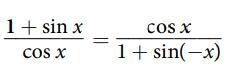
For the following exercises, prove or disprove the identity. 1 + sin x COS X COS X 1 + sin(-x)
Showing 5400 - 5500
of 8578
First
48
49
50
51
52
53
54
55
56
57
58
59
60
61
62
Last
Step by Step Answers

 Get 50% OFF
Claim Now
Get 50% OFF
Claim Now