New Semester
Started
Get
50% OFF
Study Help!
--h --m --s
Claim Now
Question Answers
Textbooks
Find textbooks, questions and answers
Oops, something went wrong!
Change your search query and then try again
S
Books
FREE
Study Help
Expert Questions
Accounting
General Management
Mathematics
Finance
Organizational Behaviour
Law
Physics
Operating System
Management Leadership
Sociology
Programming
Marketing
Database
Computer Network
Economics
Textbooks Solutions
Accounting
Managerial Accounting
Management Leadership
Cost Accounting
Statistics
Business Law
Corporate Finance
Finance
Economics
Auditing
Tutors
Online Tutors
Find a Tutor
Hire a Tutor
Become a Tutor
AI Tutor
AI Study Planner
NEW
Sell Books
Search
Search
Sign In
Register
study help
mathematics
precalculus 1st
Precalculus 1st Edition Jay Abramson - Solutions
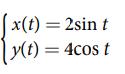
For the following exercises, sketch the curve and include the orientation. x(t) = 2sin t [y(t) = 4cos t
Given z1 = 8cis(36°) and z2 = 2cis(15°), evaluate each expression.√z1
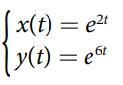
For the following exercises, eliminate the parameter t to rewrite the parametric equation as a Cartesian equation. x(t) = e²t |y(t) = e6t
For the following exercises, convert the given Cartesian equation to a polar equation.y = 4
For the following exercises, convert the given Cartesian equation to a polar equation.x2 + y2 = 64
For the following exercises, assume α is opposite side a, β is opposite side b, and γ is opposite side c. Determine whether there is no triangle, one triangle, or two triangles. Then solve each triangle, if possible. Round each answer to the nearest tenth.a = 12, c = 17, α = 35°
For the following exercises, convert the complex number from polar to rectangular form.z = 7cis (π/6)
For the following exercises, convert the complex number from polar to rectangular form.z = 2cis (π/3)
For the following exercises, use the given vectors to compute u + v, u − v, and 2u − 3v.u = 〈2, − 3〉 , v = 〈1, 5〉
For the following exercises, use the Law of Cosines to solve for the missing angle of the oblique triangle. Round to the nearest tenth.a = 16, b = 31, c = 20; find angle B.
For the following exercises, graph the polar equation. Identify the name of the shape.r = 2 + 2cos θ
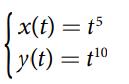
For the following exercises, eliminate the parameter t to rewrite the parametric equation as a Cartesian equation. x(t) = t³ t5 |y(t) = ¹0
Given z1 = 8cis(36°) and z2 = 2cis(15°), evaluate each expression.Plot the complex number −5 − i in the complex plane.
For the following exercises, convert the given Cartesian equation to a polar equation.y = 4x2
For the following exercises, convert the given Cartesian equation to a polar equation.x2 + y2 = − 2y
For the following exercises, assume α is opposite side a, β is opposite side b, and γ is opposite side c. Determine whether there is no triangle, one triangle, or two triangles. Then solve each triangle, if possible. Round each answer to the nearest tenth.a = 20.5, b = 35.0, β = 25°
For the following exercises, convert the complex number from polar to rectangular form.z = 4cis (7π/6)
For the following exercises, use the given vectors to compute u + v, u − v, and 2u − 3v.u = 〈−3, 4〉 , v = 〈−2, 1〉
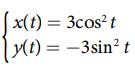
For the following exercises, sketch the curve and include the orientation. (x(t) = 3cos² t |y(t) = -3sin² t
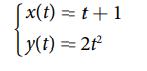
Given z1 = 8cis(36°) and z2 = 2cis(15°), evaluate each expression.Eliminate the parameter t to rewrite the following parametric equations as a Cartesian equation: [x(t)=t+1 [y(t) = 2t²
For the following exercises, use the Law of Cosines to solve for the missing angle of the oblique triangle. Round to the nearest tenth.a = 13, b = 22, c = 28; find angle A.
For the following exercises, graph the polar equation. Identify the name of the shape.r = 2 − 2cos θ
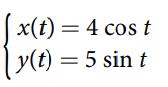
For the following exercises, eliminate the parameter t to rewrite the parametric equation as a Cartesian equation. x(t) = 4 cos t |y(t) = 5 sin t
For the following exercises, convert the given Cartesian equation to a polar equation.y = 2x4
For the following exercises, convert the given polar equation to a Cartesian equation. r = 7cos θ
For the following exercises, assume α is opposite side a, β is opposite side b, and γ is opposite side c. If possible, solve each triangle for the unknown side. Round to the nearest tenth.β = 50°, a = 105, b = 45
For the following exercises, determine whether the two vectors u and v are equal, where u has an initial point P1 and a terminal point P2 and v has an initial point P3 and a terminal point P4 .Given initial point P1 = (6, 0) and terminal point P2 = (−1, −3), write the vector v in terms of
For the following exercises, write the complex number in polar form.− 1/2 − 1/2 i
For the following exercises, assume α is opposite side a, β is opposite side b, and γ is opposite side c. Determine whether there is no triangle, one triangle, or two triangles. Then solve each triangle, if possible. Round each answer to the nearest tenth. α = 119°, a = 14, b = 26
For the following exercises, assume α is opposite side a, β is opposite side b, and γ is opposite side c. Solve each triangle, if possible. Round each answer to the nearest tenth.Convert (7,−2) to polar coordinates.
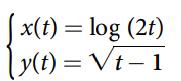
For the following exercises, eliminate the parameter t to rewrite the parametric equation as a Cartesian equation. x(t) = log (2t) |y(t)=√t-1
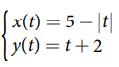
For the following exercises, sketch the curve and include the orientation. x(t) = 5 -|t| |y(t) = t +2
For the following exercises, convert the given Cartesian coordinates to polar coordinates with r > 0, 0 ≤ θ <2π. Remember to consider the quadrant in which the given point is located.(−10, −13)
Given z1 = 8cis(36°) and z2 = 2cis(15°), evaluate each expression.z1 z2
For the following exercises, test the equation for symmetry.r = 3√1−cos2 θ
For the following exercises, assume α is opposite side a, β is opposite side b, and γ is opposite side c. If possible, solve each triangle for the unknown side. Round to the nearest tenth. α = 36.6°, a = 186.2, b = 242.2
For the following exercises, determine whether the two vectors u and v are equal, where u has an initial point P1 and a terminal point P2 and v has an initial point P3 and a terminal point P4 .Given initial point P1 = (−3, 1) and terminal point P2 = (5, 2), write the vector v in terms of i
For the following exercises, assume α is opposite side a, β is opposite side b, and γ is opposite side c. Solve each triangle, if possible. Round each answer to the nearest tenth.Convertto rectangular coordinates. -2, Зл 2
For the following exercises, write the complex number in polar form. 8 − 4i
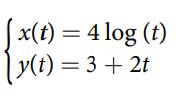
For the following exercises, eliminate the parameter t to rewrite the parametric equation as a Cartesian equation. [x(t) = 4 log (t) |y(t) = 3 + 2t
For the following exercises, use the Law of Sines to solve for the missing side for each oblique triangle. Round each answer to the nearest hundredth. Assume that angle A is opposite side a, angle B is opposite side b, and angle C is opposite side c.Find side c when B = 37°, C = 21, b = 23.
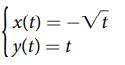
For the following exercises, sketch the curve and include the orientation. x(t) = -√t ly(t) = t
For the following exercises, convert the given Cartesian coordinates to polar coordinates with r > 0, 0 ≤ θ <2π. Remember to consider the quadrant in which the given point is located.(3, −5)
Convert the complex number from polar to rectangular form: z = 5cis (2π/3).
For the following exercises, test the equation for symmetry.r = 2/θ
For the following exercises, assume α is opposite side a, β is opposite side b, and γ is opposite side c. If possible, solve each triangle for the unknown side. Round to the nearest tenth.α = 43.1°, a = 184.2, b = 242.8
For the following exercises, determine whether the two vectors u and v are equal, where u has an initial point P1 and a terminal point P2 and v has an initial point P3 and a terminal point P4 .P1 = (8, 3), P2 = (6, 5), P3 = (11, 8), and P4 = (9, 10)
For the following exercises, eliminate the parameter t to rewrite the parametric equation as a Cartesian equation. [x(t) = e-2t |y(t) = 2e-t
For the following exercises, write the complex number in polar form. 2 + 2i
For the following exercises, assume α is opposite side a, β is opposite side b, and γ is opposite side c. Solve each triangle, if possible. Round each answer to the nearest tenth.Convertto rectangular coordinates. 6, Зл 4 Д
For the following exercises, use the Law of Sines to solve for the missing side for each oblique triangle. Round each answer to the nearest hundredth. Assume that angle A is opposite side a, angle B is opposite side b, and angle C is opposite side c.Find side a when A = 132°, C = 23°, b = 10.
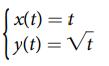
For the following exercises, sketch the curve and include the orientation. x(t) = t [y(t) = Vt
For the following exercises, convert the given Cartesian coordinates to polar coordinates with r > 0, 0 ≤ θ <2π. Remember to consider the quadrant in which the given point is located.(−4, 6)
For the following exercises, test the equation for symmetry.r = 4cos θ/2
For the following exercises, assume α is opposite side a, β is opposite side b, and γ is opposite side c. If possible, solve each triangle for the unknown side. Round to the nearest tenth.β = 67°, a = 49, b = 38
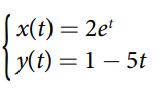
For the following exercises, eliminate the parameter t to rewrite the parametric equation as a Cartesian equation. x(t) = 2et |y(t) = 1 - 5t
For the following exercises, assume α is opposite side a, β is opposite side b, and γ is opposite side c. Solve each triangle, if possible. Round each answer to the nearest tenth.Plot the point with polar coordinates 5, 2п 3
For the following exercises, determine whether the two vectors u and v are equal, where u has an initial point P1 and a terminal point P2 and v has an initial point P3 and a terminal point P4 .P1 = (3, 7), P2 = (2, 1), P3 = (1, 2), and P4 = (−1, −4)
For the following exercises, find the absolute value of the given complex number.2.2 − 3.1i
For the following exercises, use the Law of Sines to solve for the missing side for each oblique triangle. Round each answer to the nearest hundredth. Assume that angle A is opposite side a, angle B is opposite side b, and angle C is opposite side c. Find side b when A = 37°, B = 49°, c = 5.
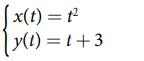
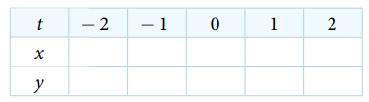
For the following exercises, graph each set of parametric equations by making a table of values. Include the orientation on the graph. x(t) = 1² |y(t)=1+3
For the following exercises, convert the given Cartesian coordinates to polar coordinates with r > 0, 0 ≤ θ <2π. Remember to consider the quadrant in which the given point is located.(4, 2)
For the following exercises, assume α is opposite side a, β is opposite side b, and γ is opposite side c. If possible, solve each triangle for the unknown side. Round to the nearest tenth.γ = 113°, b = 10, c = 32
For the following exercises, find the absolute value of the given complex number.2i
For the following exercises, determine whether the two vectors u and v are equal, where u has an initial point P1 and a terminal point P2 and v has an initial point P3 and a terminal point P4 .P1 = (−1, −1), P2 = (−4, 5), P3 = (−10, 6), and P4 = (−13,12)
For the following exercises, test the equation for symmetry.r = 2θ
Find the absolute value of the complex number 5 − 9i.
Write the complex number in polar form: 4 + i.
Test the equation for symmetry: r = − 4sin (2θ).
For the following exercises, test the equation for symmetry.r = 3 + 2sin θ
Compare right triangles and oblique triangles.
What does the absolute value of a complex number represent?
Given a vector with initial point (5, 2) and terminal point (−1,−3), find an equivalent vector whose initial point is (0, 0). Write the vector in component form 〈a, b〉.
Convert the polar equation to a Cartesian equation: x2 + y2 = 5y.
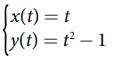
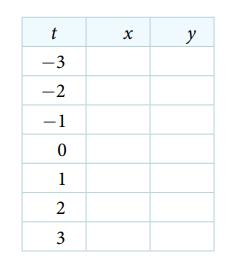
For the following exercises, graph each set of parametric equations by making a table of values. Include the orientation on the graph. [x(t) = t (y(t) = t²-1
For the following exercises, convert the given polar coordinates to Cartesian coordinates with r > 0 and 0 ≤ θ ≤2π. Remember to consider the quadrant in which the given point is located when determining θ for the point. (7, 7π/6)
For the following exercises, assume α is opposite side a, β is opposite side b, and γ is opposite side c. Solve each triangle, if possible. Round each answer to the nearest tenth.Solve the triangle, rounding to the nearest tenth, assuming α is opposite side a, β is opposite side b, and γ is
For the following exercises, find the absolute value of the given complex number. 5 + 3i
Given a vector with initial point (−4, 2) and terminal point (3,− 3), find an equivalent vector whose initial point is (0, 0). Write the vector in component form 〈a, b〉.
For the following exercises, test the equation for symmetry.r = 3 − 3cos θ
Convert to rectangular form and graph: r = − 3csc θ.
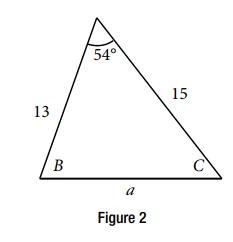
For the following exercises, assume α is opposite side a, β is opposite side b, and γ is opposite side c. Solve each triangle, if possible. Round each answer to the nearest tenth.Solve the triangle in Figure 2, rounding to the nearest tenth. 13 B 54° a Figure 2 15 C
For the following exercises, assume α is opposite side a, β is opposite side b, and γ is opposite side c. Solve each triangle, if possible. Round each answer to the nearest tenth.α = 35°, γ = 73°, c = 20
For the following exercises, find the absolute value of the given complex number.−7 + i
Given a vector with initial point (7,−1) and terminal point (−1,−7), find an equivalent vector whose initial point is (0, 0). Write the vector in component form 〈a, b〉.
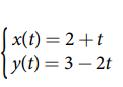
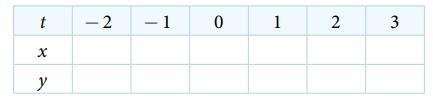
For the following exercises, graph each set of parametric equations by making a table of values. Include the orientation on the graph. x(t)=2+t [y(t) = 3-2t
For the following exercises, assume α is opposite side a, β is opposite side b, and γ is opposite side c. If possible, solve each triangle for the unknown side. Round to the nearest tenth.β = 58.7°, a = 10.6, c = 15.7
For the following exercises, convert the given polar coordinates to Cartesian coordinates with r > 0 and 0 ≤ θ ≤2π. Remember to consider the quadrant in which the given point is located when determining θ for the point.(6, −π/4)
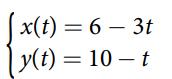
For the following exercises, eliminate the parameter t to rewrite the parametric equation as a Cartesian equation. x(t) = 6 - 3t |y(t) = 10-t
For the following exercises, assume α is opposite side a, β is opposite side b, and γ is opposite side c. Solve each triangle, if possible. Round each answer to the nearest tenth.Find the area of a triangle with sides of length 8.3, 6.6, and 9.1.
For the following exercises, assume α is opposite side a, β is opposite side b, and γ is opposite side c. Solve each triangle, if possible. Round each answer to the nearest tenth.α = 60°, β = 60°, γ = 60°
For the following exercises, find the absolute value of the given complex number.−3 − 3i
For the following exercises, determine whether the two vectors u and v are equal, where u has an initial point P1 and a terminal point P2 and v has an initial point P3 and a terminal point P4 .P1 = (5, 1), P2 = (3, −2), P3 = (−1, 3), and P4 = (9, −4)
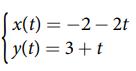
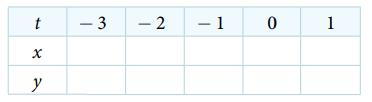
For the following exercises, graph each set of parametric equations by making a table of values. Include the orientation on the graph. x(t)=-2-2t y(t) = 3+ t
For the following exercises, assume α is opposite side a, β is opposite side b, and γ is opposite side c. If possible, solve each triangle for the unknown side. Round to the nearest tenth.γ = 115°, a = 18, b = 23
For the following exercises, test the equation for symmetry.r = 3sin 2θ
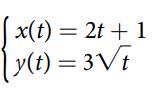
For the following exercises, eliminate the parameter t to rewrite the parametric equation as a Cartesian equation. x(t) = 2t + 1 |y(t) = 3√t
For the following exercises, convert the given polar coordinates to Cartesian coordinates with r > 0 and 0 ≤ θ ≤2π. Remember to consider the quadrant in which the given point is located when determining θ for the point.(−3, π/6)
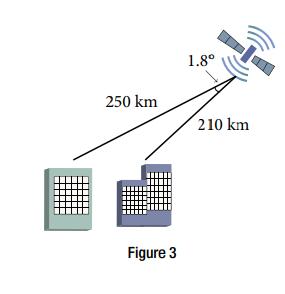
For the following exercises, assume α is opposite side a, β is opposite side b, and γ is opposite side c. Solve each triangle, if possible. Round each answer to the nearest tenth.To find the distance between two cities, a satellite calculates the distances and angle shown in Figure 3 (not to
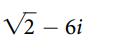
For the following exercises, find the absolute value of the given complex number. √2 – бі
Showing 5100 - 5200
of 8578
First
45
46
47
48
49
50
51
52
53
54
55
56
57
58
59
Last
Step by Step Answers

 Get 50% OFF
Claim Now
Get 50% OFF
Claim Now