New Semester
Started
Get
50% OFF
Study Help!
--h --m --s
Claim Now
Question Answers
Textbooks
Find textbooks, questions and answers
Oops, something went wrong!
Change your search query and then try again
S
Books
FREE
Study Help
Expert Questions
Accounting
General Management
Mathematics
Finance
Organizational Behaviour
Law
Physics
Operating System
Management Leadership
Sociology
Programming
Marketing
Database
Computer Network
Economics
Textbooks Solutions
Accounting
Managerial Accounting
Management Leadership
Cost Accounting
Statistics
Business Law
Corporate Finance
Finance
Economics
Auditing
Tutors
Online Tutors
Find a Tutor
Hire a Tutor
Become a Tutor
AI Tutor
AI Study Planner
NEW
Sell Books
Search
Search
Sign In
Register
study help
mathematics
precalculus 1st
Precalculus 1st Edition Jay Abramson - Solutions
Use the definition of a logarithm to find the exact solution for 4log(2n) − 7 = −11.
For the following exercises, solve each equation by rewriting the exponential expression using the indicated logarithm. Then use a calculator to approximate the variable to 3 decimal places.1000(1.03)t = 5000 using the common log.
For the following exercises, solve each equation by rewriting the exponential expression using the indicated logarithm. Then use a calculator to approximate the variable to 3 decimal places.e5x = 17 using the natural log
For the following exercises, solve each equation by rewriting the exponential expression using the indicated logarithm. Then use a calculator to approximate the variable to 3 decimal places.3(1.04)3t = 8 using the common log
For the following exercises, solve each equation by rewriting the exponential expression using the indicated logarithm. Then use a calculator to approximate the variable to 3 decimal places.34x−5 = 38 using the common log
For the following exercises, solve each equation by rewriting the exponential expression using the indicated logarithm. Then use a calculator to approximate the variable to 3 decimal places.50e−0.12t = 10 using the natural log
For the following exercises, use a calculator to solve the equation. Unless indicated otherwise, round all answers to the nearest ten-thousandth.7e3x − 5 + 7.9 = 47
For the following exercises, use a calculator to solve the equation. Unless indicated otherwise, round all answers to the nearest ten-thousandth.ln(3) + ln(4.4x + 6.8) = 2
For the following exercises, use a calculator to solve the equation. Unless indicated otherwise, round all answers to the nearest ten-thousandth.log(−0.7x − 9) = 1 + 5log(5)
For the following exercises, use a calculator to solve the equation. Unless indicated otherwise, round all answers to the nearest ten-thousandth.Atmospheric pressure P in pounds per square inch is represented by the formula P = 14.7e−0.21x, where x is the number of miles above sea level. To the
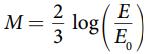
Unless indicated otherwise, round all answers to the nearest ten-thousandth.The magnitude M of an earthquake is represented by the equation where E is the amount of energy released by the earthquake in joules and E0 = 104.4 is the assigned minimal measure released by an earthquake. To the
Use the definition of a logarithm along with the one to-one property of logarithms to prove that blogbx = x.
Recall the formula for continually compounding interest, y = Aekt. Use the definition of a logarithm along with properties of logarithms to solve the formula for time t such that t is equal to a single logarithm.
Recall the compound interest formula A = a (1 + r/k)kt. Use the definition of a logarithm along with properties of logarithms to solve the formula for time t.
For the following exercises, use a graphing utility to create a scatter diagram of the data given in the table. Observe the shape of the scatter diagram to determine whether the data is best described by an exponential, logarithmic, or logistic model. Then use the appropriate regression feature to
Kyoko has $10,000 that she wants to invest. Her bank has several investment accounts to choose from, all compounding daily. Her goal is to have $15,000 by the time she finishes graduate school in 6 years. To the nearest hundredth of a percent, what should her minimum annual interest rate be in
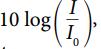
For the following exercises, solve for the indicated value, and graph the situation showing the solution point.The formula for measuring sound intensity in decibels D is defined by the equation D = where I is the intensity of the sound in watts per square meter and I0 = 10−12 is the lowest level
Alyssa opened a retirement account with 7.25% APR in the year 2000. Her initial deposit was $13,500. How much will the account be worth in 2025 if interest compounds monthly? How much more would she make if interest compounded continuously?
For the following exercises, solve for the indicated value, and graph the situation showing the solution point.The population of a small town is modeled by the equation P = 1650e0.5t where t is measured in years. In approximately how many years will the town’s population reach 20,000?
For the following exercises, use a graphing utility to create a scatter diagram of the data given in the table. Observe the shape of the scatter diagram to determine whether the data is best described by an exponential, logarithmic, or logistic model. Then use the appropriate regression feature to
For the following exercises, use a graphing utility to create a scatter diagram of the data given in the table. Observe the shape of the scatter diagram to determine whether the data is best described by an exponential, logarithmic, or logistic model. Then use the appropriate regression feature to
An investment account with an annual interest rate of 7% was opened with an initial deposit of $4,000. Compare the values of the account after 9 years when the interest is compounded annually, quarterly,monthly, and continuously.
Newton’s Law of Cooling states that the temperature T of an object at any time t can be described by the equation T = Ts + (T0 − Ts )e−kt, where Ts is the temperature of the surrounding environment, T0 is the initial temperature of the object, and k is the cooling rate. Use the definition of
For the following exercises, enter the data from each table into a graphing calculator and graph the resulting scatter plots. Determine whether the data from the table would likely represent a function that is linear, exponential, or logarithmic. 1 f(x) 3.05 8 2 4.42 3 6.4 4 9.28 5 6 13.46
Is the following true: log3 (27)/log4 (1/64) = −1? Verify the result.
For the following exercises, solve the equation for x, if there is a solution. Then graph both sides of the equation, and observe the point of intersection (if it exists) to verify the solution.log9 (3 − x) = log9 (4x − 8)
For the following exercises, rewrite each equation in logarithmic form.ek = h
For the following exercises, use the definition of a logarithm to solve the equation.10 − 4ln(9 − 8x) = 6
For the following exercises, sketch the graphs of each pair of functions on the same axis. f(x) = log(x) and g(x) = log (x) 2
For the following exercises, use the change-of-base formula to evaluate each expression as a quotient of natural logs. Use a calculator to approximate each to five decimal places.log6 (5.38)
For the following exercises, solve for x by converting the logarithmic equation to exponential form.log18 (x) = 2
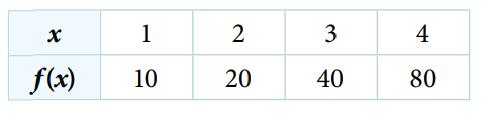
For the following exercises, determine whether the table could represent a function that is linear, exponential, or neither. If it appears to be exponential, find a function that passes through the points. x f(x) 1 10 2 20 3 40 4 80
For the following exercises, solve for x by converting the logarithmic equation to exponential form.log3 (x) = 2
For the following exercises, suppose log5 (6) = a and log5 (11) = b. Use the change-of-base formula along with properties of logarithms to rewrite each expression in terms of a and b. Show the steps for solving.log11(5)
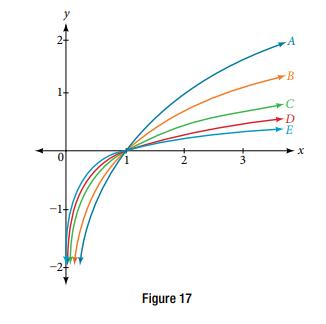
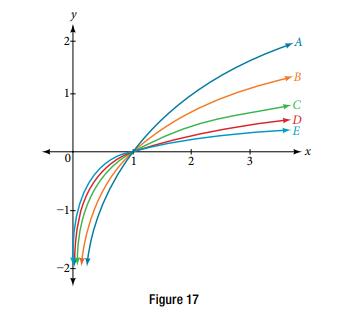
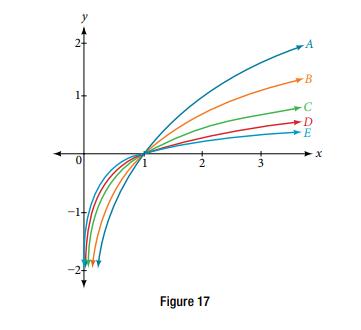
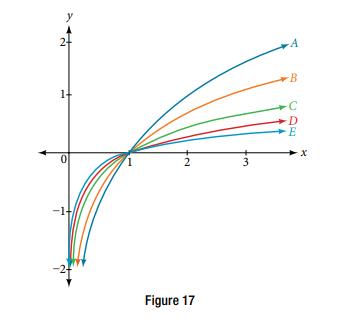
For the following exercises, match each function in Figure 17 with the letter corresponding to its graph.f(x) = ln(x) y 2- 14 0 -1+ 2 Figure 17 3 A B C D E
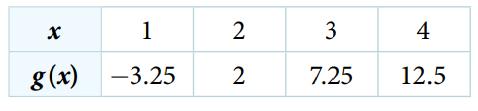
For the following exercises, determine whether the table could represent a function that is linear, exponential, or neither. If it appears to be exponential, find a function that passes through the points. 1 g(x) -3.25 2 2 3 7.25 4 12.5
For the following exercises, use logarithms to solve.e2x − ex − 6 = 0
For the following exercises, graph the transformation of f(x) = 2x. Give the horizontal asymptote, the domain, and the range.h(x) = 2x + 3
For the following exercises, solve for x by converting the logarithmic equation to exponential form.log2 (x) = −3
For the following exercises, suppose log5 (6) = a and log5 (11) = b. Use the change-of-base formula along with properties of logarithms to rewrite each expression in terms of a and b. Show the steps for solving.log6 (55)
For the following exercises, match each function in Figure 17 with the letter corresponding to its graph.g(x) = log2 (x) y 2+ 1+ 0 -1+ 2 Figure 17 3 A B D E x
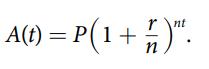
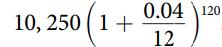
For the following exercises, use the compound interest formula, After a certain number of years, the value of an investment account is represented by the equation What is the value of the account? A(t) = P(1 + 7)". r nt
For the following exercises, use logarithms to solve.3e3 − 3x + 6 = −31
For the following exercises, match each function in Figure 17 with the letter corresponding to its graph.h(x) = log5 (x) 2+ 14 0 -14 2 Figure 17 3 B -C D E X
For the following exercises, graph the transformation of f(x) = 2x. Give the horizontal asymptote, the domain, and the range.f(x) = 2x − 2
For the following exercises, solve for x by converting the logarithmic equation to exponential form.log5 (x) = 2
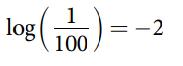
For the following exercises, use the definition of a logarithm to rewrite the equation as an exponential equation. log (100) = -2
For the following exercises, suppose log5 (6) = a and log5 (11) = b. Use the change-of-base formula along with properties of logarithms to rewrite each expression in terms of a and b. Show the steps for solving.log11 (6/11)
For the following exercises, use the compound interest formula, What was the initial deposit made to the account in the previous exercise? A(t) = P(1 + 7)". r nt
For the following exercises, match each function in Figure 17 with the letter corresponding to its graph.j(x) = log25(x) 2 1+ 0 -14 2 Figure 17 3 A B C D E X
For the following exercises, describe the end behavior of the graphs of the functions.f(x) = −5(4)x − 1
For the following exercises, solve for x by converting the logarithmic equation to exponential form.log3 (x) = 3
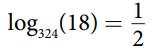
For the following exercises, use the definition of a logarithm to rewrite the equation as an exponential equation. 1 log324 (18) = 2
For the following exercises, use properties of logarithms to evaluate without using a calculator.log3 (1/9) − 3log3 (3)
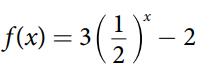
For the following exercises, describe the end behavior of the graphs of the functions. f(x) = 3 ( ¹ ) * - 2 - 2
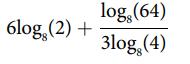
For the following exercises, use properties of logarithms to evaluate without using a calculator. 6log(2) + log, (64) 3logg (4)
For the following exercises, use the compound interest formula, How many years had the account from the previous exercise been accumulating interest? A(t) = P(1 + 7)". r nt
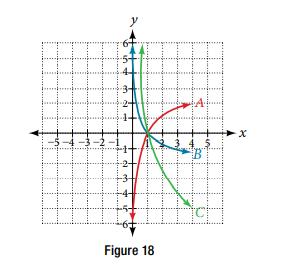
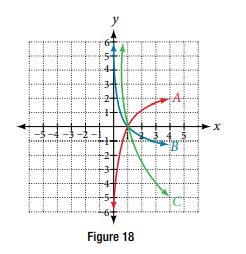
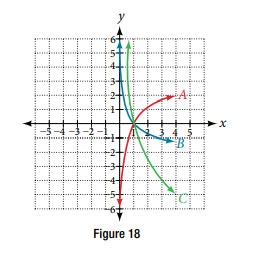
For the following exercises, match each function in Figure 18 with the letter corresponding to its graph. f(x) = log1/3 (x) -5-4-3-2-1 Figure 18 -X
For the following exercises, solve for x by converting the logarithmic equation to exponential form.log2 (x) = 6
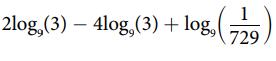
For the following exercises, use properties of logarithms to evaluate without using a calculator. 2log,(3) — 4log,(3) + log, (729) -
For the following exercises, use the definition of a logarithm to solve the equation.5log7 (n) = 10
For the following exercises, use the compound interest formula, An account is opened with an initial deposit of $6,500 and earns 3.6% interest compounded semi-annually. What will the account be worth in 20 years? A(t) = P(1 + 7)". r nt
For the following exercises, describe the end behavior of the graphs of the functions.f(x) = 3(4)−x + 2
For the following exercises, solve for x by converting the logarithmic equation to exponential form.log9 (x) = 1/2
For the following exercises, match each function in Figure 18 with the letter corresponding to its graph.g(x) = log2 (x) Figure 18 3 4 5 -x
For the following exercises, use the definition of a logarithm to solve the equation.−8log9 (x) = 16
For the following exercises, use the compound interest formula, How much more would the account in the previous exercise have been worth if the interest were compounding weekly? A(t) = P(1 + 7)". r nt
For the following exercises, start with the graph of f(x) = 4x. Then write a function that results from the given transformation.Shift f(x) 4 units upward
For the following exercises, match each function in Figure 18 with the letter corresponding to its graph.h(x) = log 3/4 (x) 5+ Figure 18 34
For the following exercises, use the change-of-base formula to evaluate each expression as a quotient of natural logs. Use a calculator to approximate each to five decimal places.log3 (22)
For the following exercises, use the definition of a logarithm to solve the equation.4 + log2 (9k) = 2
For the following exercises, use the compound interest formula, Solve the compound interest formula for the principal, P. A(t) = P(1 + 7)". r nt
For the following exercises, start with the graph of f(x) = 4x. Then write a function that results from the given transformation.Shift f(x) 3 units downward
For the following exercises, solve for x by converting the logarithmic equation to exponential form.log6 (x) = −3
For the following exercises, use the change-of-base formula to evaluate each expression as a quotient of natural logs. Use a calculator to approximate each to five decimal places.log8 (65)
For the following exercises, sketch the graphs of each pair of functions on the same axis.f(x) = log(x) and g(x) = 10x
For the following exercises, use the definition of a logarithm to solve the equation.2log(8n + 4) + 6 = 10
For the following exercises, start with the graph of f(x) = 4x. Then write a function that results from the given transformation.Shift f(x) 2 units left
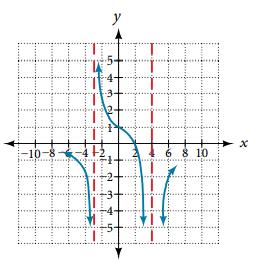
For the following exercises, use the graphs to write an equation for the function. IIIT 2000 -10-8-- y انا - انا el m S5 DII 6 8 10 x
For the following exercises, solve for x by converting the logarithmic equation to exponential form.log(x) = 3
For the following exercises, determine the function described and then use it to answer the question.The period T, in seconds, of a simple pendulum as a function of its length l, in feet, is given by T(l) = 2π√l/32.2 . Express l as a function of T and determine the length of a pendulum with
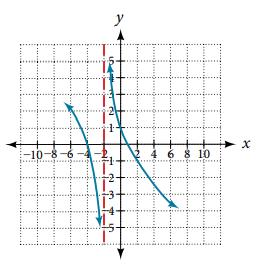
For the following exercises, use the graphs to write an equation for the function. -10-8-6-4- II y PI HE 4 6 8 10 IITO X
For the following exercises, use your calculator to graph the polynomial function. Based on the graph, find the rational zeros. All real solutions are rational.f(x) = 4x3 − 4x2 − 13x − 5
For the following exercises, use your calculator to graph the polynomial function. Based on the graph, find the rational zeros. All real solutions are rational.f(x) = 8x3 − 6x2 − 23x + 6
For the following exercises, write the equation of the quadratic function that contains the given point and has the same shape as the given function.Contains (1, −6) has the shape of f(x) = 3x2 . Vertex has x-coordinate of −1.
The Oxford Dictionary defines the word nominal as a value that is “stated or expressed but not necessarily corresponding exactly to the real value.” Develop a reasonable argument for why the term nominal rate is used to describe the annual percentage rate of an investment account that compounds
For the following exercises, state the domain and range of the function.f(x) = log2 (12 − 3x) − 3
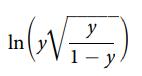
For the following exercises, use the properties of logarithms to expand each logarithm as much as possible. Rewrite each expression as a sum, difference, or product of logs. In y 1-y
For the following exercises, condense to a single logarithm if possible.ln(a) − ln(d) − ln(c)
For the following exercises, state the domain, vertical asymptote, and end behavior of the function.h(x) = −log(3x − 4) + 3
For the following exercises, use logarithms to solve.−5e9x − 8 − 8 = −62
For the following exercises, rewrite each equation in logarithmic form.m−7 = n
For the following exercises, condense each expression to a single logarithm using the properties of logarithms.ln(6x9) − ln(3x2)
For the following exercises, state the domain, range, and x- and y-intercepts, if they exist. If they do not exist, write DNE.h(x) = log4 (x − 1) + 1
For the following exercises, use logarithms to solve.e2x − ex − 132 = 0
For the following exercises, rewrite each equation in logarithmic form.n4 = 103
For the following exercises, find the formula for an exponential function that passes through the two points given.(−2, 6) and (3, 1)
For the following exercises, condense each expression to a single logarithm using the properties of logarithms.2log(x) + 3log(x + 1)
For the following exercises, state the domain, range, and x- and y-intercepts, if they exist. If they do not exist, write DNE.f(x) = log(5x + 10) + 3
For the following exercises, state the domain, range, and x- and y-intercepts, if they exist. If they do not exist, write DNE.g(x) = ln(−x) − 2
Showing 6700 - 6800
of 8578
First
61
62
63
64
65
66
67
68
69
70
71
72
73
74
75
Last
Step by Step Answers

 Get 50% OFF
Claim Now
Get 50% OFF
Claim Now