New Semester
Started
Get
50% OFF
Study Help!
--h --m --s
Claim Now
Question Answers
Textbooks
Find textbooks, questions and answers
Oops, something went wrong!
Change your search query and then try again
S
Books
FREE
Study Help
Expert Questions
Accounting
General Management
Mathematics
Finance
Organizational Behaviour
Law
Physics
Operating System
Management Leadership
Sociology
Programming
Marketing
Database
Computer Network
Economics
Textbooks Solutions
Accounting
Managerial Accounting
Management Leadership
Cost Accounting
Statistics
Business Law
Corporate Finance
Finance
Economics
Auditing
Tutors
Online Tutors
Find a Tutor
Hire a Tutor
Become a Tutor
AI Tutor
AI Study Planner
NEW
Sell Books
Search
Search
Sign In
Register
study help
mathematics
precalculus 1st
Precalculus 1st Edition Jay Abramson - Solutions
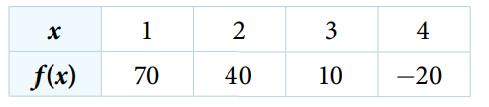
For the following exercises, determine whether the table could represent a function that is linear, exponential, or neither. If it appears to be exponential, find a function that passes through the points. ४ f(x) 1 70 2 40 3 10 4 -20
For the following exercises, use logarithms to solve.10e8x + 3 + 2 = 8
For the following exercises, graph the function and its reflection about the x-axis on the same axes.f(x) = 1/2 (4)x
For the following exercises, rewrite each equation in logarithmic form.yx = 39/100
For the following exercises, state the domain, range, and x- and y-intercepts, if they exist. If they do not exist, write DNE.f(x) = log2 (x + 2) − 5
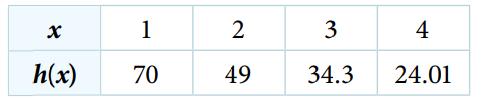
For the following exercises, determine whether the table could represent a function that is linear, exponential, or neither. If it appears to be exponential, find a function that passes through the points. x h(x) 1 70 2 49 3 34.3 4 24.01
For the following exercises, use logarithms to solve.4e3x + 3 − 7 = 53
For the following exercises, graph the function and its reflection about the x-axis on the same axes.f(x) = 3(0.75)x − 1
For the following exercises, rewrite each expression as an equivalent ratio of logs using the indicated base.log7 (15) to base e
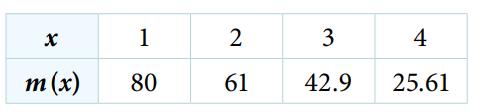
For the following exercises, determine whether the table could represent a function that is linear, exponential, or neither. If it appears to be exponential, find a function that passes through the points. m (x) 1 80 2 61 3 42.9 4 25.61
For the following exercises, use logarithms to solve.8e−5x − 2 − 4 = −90
For the following exercises, graph the function and its reflection about the x-axis on the same axes.f(x) = −4(2)x + 2
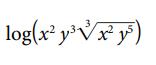
For the following exercises, use the properties of logarithms to expand each logarithm as much as possible. Rewrite each expression as a sum, difference, or product of logs. log(x²y³√x²y³)
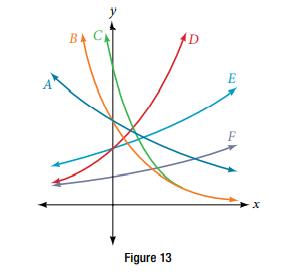
For the following exercises, use the graphs shown in Figure 13. All have the form f(x) = abx .Which graph has the largest value for a? BA CN Figure 13 D E
For the following exercises, find the formula for an exponential function that passes through the two points given.(0, 6) and (3, 750)
For the following exercises, state the domain, vertical asymptote, and end behavior of the function.g(x) = ln(2x + 6) − 5
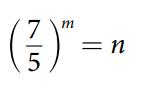
For the following exercises, rewrite each equation in logarithmic form. 7 5 m ( = n
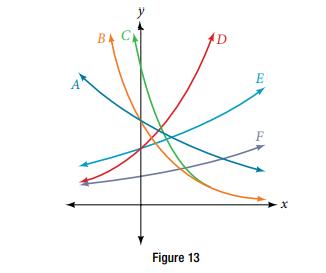
For the following exercises, use the graphs shown in Figure 13. All have the form f(x) = abx.Which graph has the smallest value for a? BAC Figure 13 D E
For the following exercises, use logarithms to solve.7e8x + 8 − 5 = −95
For the following exercises, find the formula for an exponential function that passes through the two points given.(3, 1) and (5, 4)
For the following exercises, condense each expression to a single logarithm using the properties of logarithms.log(x) −1/2 log(y) + 3log(z)
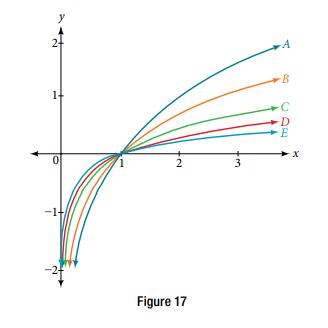
For the following exercises, match each function in Figure 17 with the letter corresponding to its graph.d(x) = log(x) 2+ 1+ 0 -14 2 Figure 17 3 A B C -D E x
For the following exercises, condense each expression to a single logarithm using the properties of logarithms.4log7 (c) + log7 (a)/3 + log7 (b)/3
For the following exercises, rewrite each equation in logarithmic form.10a = b
For the following exercises, state the domain, range, and x- and y-intercepts, if they exist. If they do not exist, write DNE.h(x) = 3ln(x) − 9
For the following exercises, rewrite each expression as an equivalent ratio of logs using the indicated base.log14(55.875) to base 10
For the following exercises, use logarithms to solve.32x + 1 = 7x − 2
For the following exercises, graph the transformation of f(x) = 2x. Give the horizontal asymptote, the domain, and the range.f(x) = 2−x
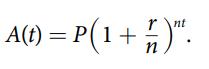
For the following exercises, use the compound interest formula, Use the formula found in Exercise #31 to calculate the initial deposit of an account that is worth $14,472.74 after earning 5.5% interest compounded monthly for 5 years. (Round to the nearest dollar.) A(t) = P(1 + 7)". r nt
For the following exercises, evaluate the expressions, writing the result as a simplified complex number. 1 21
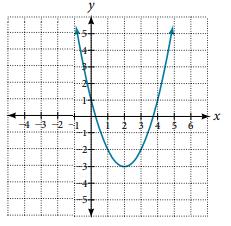
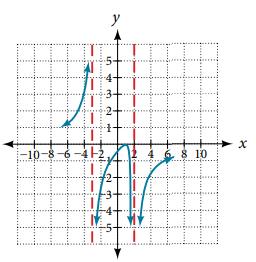
For the following exercises, write the equation for the graphed function. ܼܿ 3-2 143 5
For the following exercises, list all possible rational zeros for the functions.f(x) = 3x3 + 5x2 − 5x + 4
For the following exercises, use the given information about the polynomial graph to write the equation.Degree 5. Roots of multiplicity 2 at x = 3 and x = 1, and a root of multiplicity 1 at x = −3. y-intercept at (0, 9)
For the following exercises, use synthetic division to determine the quotient involving a complex number.x + 1/x − i
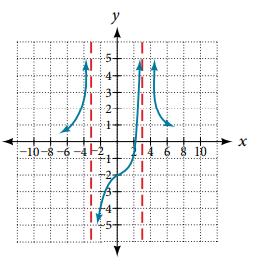
For the following exercises, use the graphs to write an equation for the function. -10-8-6 y 321 5 45 5- 6 8 10 II x
For the following exercises, determine the function described and then use it to answer the question.The volume, V, of a sphere in terms of its radius, r, is given by V(r) = 4/3 πr3 . Express r as a function of V, and find the radius of a sphere with volume of 200 cubic feet.
For the following exercises, graph the polynomial functions using a calculator. Based on the graph, determine the intercepts and the end behavior.f(x) = x3 − 2x2 − 15x
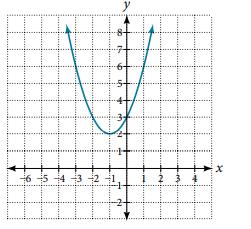
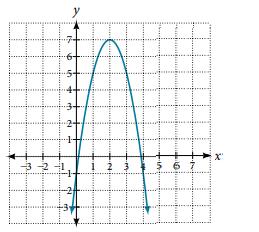
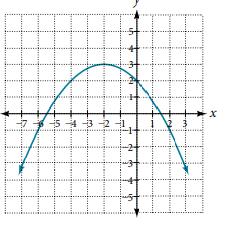
For the following exercises, write the equation for the graphed function. -6-5-4-3-2-1 У
For the following exercises, use the given information to answer the questions.The horsepower (hp) that a shaft can safely transmit varies jointly with its speed (in revolutions per minute (rpm)) and the cube of the diameter. If the shaft of a certain material 3 inches in diameter can transmit 45
For the following exercises, list all possible rational zeros for the functions.f(x) = 6x4 − 10x2 + 13x + 1
For the following exercises, use the given information about the polynomial graph to write the equation.Degree 4. Root of multiplicity 2 at x = 4, and roots of multiplicity 1 at x = 1 and x = −2. y-intercept at (0, −3).
For the following exercises, use synthetic division to determine the quotient involving a complex number.x2 + 1/x − i
For the following exercises, determine the function described and then use it to answer the question.The surface area, A, of a sphere in terms of its radius, r, is given by A(r) = 4πr2 . Express r as a function of V, and find the radius of a sphere with a surface area of 1000 square inches.
For the following exercises, graph the polynomial functions using a calculator. Based on the graph, determine the intercepts and the end behavior.f(x) = x3 − 0.01x
For the following exercises, use the given information to answer the questions.The kinetic energy K of a moving object varies jointly with its mass m and the square of its velocity v. If an object weighing 40 kilograms with a velocity of 15 meters per second has a kinetic energy of 1000 joules,
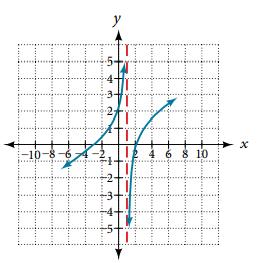
For the following exercises, write the equation for the graphed function. IS 3-2-1 in + m III 5 6 *
For the following exercises, list all possible rational zeros for the functions.f(x) = 4x5 − 10x4 + 8x3 + x2 − 8
For the following exercises, use the given information about the polynomial graph to write the equation.Degree 5. Double zero at x = 1, and triple zero at x = 3. Passes through the point (2, 15).
For the following exercises, use the graphs to write an equation for the function. -10-8-6. النا نا -2- [III. 4 6 8 10 x
For the following exercises, use synthetic division to determine the quotient involving a complex number.x + 1/x + i
For the following exercises, determine the function described and then use it to answer the question.A container holds 100 ml of a solution that is 25 ml acid. If n ml of a solution that is 60% acid is added, the function C(n) = 25 + 0.6n/100 + n gives the concentration, C, as a function of the
For the following exercises, use the information about the graph of a polynomial function to determine the function. Assume the leading coefficient is 1 or −1. There may be more than one correct answer.The y-intercept is (0, −4). The x-intercepts are (−2, 0), (2, 0). Degree is 2. End
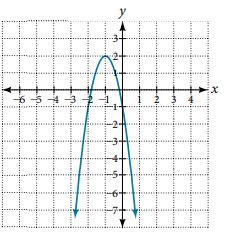
For the following exercises, write the equation for the graphed function. &&&& II II x
For the following exercises, use your calculator to graph the polynomial function. Based on the graph, find the rational zeros. All real solutions are rational.f(x) = 6x3 − 7x2 + 1
For the following exercises, use the given information about the polynomial graph to write the equation.Degree 3. Zeros at x = 4, x = 3, and x = 2. y-intercept at (0, −24).
For the following exercises, use synthetic division to determine the quotient involving a complex number.x2 + 1/x + i
For the following exercises, use the information about the graph of a polynomial function to determine the function. Assume the leading coefficient is 1 or −1. There may be more than one correct answer.The y-intercept is (0, 9). The x-intercepts are (−3, 0), (3, 0). Degree is 2. End behavior:
For the following exercises, use the given information about the polynomial graph to write the equation.Degree 3. Zeros at x = −3, x = −2 and x = 1. y-intercept at (0, 12).
For the following exercises, use synthetic division to determine the quotient involving a complex number.x3 + 1/x − i
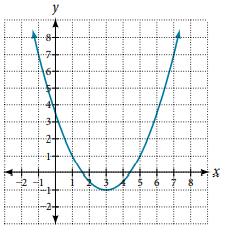
For the following exercises, write the equation for the graphed function. -2-1 D X
For the following exercises, use the graphs to write an equation for the function. II y תי 32 3 -10-8-6-4-2. -3- TH HII 4 6 8 10 II x
For the following exercises, determine the function described and then use it to answer the question.The volume of a cylinder, V, in terms of radius, r, and height, h, is given by V = πr2 h. If a cylinder has a height of 6 meters, express the radius as a function of V and find the radius of a
For the following exercises, use the information about the graph of a polynomial function to determine the function. Assume the leading coefficient is 1 or −1. There may be more than one correct answer.The y-intercept is (0, 0). The x-intercepts are (0, 0), (2, 0). Degree is 3. End behavior: as x
For the following exercises, use the given information about the polynomial graph to write the equation.Degree 5. Roots of multiplicity 2 at x = −3 and x = 2 and a root of multiplicity 1 at x=−2. y-intercept at (0, 4).
For the following exercises, write the equation for the graphed function. - - - myn wi -
For the following exercises, use the graphs to write an equation for the function. F -10-8-6 1 UT [I 6 8 10 II x
For the following exercises, use the given length and area of a rectangle to express the width algebraically.Length is x + 5, area is 2x2 + 9x − 5.
For the following exercises, determine the function described and then use it to answer the question.The surface area, A, of a cylinder in terms of its radius, r, and height, h, is given by A = 2πr2 + 2πrh. If the height of the cylinder is 4 feet, express the radius as a function of V and find
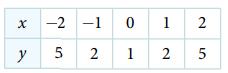
For the following exercises, use the table of values that represent points on the graph of a quadratic function. By determining the vertex and axis of symmetry, find the general form of the equation of the quadratic function. y -2 -1 0 1 5 2 1 2 2 5
For the following exercises, use the information about the graph of a polynomial function to determine the function. Assume the leading coefficient is 1 or −1. There may be more than one correct answer.The y-intercept is (0, 1). The x-intercept is (1, 0). Degree is 3. End behavior: as x →
For the following exercises, use your calculator to graph the polynomial function. Based on the graph, find the rational zeros. All real solutions are rational.f(x) = 12x4 + 55x3 + 12x2 − 117x + 54
For the following exercises, use the given information about the polynomial graph to write the equation.Degree 4. Roots of multiplicity 2 at x = 1/2 and roots of multiplicity 1 at x = 6 and x = −2. y-intercept at (0,18).
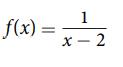
For the following exercises, make tables to show the behavior of the function near the vertical asymptote and reflecting the horizontal asymptote. f(x)= = 1 x-2
For the following exercises, use the given length and area of a rectangle to express the width algebraically. Length is 2x + 5, area is 4x3 + 10x2 + 6x + 15
For the following exercises, determine the function described and then use it to answer the question.The volume of a right circular cone, V, in terms of its radius, r, and its height, h, is given by V = 1/3 πr2h. Express r in terms of h if the height of the cone is 12 feet and find the radius of a
For the following exercises, use the table of values that represent points on the graph of a quadratic function. By determining the vertex and axis of symmetry, find the general form of the equation of the quadratic function. x y -2 -1 1 0 012 1 4 9
For the following exercises, use the information about the graph of a polynomial function to determine the function. Assume the leading coefficient is 1 or −1. There may be more than one correct answer.The y-intercept is (0, 1). There is no x-intercept. Degree is 4. End behavior: as x → −∞,
For the following exercises, use your calculator to graph the polynomial function. Based on the graph, find the rational zeros. All real solutions are rational.f(x) = 16x4 − 24x3 + x2 − 15x + 25
For the following exercises, use the given information about the polynomial graph to write the equation.Double zero at x = −3 and triple zero at x = 0. Passes through the point (1, 32).
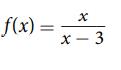
For the following exercises, make tables to show the behavior of the function near the vertical asymptote and reflecting the horizontal asymptote. f(x)= X x-3
For the following exercises, use the given length and area of a rectangle to express the width algebraically. Length is 3x − 4, area is 6x4 − 8x3 + 9x2 − 9x − 4
Consider a cone with height of 30 feet. Express theradius, r, in terms of the volume, V, and find the radius of a cone with volume of 1000 cubic feet.
For the following exercises, use the written statements to construct a polynomial function that represents the required information.An oil slick is expanding as a circle. The radius of the circle is increasing at the rate of 20 meters per day. Express the area of the circle as a function of d, the
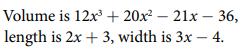
For the following exercises, use the given volume of a box and its length and width to express the height of the box algebraically. Volume is 12x³ + 20x² - 21x - 36, length is 2x + 3, width is 3x - 4.
For the following exercises, construct a polynomial function of least degree possible using the given information.Real roots: −1, 1, 3 and (2, f(2)) = (2, 4)
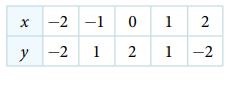
For the following exercises, use the table of values that represent points on the graph of a quadratic function. By determining the vertex and axis of symmetry, find the general form of the equation of the quadratic function. -2 y -2 ४ 0 1 1 2 1 -1 2 -2
For the following exercises, use a calculator to approximate local minima and maxima or the global minimum and maximum.f(x) = x3 − x − 1
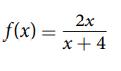
For the following exercises, make tables to show the behavior of the function near the vertical asymptote and reflecting the horizontal asymptote. f(x)= 2x x + 4
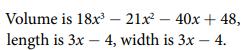
For the following exercises, use the given volume of a box and its length and width to express the height of the box algebraically. Volume is 18x³ - 21x² 40x + 48, - length is 3x4, width is 3x - 4.
For the following exercises, use the written statements to construct a polynomial function that represents the required information.A cube has an edge of 3 feet. The edge is increasing at the rate of 2 feet per minute. Express the volume of the cube as a function of m, the number of minutes elapsed.
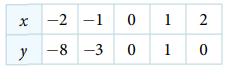
For the following exercises, use the table of values that represent points on the graph of a quadratic function. By determining the vertex and axis of symmetry, find the general form of the equation of the quadratic function. ४ y -2 -1 -8-3 0 1 0 1 2 0
For the following exercises, construct a polynomial function of least degree possible using the given information.Real roots: −1, 1 (with multiplicity 2 and 1) and (2, f (2)) = (2, 4)
For the following exercises, use a calculator to approximate local minima and maxima or the global minimum and maximum.f(x) = 2x3 − 3x − 1
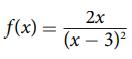
For the following exercises, make tables to show the behavior of the function near the vertical asymptote and reflecting the horizontal asymptote. 2x = (x - 3)² f(x)=
For the following exercises, use the written statements to construct a polynomial function that represents the required information.A rectangle has a length of 10 inches and a width of 6 inches. If the length is increased by x inches and the width increased by twice that amount, express the area of
For the following exercises, construct a polynomial function of least degree possible using the given information.Real roots: −2, 1/2 (with multiplicity 2) and (−3, f(−3)) = (−3, 5)
For the following exercises, use a calculator to approximate local minima and maxima or the global minimum and maximum.f(x) = x4 + x
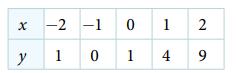
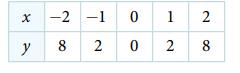
For the following exercises, use the table of values that represent points on the graph of a quadratic function. By determining the vertex and axis of symmetry, find the general form of the equation of the quadratic function. X -2 -1 -1 y 8 2 0 1 02 2 8
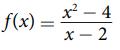
For the following exercises, identify the removable discontinuity. f(x): = x² - 4 x-2
For the following exercises, use the given volume of a box and its length and width to express the height of the box algebraically.Volume is 10x3 + 27x2 + 2x − 24, length is 5x − 4, width is 2x + 3.
Showing 6800 - 6900
of 8578
First
62
63
64
65
66
67
68
69
70
71
72
73
74
75
76
Last
Step by Step Answers

 Get 50% OFF
Claim Now
Get 50% OFF
Claim Now