New Semester
Started
Get
50% OFF
Study Help!
--h --m --s
Claim Now
Question Answers
Textbooks
Find textbooks, questions and answers
Oops, something went wrong!
Change your search query and then try again
S
Books
FREE
Study Help
Expert Questions
Accounting
General Management
Mathematics
Finance
Organizational Behaviour
Law
Physics
Operating System
Management Leadership
Sociology
Programming
Marketing
Database
Computer Network
Economics
Textbooks Solutions
Accounting
Managerial Accounting
Management Leadership
Cost Accounting
Statistics
Business Law
Corporate Finance
Finance
Economics
Auditing
Tutors
Online Tutors
Find a Tutor
Hire a Tutor
Become a Tutor
AI Tutor
AI Study Planner
NEW
Sell Books
Search
Search
Sign In
Register
study help
mathematics
precalculus
Precalculus Concepts Through Functions A Unit Circle Approach To Trigonometry 5th Edition Michael Sullivan - Solutions
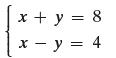
In Problems 39–74, solve each system of equations using matrices (row operations). If the system has no solution, say that it is inconsistent. x + y = 8 x - y = 4
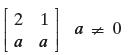
In Problems 35 – 44, each matrix is nonsingular. Find the inverse of each matrix. 0 D = 10 2 1
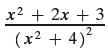
In Problems 17–50, find the partial fraction decomposition of each rational expression. x² + 2x + 3 2 2 (x² + 4)² 2
Problems 34–43. The purpose of these problems is to keep the material fresh in your mind so that you are better prepared for later sections, a final exam, or subsequent courses such as calculus.The sum of two numbers is 16. If the larger number is 4 less than 3 times the smaller number, find the
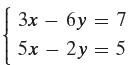
In Problems 19–56, solve each system of equations. If the system has no solution, state that it is inconsistent. For Problems 19–30, graph the lines of the system. = 7 = 3x-6y 5x-2y = 5
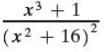
In Problems 17–50, find the partial fraction decomposition of each rational expression. x³ + 1 (x² + 16)² દર્દી
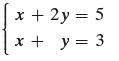
In Problems 39–74, solve each system of equations using matrices (row operations). If the system has no solution, say that it is inconsistent. x + 2y = 5 x + y = 3
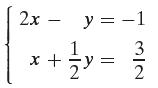
In Problems 19–56, solve each system of equations. If the system has no solution, state that it is inconsistent. For Problems 19–30, graph the lines of the system. 2x - y = -1 x + 1⁄2 y = 2
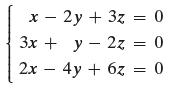
In Problems 15–42, solve each system of equations using Cramer’s Rule if it is applicable. If Cramer’s Rule is not applicable, write, “Not applicable.” x - 2y + 3z = 0 = 3x + y - у 2z 2z = 0 2x - 4y + 6z = 0
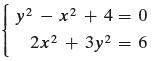
In Problems 25 – 54, solve each system. Use any method you wish. y2 – x2 + 4 = 0 2x² + 3y² = 6
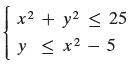
In Problems 35 – 42, graph each system of inequalities. x² + y² ≤ 25 + VI y ≤ x²-5
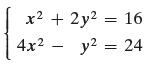
In Problems 25 – 54, solve each system. Use any method you wish. x² + 2y² = 16 y2 y² = 24 4x²
Problems 34–43. The purpose of these problems is to keep the material fresh in your mind so that you are better prepared for later sections, a final exam, or subsequent courses such as calculus.What amount must be invested at 4% interest compounded daily to have $15,000 in 3 years?
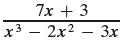
In Problems 17–50, find the partial fraction decomposition of each rational expression. 7x + 3 x3 - 2x² - 3x
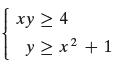
In Problems 35 – 42, graph each system of inequalities. xy > 4 y > x² + 1
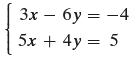
In Problems 39–74, solve each system of equations using matrices (row operations). If the system has no solution, say that it is inconsistent. 3x-бу = -4 5x +4y = 5
Problems 34–43. The purpose of these problems is to keep the material fresh in your mind so that you are better prepared for later sections, a final exam, or subsequent courses such as calculus. If f(x) = = 2x - 7 5x+1 find f-¹(x).
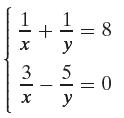
In Problems 19–56, solve each system of equations. If the system has no solution, state that it is inconsistent. For Problems 19–30, graph the lines of the system. 8 = ०९/ + = 0 I
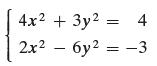
In Problems 25 – 54, solve each system. Use any method you wish. 4х2 + 3у2 = 4 2х2 - бу² = -3
In Problems 17–50, find the partial fraction decomposition of each rational expression. x 3 +1 - x4 x5
Problems 34–43. The purpose of these problems is to keep the material fresh in your mind so that you are better prepared for later sections, a final exam, or subsequent courses such as calculus.Find an equation of the ellipse that has vertices ( 0, ±5) and foci ( 0, ±3).
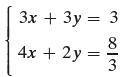
In Problems 39–74, solve each system of equations using matrices (row operations). If the system has no solution, say that it is inconsistent. 3x + 3y = 3 3 ∞013 4x + 2 =
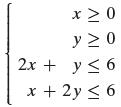
In Problems 43 – 52, graph each system of linear inequalities. State whether the graph is bounded or unbounded, and label the corner points. x > 0 y 20 2x + y ≤ 6 x + 2y ≤ 6
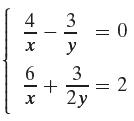
In Problems 19–56, solve each system of equations. If the system has no solution, state that it is inconsistent. For Problems 19–30, graph the lines of the system. 0 = د در | || 2y +
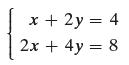
In Problems 39–74, solve each system of equations using matrices (row operations). If the system has no solution, say that it is inconsistent. x + 2y = 4 2x + 4y = 8
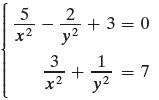
In Problems 25 – 54, solve each system. Use any method you wish. 5 x2 3 12 + +3=0 1 = 7
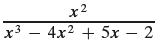
In Problems 17–50, find the partial fraction decomposition of each rational expression. x2 x3 4x2 + 5x - 2
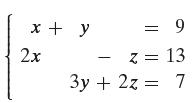
In Problems 19–56, solve each system of equations. If the system has no solution, state that it is inconsistent. For Problems 19–30, graph the lines of the system. x + y 2x 9 2 = 13 7 = 3y + 2z =
Problems 34–43. The purpose of these problems is to keep the material fresh in your mind so that you are better prepared for later sections, a final exam, or subsequent courses such as calculus.Factor completely: 30x2 ( x − 7)3/2 + 15x3 ( x − 7)1/2
Problems 34–43. The purpose of these problems is to keep the material fresh in your mind so that you are better prepared for later sections, a final exam, or subsequent courses such as calculus.Consider the functions f (x) = 1/3 x3 − 3x2 + 5x + 7 and f''(x) = 2x − 6. Given that f is concave
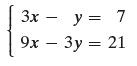
In Problems 39–74, solve each system of equations using matrices (row operations). If the system has no solution, say that it is inconsistent. 3x-y= y = 7 9x-3y = 21
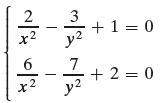
In Problems 25 – 54, solve each system. Use any method you wish. 2 x2 x2 3 7 y2 -+ 1 = 0 +2=0
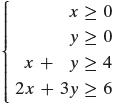
In Problems 43 – 52, graph each system of linear inequalities. State whether the graph is bounded or unbounded, and label the corner points. x>0 y ≥ 0 x + y 24 2x + 3y ≥ 6
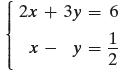
In Problems 39–74, solve each system of equations using matrices (row operations). If the system has no solution, say that it is inconsistent. 2x + 3y = 6 x - y = 1|2
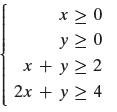
In Problems 43 – 52, graph each system of linear inequalities. State whether the graph is bounded or unbounded, and label the corner points. x ≥ 0 y ≥ 0 x + y 22 2x + y 24
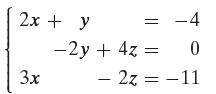
In Problems 19–56, solve each system of equations. If the system has no solution, state that it is inconsistent. For Problems 19–30, graph the lines of the system. 2x + у y 3x -2y +4z = -4 0 - 2z = -11
In Problems 17–50, find the partial fraction decomposition of each rational expression. x3 (x²+16)* 2 3
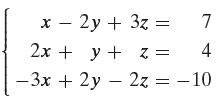
In Problems 19–56, solve each system of equations. If the system has no solution, state that it is inconsistent. For Problems 19–30, graph the lines of the system. x - 2y + 3z = 7 2x + y + z = 4 -3x + 2y - 2z = -10
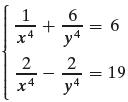
In Problems 25 – 54, solve each system. Use any method you wish. || + 19 ~|B
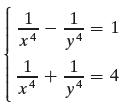
In Problems 25 – 54, solve each system. Use any method you wish. x4 X + 1 1 1 4
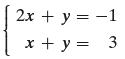
In Problems 45–64, use the inverses found in Problems 35–44 to solve each system of equations. 2x + y = -1 x +y = 3
In Problems 17–50, find the partial fraction decomposition of each rational expression. x² 2 (x² + 4)³
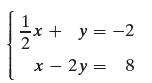
In Problems 39–74, solve each system of equations using matrices (row operations). If the system has no solution, say that it is inconsistent. x + y = -2 x - 2y = 8
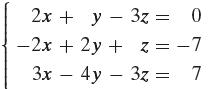
In Problems 19–56, solve each system of equations. If the system has no solution, state that it is inconsistent. For Problems 19–30, graph the lines of the system. 2x + y - 3z = 0 -2x+2y +z=-1 3x-4y -3z = 7
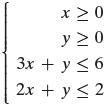
In Problems 43 – 52, graph each system of linear inequalities. State whether the graph is bounded or unbounded, and label the corner points. x ≥ 0 y ≥ 0 3x + y ≤ 6 2x + y ≤ 2
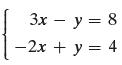
In Problems 45–64, use the inverses found in Problems 35–44 to solve each system of equations. 3x - y = 8 -2x + y = 4
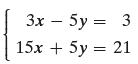
In Problems 39–74, solve each system of equations using matrices (row operations). If the system has no solution, say that it is inconsistent. 3x-5y=3 15x + 5y = 21
Open the “Ellipse” interactive figure, which is available in the Video & Resource Library of MyLab Math (under Interactive Figures) or at bit.ly/3raFUGB.(a) Uncheck the box “Equation of Ellipse.” Grab the point F1, which represents a focus of an ellipse, and move the point F 1 to (−2,
Open the “Ellipse” interactive figure, which is available in the Video & Resource Library of MyLab Math (under Interactive Figures) or at bit.ly/3raFUGB.(a) Uncheck the box “Equation of Ellipse.” Grab the point F1, which represents a focus of an ellipse, and move the point F 1 to (−2,
Open the “Hyperbola” interactive figure, which is available in the Video & Resource Library of MyLab Math (under Interactive Figures) or at bit.ly/3raFUGB.(a) Set the slider to a = 2. Grab the point F1, which represents a focus of a hyperbola, and move the point F1 to (−2, 1). Grab the
Answer Problems 11–14 using the figure shown to the right.If a > 0, the equation of the parabola is of the form (a) (y - k)² (c) (xh)² = = 4a (x - h) 4a(yk) (b) (yk)² (d) (x - h)² = -4a(x - h) : -4a(y - k) =
Prove that De Moivre’s Theorem is true for all integers n by assuming it is true for integers n ≥ 1 and then showing it is true for 0 and for negative integers.Multiply the numerator and the denominator by the conjugate of the denominator, and use even-odd properties.
(a) Grab the directrix slider so that the directrix is x = −2. Grab the point F (the focus) and move to (4, 2). Check the box “Show Point on Parabola.” Grab point P and move it around the Cartesian Plane. Notice the distance from P to F and the distance from P to the directrix is computed.
In Problems 27 – 34, find two different pairs of parametric equations for each rectangular equation. x = √y
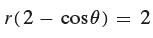
In Problems 25 – 36, convert each polar equation to a rectangular equation. r(2 cos0) = 2
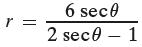
In Problems 25 – 36, convert each polar equation to a rectangular equation. r = 6 sec0 2 sec 0 - 1
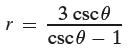
In Problems 25 – 36, convert each polar equation to a rectangular equation. r = 3 csc 0 csc 1
In Problems 23–40, find the equation of the parabola described. Find the two points that define the latus rectum, and graph the equation.Vertex at (2, −3); focus at (2, −5)
In Problems 31–38, find the center, transverse axis, vertices, foci, and asymptotes. Graph each equation.4x2 − y2 = 16
In Problems 31–38, find the center, transverse axis, vertices, foci, and asymptotes. Graph each equation.4y2 − x2 = 16
In Problems 23–40, find the equation of the parabola described. Find the two points that define the latus rectum, and graph the equation.Vertex at (4, −2); focus at (6, −2)
Find two different pairs of parametric equations for y = −2x + 4.
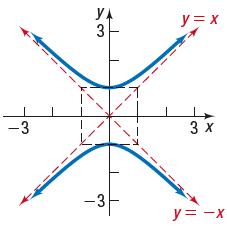
In Problems 39–42, find an equation for each hyperbola. -3 YA 3 -3 35 2 y = x 3x y=-x
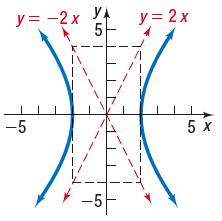
In Problems 39–42, find an equation for each hyperbola. у=-2х у 5 -5 II IN I 1 -5 y=2x Л 5 х
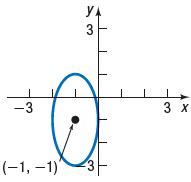
In Problems 41–44, find an equation for each ellipse. -3 УА 3 (-1,-1)" -3 3 x
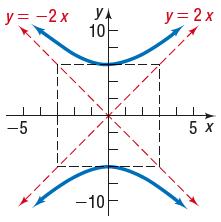
In Problems 39–42, find an equation for each hyperbola. y = -2x -5 УА 10 -10 y= 2x 5 x
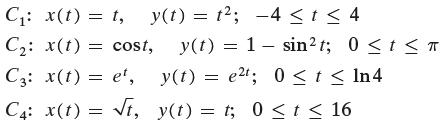
In Problems 43 parametric equations of four plane curves are given. Graph each of them, indicating the orientation. C₁: x(t) = t, y(t) = 1²; -4 ≤ t ≤ 4 C₂: x(t) = cost, y(t) = 1 sin²t; 0 ≤ t ≤ T C₂: x(t) = et, y(t) = e²t; 0 ≤ t < ln4 C4: x(t) = √t, y(t) = t; 0 ≤ t ≤ 16
In Problems 31–38, find the center, transverse axis, vertices, foci, and asymptotes. Graph each equation.y2 − 9x2 = 9
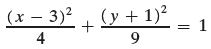
In Problems 45–56, analyze each equation; that is, find the center, foci, and vertices of each ellipse. Graph each equation. (x - 3)² (y + 1)² + 4 9 = 1
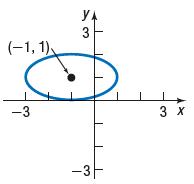
In Problems 41–44, find an equation for each ellipse. (-1, 1) -3 УА 3 -3 3 x
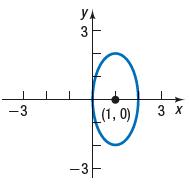
In Problems 41–44, find an equation for each ellipse. -3 YA 3 -3 (1, 0) 3 x
In Problems 23–40, find the equation of the parabola described. Find the two points that define the latus rectum, and graph the equation.Vertex at (−1, −2); focus at (0, −2)
In Problems 31–38, find the center, transverse axis, vertices, foci, and asymptotes. Graph each equation.x2 − y2 = 4
In Problems 31–38, find the center, transverse axis, vertices, foci, and asymptotes. Graph each equation.y2 − x2 = 25
In Problems 23–40, find the equation of the parabola described. Find the two points that define the latus rectum, and graph the equation.Focus at (−3, 4); directrix the line y = 2
In Problems 31–38, find the center, transverse axis, vertices, foci, and asymptotes. Graph each equation.2x2 − y2 = 4
In Problems 29–40, find an equation for each ellipse. Graph the equation.Vertices at (±4, 0); y-intercepts are ±1
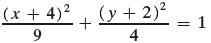
In Problems 45–56, analyze each equation; that is, find the center, foci, and vertices of each ellipse. Graph each equation. (x+4)² (y + 2)² + 9 4 = 1
In Problems 23–40, find the equation of the parabola described. Find the two points that define the latus rectum, and graph the equation.Focus at (−3, −2); directrix the line x = 1
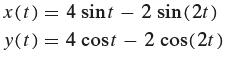
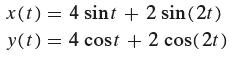
In Problems 45–48, use a graphing utility to graph the plane curve defined by the given parametric equations. x(t) = 4 sint 2 sin (2t) - y(t) = 4 cost 2 cos(2t)
In Problems 23–40, find the equation of the parabola described. Find the two points that define the latus rectum, and graph the equation.Focus at (−4, 4); directrix the line y = −2
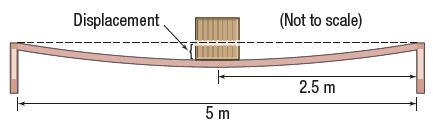
A crate is placed at the center of a 5-meter board that is supported only at its ends. The weight of the crate causes a deflection of the board at its center. If the shape of the deflected board is a parabola given bydetermine the amount of deflection at the center assuming the focus is at the
Patrick Mahomes throws a football with an initial speed of 80 feet per second at an angle of 35° to the horizontal. The ball leaves his hand at a height of 6 feet.(a) Find parametric equations that model the position of the ball as a function of time.(b) How long is the ball in the air?(c) When is
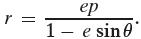
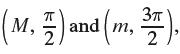
Suppose that a conic has an equation of the formIf the polar coordinates of two points on the graph areshow that r ep 1 e sino
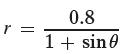
A tank is punctured on its side, and water begins to stream out in a parabolic path. If the path of the water is given byand the water hits the ground 4 inches away from the base of the tank, what is the height of the puncture from the base of the tank? Assume the focus is at the pole. r = 0.8 1 +
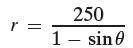
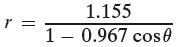
Halley’s comet travels around the Sun in an elliptical orbit given approximately bywhere the Sun is at the pole and r is measured in AU (astronomical units). Find the distance from Halley’s comet to the Sun at aphelion and at perihelion. Use the aphelion and perihelion to graph the orbit of
In Problems 45–48, use a graphing utility to graph the plane curve defined by the given parametric equations. x(t) = 4 sint + 2 sin(2t) y(t) = 4 cost + 2 cos(2t)
In Problems 45–48, use a graphing utility to graph the plane curve defined by the given parametric equations.x(t) = t sin t, y(t) = t cost, t > 0
In Problems 43–52, identify the graph of each equation without applying a rotation of axes.x2 − 7xy + 3y2 − y − 10 = 0
In Problems 45–56, analyze each equation; that is, find the center, foci, and vertices of each ellipse. Graph each equation.(x + 5)2 + 4( y − 4)2 = 16
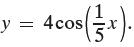
Problems 52–61. The purpose of these problems is to keep the material fresh in your mind so that you are better prepared for later sections, a final exam, or subsequent courses such as calculus.Without graphing, determine the amplitude and period of 4 cos(x). y = 4 cos
In Problems 45–48, use a graphing utility to graph the plane curve defined by the given parametric equations.x(t) = sint + cost, y = sint − cost
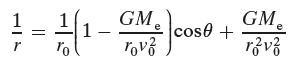
From physics, the equation for the free-flight trajectory of a satellite launched a distance r0 from the center of the earth is given by the polar equationwhere Me is the mass of the earth, G is the gravitational constant, and v0 is the initial velocity of the satellite. If the initial velocity is
A parabolic satellite receiver is initially positioned so its axis of symmetry is parallel to the x-axis. A motor allows the receiver to rotate and track the satellite signal. If the rotated receiver has the equationthrough what acute angle did the receiver rotate, to the nearest tenth of a degree?
In Problems 55 – 58, apply the rotation formulas (5) toto obtain the equationShow that A + C = A'+ C', which proves that A + C is invariant ; that is, its value does not change under a rotation of axes. Ax² + Bxy + Cy² + Dx + Ey + F = 0
In Problems 45–56, analyze each equation; that is, find the center, foci, and vertices of each ellipse. Graph each equation.9( x − 3)2 + ( y + 2)2 = 18
A runner on an elliptical trainer inclines the machine to increase the difficulty of her workout. If the initial elliptic path of the pedals had a horizontal major axis, and the inclined path has the equationthrough what acute angle did the runner incline the machine, to the nearest tenth of a
Problems 52–61. The purpose of these problems is to keep the material fresh in your mind so that you are better prepared for later sections, a final exam, or subsequent courses such as calculus.Determine where the functionis increasing, decreasing, and constant. f(x) = x + 3 if -2 < x < -1 x² +
Problems 52–61. The purpose of these problems is to keep the material fresh in your mind so that you are better prepared for later sections, a final exam, or subsequent courses such as calculus.Find the area of the triangle described: a = 7, b = 8, and c = 10. Round to two decimal places.
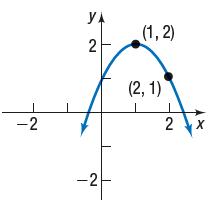
In Problems 59–66, write an equation for each parabola. -2 УА 2 -2 (1,2) (2,1) 2 X
Showing 1500 - 1600
of 29454
First
9
10
11
12
13
14
15
16
17
18
19
20
21
22
23
Last
Step by Step Answers

 Get 50% OFF
Claim Now
Get 50% OFF
Claim Now