New Semester
Started
Get
50% OFF
Study Help!
--h --m --s
Claim Now
Question Answers
Textbooks
Find textbooks, questions and answers
Oops, something went wrong!
Change your search query and then try again
S
Books
FREE
Study Help
Expert Questions
Accounting
General Management
Mathematics
Finance
Organizational Behaviour
Law
Physics
Operating System
Management Leadership
Sociology
Programming
Marketing
Database
Computer Network
Economics
Textbooks Solutions
Accounting
Managerial Accounting
Management Leadership
Cost Accounting
Statistics
Business Law
Corporate Finance
Finance
Economics
Auditing
Tutors
Online Tutors
Find a Tutor
Hire a Tutor
Become a Tutor
AI Tutor
AI Study Planner
NEW
Sell Books
Search
Search
Sign In
Register
study help
mathematics
precalculus
Precalculus Concepts Through Functions A Unit Circle Approach To Trigonometry 5th Edition Michael Sullivan - Solutions
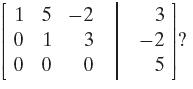
Which statement describes the system of equations represented by(a) The system has one solution.(b) The system has infinitely many solutions.(c) The system has no solution.(d) The number of solutions cannot be determined. 15 5-2 0 1 3 00 30 0 1 3 325 -2? 5
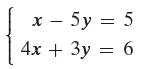
In Problems 7 – 18, write the augmented matrix of the given system of equations. x-5y = 5 4x + 3y = 6
Graph the equation: x2 + 4y2 = 4
Graph the equation: y = x2 + 4
If a system of equations has one solution, the system is_______ and the equations are _________.
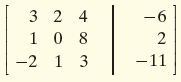
Write the system of equations corresponding to the augmented matrix: 324 108 -2 1 3 -6 2 -11
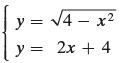
In Problems 5 – 24, graph each equation of the system. Then solve the system to find the points of intersection. y = y = √4x² 2x + 4
If the only solution to a system of two linear equations containing two variables is x = 3, y = −2, then the graphs of the lines in the system intersect at the point ________.
In Problems 7 – 14, find the value of each determinant. 64 -1 3
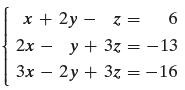
In Problems 1 – 10, solve each system of equations using the method of substitution or the method of elimination. If the system has no solution, state that it is inconsistent. x + 2y - z = 6 2xy + 3z = -13 3x - 2y + 3z = -16
Solve the inequality: x2 − 4 ≤ 5
In Problems 5 – 16, determine whether the given rational expression is proper or improper. If the expression is improper, rewrite it as the sum of a polynomial and a proper rational expression. 3x² - 2 2 x²1 2
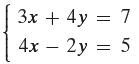
In Problems 7 – 18, write the augmented matrix of the given system of equations. 3x + 4y = 7 4x − 2y = 5
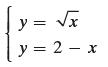
In Problems 5 – 24, graph each equation of the system. Then solve the system to find the points of intersection. = √x y = y = 2 x
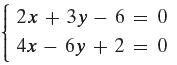
In Problems 7 – 18, write the augmented matrix of the given system of equations. 2x+3y - 6 = 0 6=0 4x - бу + 2 = 0
In Problems 7 – 14, find the value of each determinant. -3 4 -1 2
In Problems 7 – 14, find the value of each determinant. 8-3 4 2
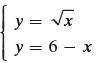
In Problems 5 – 24, graph each equation of the system. Then solve the system to find the points of intersection. y = x y = 6 - x
To find the product AB of two matrices A and B, which statement must be true?(a) The number of columns in A must equal the number of rows in B.(b) The number of rows in A must equal the number of columns in B.(c) A and B must have the same number of rows and the same number of columns.(d) A and B
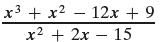
In Problems 5 – 16, determine whether the given rational expression is proper or improper. If the expression is improper, rewrite it as the sum of a polynomial and a proper rational expression. x3 + x2 12x + 9 - x² + 2x 15
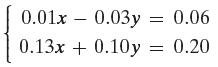
In Problems 7 – 18, write the augmented matrix of the given system of equations. 0.01x - 0.03y = 0.06 0.13x + 0.10y = 0.20
In Problems 7 – 14, find the value of each determinant. -4 2 -5 3
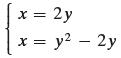
In Problems 5 – 24, graph each equation of the system. Then solve the system to find the points of intersection. x = 2y x = y² - 2y
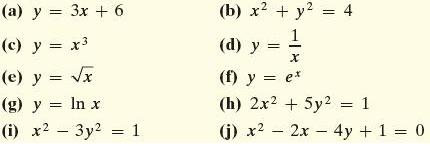
Graph each equation. (a) y = 3x + 6 (c) y = x³ (e) y = √x (g) y = ln x (i) x² 3y2 = 1 (b) x² + y² = 4 (d) y X (f) y = ex (h) 2x² + 5y² = 1 (j) x² - 2x - 4y + 1 = 0
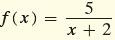
The function is one-to-one. Find f−1. Find the domain and the range of f and the domain and the range of f−1. f(x) = 5 x + 2
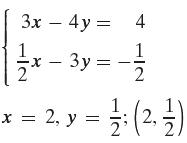
In Problems 9 – 18, verify that the values of the variables listed are solutions of the system of equations. 3x - 4y = 4 =글 2 X - 3y = I x= 2, y = 1/1: (2, 1/1)
Find the center and radius of the circle x2 + y2 − 2x + 4y − 11 = 0 Graph the circle.
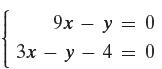
In Problems 7 – 18, write the augmented matrix of the given system of equations. 9x - y = 0 3x - y - 4 = 0
In Problems 11 – 22, graph each inequality. x 20
The graph of a linear equation is a line that separates the xy-plane into two regions called _________.
If a system of dependent equations containing three variables has the general solution {(x, y, z) x = −z + 4, y = − 2z + 5, z is any real n umber} then_______ is one of the infinite number of solutions of the system.(a) (1, −1, 3)(b) ( 0, 4, 5)(c) (4, −3, 0)(d) (−1, 5, 7)
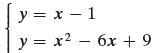
In Problems 5 – 24, graph each equation of the system. Then solve the system to find the points of intersection. y = x - 1 y = x² - 6x + 9
In Problems 11 – 22, graph each inequality. y ≥ 0
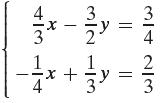
In Problems 7 – 18, write the augmented matrix of the given system of equations. 314 23 = || || लोत नाल नौक 1 +
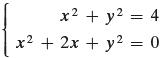
In Problems 5 – 24, graph each equation of the system. Then solve the system to find the points of intersection. x² + y² = 4 x² + 2x + y² = 0
In Problems 11 – 22, graph each inequality. x IV 4
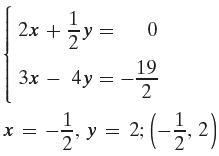
In Problems 9 – 18, verify that the values of the variables listed are solutions of the system of equations. 1 -= 2x + x = = 3x - 4y = 1 2 y = 0 19 2 2; (-1/2, 2²)
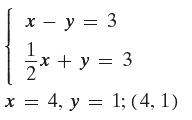
In Problems 9 – 18, verify that the values of the variables listed are solutions of the system of equations. x - y = 3 1/2 x 5x + y = 3 x = 4, y = 1; (4,1)
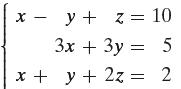
In Problems 7 – 18, write the augmented matrix of the given system of equations. y + z = 10 3x + 3y = 5 x + y + 2z = 2 X
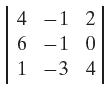
In Problems 7 – 14, find the value of each determinant. 4 6 1 -1 2 -1 0 -3 -3 4
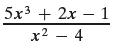
In Problems 5 – 16, determine whether the given rational expression is proper or improper. If the expression is improper, rewrite it as the sum of a polynomial and a proper rational expression. 5x3 + 2x - 1 x2 x²4
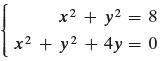
In Problems 5–24, graph each equation of the system. Then solve the system to find the points of intersection. x² + y² = 8 x² + y² + 4y = 0
In Problems 9–18, solve each linear programming problem. Maximize z = 5x + 3y subject to the constraints x ≥ 0, y ≥ 0, x + y ≥ 2, x + y ≤ 8, 2x + y ≤ 10
In Problems 9–18, solve each linear programming problem. Minimize z = 5x + 4y subject to the constraints x ≥ 0, y ≥ 0, x + y 22, 2x + 3y 12, 3x + y ≤ 12
In Problems 11 – 22, graph each inequality. y ≤ 2
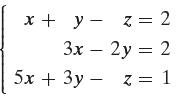
In Problems 7 – 18, write the augmented matrix of the given system of equations. x+y - z = 2 3x-2y = 2 5x+3y-z= 1 =
In Problems 13 – 16, use the following matrices to compute each expression.AB A || 10 24 -1 2 B = 4 1 -3 0 1 1-2 C = 315 -4 5 52
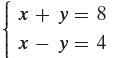
In Problems 15–42, solve each system of equations using Cramer’s Rule if it is applicable. If Cramer’s Rule is not applicable, write, “Not applicable.” x + y = x - y = 8 4
In Problems 9–18, solve each linear programming problem. Minimize z = 2x + 3y subject to the constraints x > 0, y ≥ 0, x + y ≥ 3, x + y ≤ 9, x + 3y ≥ 6
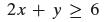
In Problems 11 – 22, graph each inequality. 2x + y 2 6
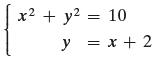
In Problems 5 – 24, graph each equation of the system. Then solve the system to find the points of intersection. x2 x² + y² = 10 y = x + 2
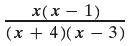
In Problems 5 – 16, determine whether the given rational expression is proper or improper. If the expression is improper, rewrite it as the sum of a polynomial and a proper rational expression. x(x - 1) (x + 4)(x − 3)
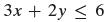
In Problems 11 – 22, graph each inequality. 3x + 2y 5 6
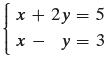
In Problems 15–42, solve each system of equations using Cramer’s Rule if it is applicable. If Cramer’s Rule is not applicable, write, “Not applicable.” x + 2y = 5 x - y = 3
In Problems 9–18, solve each linear programming problem. Maximize z = 5x + 2y subject to the constraints x ≥ 0, y ≥ 0, x + y ≤ 10, 2x + y 2 10, x + 2y > 10
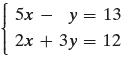
In Problems 15–42, solve each system of equations using Cramer’s Rule if it is applicable. If Cramer’s Rule is not applicable, write, “Not applicable.” 5x - y = 2x + 3y = 13 12
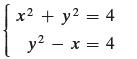
In Problems 5 – 24, graph each equation of the system. Then solve the system to find the points of intersection. x² + y² = 4 y² - x = 4
In Problems 9–18, solve each linear programming problem. Maximize z = 2x + 4y subject to the constraints x ≥ 0, y ≥ 0, 2x + y ≥ 4, x + y ≤ 9
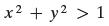
In Problems 11 – 22, graph each inequality. x² + y² > 1 2
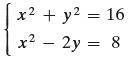
In Problems 5 – 24, graph each equation of the system. Then solve the system to find the points of intersection. x² + y² = 16 x² - 2y = 8
In Problems 17–50, find the partial fraction decomposition of each rational expression. 4 x(x - 1)
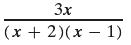
In Problems 17–50, find the partial fraction decomposition of each rational expression. 3x (x + 2)(x-1)
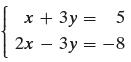
In Problems 15–42, solve each system of equations using Cramer’s Rule if it is applicable. If Cramer’s Rule is not applicable, write, “Not applicable.” x + 3y = 5 2x - 3y = -8
In Problems 11 – 22, graph each inequality. x2 x² + y2 ≤ 9
In Problems 17–50, find the partial fraction decomposition of each rational expression. 1 x(x² + 1) 2
In Problems 19–56, solve each system of equations. If the system has no solution, state that it is inconsistent. For Problems 19–30, graph the lines of the system. x + y = 8 x - y = 4
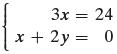
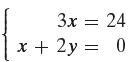
In Problems 15–42, solve each system of equations using Cramer’s Rule if it is applicable. If Cramer’s Rule is not applicable, write, “Not applicable.” 3x = x + 2y = 24 0
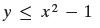
In Problems 11 – 22, graph each inequality. 2 y ≤ x² - 1
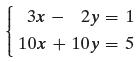
In Problems 20–25, solve each system of equations using matrices. If the system has no solution, state that it is inconsistent. 3x - 2y = 1 10x +10y = 5
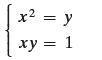
In Problems 5 – 24, graph each equation of the system. Then solve the system to find the points of intersection. x² = = y xy = 1
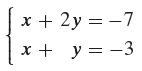
In Problems 19–56, solve each system of equations. If the system has no solution, state that it is inconsistent. For Problems 19–30, graph the lines of the system. x + 2y = x + y = -7 -3
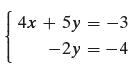
In Problems 15–42, solve each system of equations using Cramer’s Rule if it is applicable. If Cramer’s Rule is not applicable, write, “Not applicable.” 4x + 5y = -3 -2y = -4
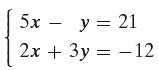
In Problems 19–56, solve each system of equations. If the system has no solution, state that it is inconsistent. For Problems 19–30, graph the lines of the system. 5x - y = 2x + 3y = 12 21
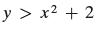
In Problems 11 – 22, graph each inequality. 2 y > x² + 2
In Problems 9 – 26, use the following matrices. Determine whether the given expression is defined. If it is defined, express the result as a single matrix; if it is not, write “not defined”BA 03-5 4 0 ^-[123] - - 1 -2] A = B = 6 -2 C = 4 1 6 2 3 -2
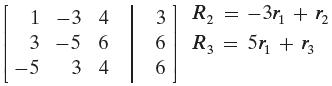
In Problems 19 – 26, write the system of equations corresponding to each augmented matrix. Then perform the indicated row operation(s) on the given augmented matrix. 1 -3 4 3 -5 -5 6 34 3 6 1 6 R₂ = 3r₁ + 1₂ R2 R3 = 5r₁ + 13
In Problems 11 – 22, graph each inequality. xy > 4
In Problems 11 – 22, graph each inequality. xy ≤ 1
In Problems 9 – 26, use the following matrices. Determine whether the given expression is defined. If it is defined, express the result as a single matrix; if it is not, write “not defined”C (A + B) 03-5 4 0 ^-[123] - - 1 -2] A = B = 6 -2 C = 4 1 6 2 3 -2
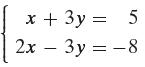
In Problems 19–56, solve each system of equations. If the system has no solution, state that it is inconsistent. For Problems 19–30, graph the lines of the system. x + 3y = 5 2x — 3y = −8
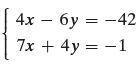
In Problems 15–42, solve each system of equations using Cramer’s Rule if it is applicable. If Cramer’s Rule is not applicable, write, “Not applicable.” 4х 4x - бу = -42 7x +4y = -1
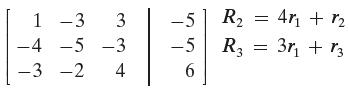
In Problems 19 – 26, write the system of equations corresponding to each augmented matrix. Then perform the indicated row operation(s) on the given augmented matrix. 1-3 -4 -5 -3 -3 -2 4 3 تنا -5 ] -5 | 6 R2 R = = 41₁ + 1₂ 3r + r3 =
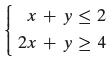
In Problems 23 – 34, graph each system of linear inequalities. x + y ≤2 2x + y 24
In Problems 19–56, solve each system of equations. If the system has no solution, state that it is inconsistent. For Problems 19–30, graph the lines of the system. 3x = 24 x + 2y = 0
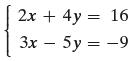
In Problems 15–42, solve each system of equations using Cramer’s Rule if it is applicable. If Cramer’s Rule is not applicable, write, “Not applicable.” 2x + 4y = 16 3x-5y=-9
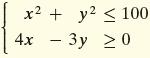
Graph the system of inequalities: x² + у2 х2 4x - 3у ≤ 100 < 20
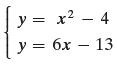
In Problems 5 – 24, graph each equation of the system. Then solve the system to find the points of intersection. y = = x² - 4 y = 6x13
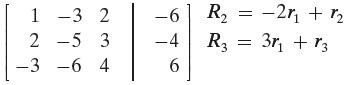
In Problems 19 – 26, write the system of equations corresponding to each augmented matrix. Then perform the indicated row operation(s) on the given augmented matrix. 1-3 2 2 -5 3 4 -3 -6 -6 - 4 6 R₂ = -2r₁ + 1₂ 37₁ +3 R3 =
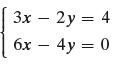
In Problems 15–42, solve each system of equations using Cramer’s Rule if it is applicable. If Cramer’s Rule is not applicable, write, “Not applicable.” 3x - 2y = 4 6x - 4y = 0
Open the “Slope” interactive figure, which is available in the Video & Resource Library of MyLab Math (under Interactive Figures) or at bit.ly/3raFUGB.(a) Be sure the “Show Slope” box is not checked. Grab point B and move it to the point with coordinates (3, 5). What is the value of the
Open the “Circle” interactive figure, which is available in the Video & Resource Library of MyLab Math (under Interactive Figures) or at bit.ly/3raFUGB.(a) Check the box “Equation of the Circle” and uncheck the boxes “Show x -intercepts” and “Show y -intercepts.” Use the sliders
The x-intercepts of the graph of an equation are those x-values for which ________.
Open the “Circle” interactive figure, which is available in the Video & Resource Library of MyLab Math (under Interactive Figures) or at bit.ly/3raFUGB.(a) Check the boxes “Equation of the Circle,” “Show x -intercepts,” and “Show y -intercepts.” Change the value of r to 3 and
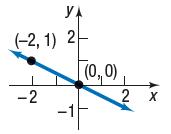
In Problems 13–16,(a) Find the slope of the line(b) Interpret the slope. У (-2, 1) 2 -2 -1 (0,0) 2 х
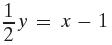
In Problems 79–98, find the slope and y-intercept of each line. Graph the line. 1 2 -y = x - 1
In Problems 79–86,(a) Find the intercepts of each equation,(b) Test each equation for symmetry with respect to the x-axis, the y-axis, and the origin,(c) Graph each equation by hand by plotting points. Be sure to label the intercepts on the graph and use any symmetry to assist in drawing the
In Problems 79–86,(a) Find the intercepts of each equation,(b) Test each equation for symmetry with respect to the x-axis, the y-axis, and the origin,(c) Graph each equation by hand by plotting points. Be sure to label the intercepts on the graph and use any symmetry to assist in drawing the
In Problems 79–86,(a) Find the intercepts of each equation,(b) Test each equation for symmetry with respect to the x-axis, the y-axis, and the origin,(c) Graph each equation by hand by plotting points. Be sure to label the intercepts on the graph and use any symmetry to assist in drawing the
In Problems 79–98, find the slope and y-intercept of each line. Graph the line.x − y = 2
Solve the equation 2( x + 3) − 1 = −7.
Showing 1700 - 1800
of 29454
First
11
12
13
14
15
16
17
18
19
20
21
22
23
24
25
Last
Step by Step Answers

 Get 50% OFF
Claim Now
Get 50% OFF
Claim Now