New Semester
Started
Get
50% OFF
Study Help!
--h --m --s
Claim Now
Question Answers
Textbooks
Find textbooks, questions and answers
Oops, something went wrong!
Change your search query and then try again
S
Books
FREE
Study Help
Expert Questions
Accounting
General Management
Mathematics
Finance
Organizational Behaviour
Law
Physics
Operating System
Management Leadership
Sociology
Programming
Marketing
Database
Computer Network
Economics
Textbooks Solutions
Accounting
Managerial Accounting
Management Leadership
Cost Accounting
Statistics
Business Law
Corporate Finance
Finance
Economics
Auditing
Tutors
Online Tutors
Find a Tutor
Hire a Tutor
Become a Tutor
AI Tutor
AI Study Planner
NEW
Sell Books
Search
Search
Sign In
Register
study help
mathematics
precalculus
Calculus Early Transcendentals 8th edition James Stewart - Solutions
Solve the differential equation.dy/dx = 3x2y2
(a) Use Euler’s method with step size 0.2 to estimate y(0.6), where y(x) is the solution of the initial-value problem y' = cos(x + y), y(0) = 0.(b) Repeat part (a) with step size 0.1.
Use Euler’s method with step size 0.2 to estimate y(1), where y(x) is the solution of the initial-value problem y' = x2 y - 1/2 y2, y(0) = 1.
Use Euler’s method with step size 0.5 to compute the approximate y-values y1, y2, y3, and y4 of the solution of the initial-value problem y' = y - 2x, y(1) = 0.
Use a computer algebra system to draw a direction field for the given differential equation. Get a printout and sketch on it the solution curve that passes through (0, 1). Then use the CAS to draw the solution curve and compare it with your sketch.y' = cos(x + y)
Use a computer algebra system to draw a direction field for the given differential equation. Get a printout and sketch on it the solution curve that passes through (0, 1). Then use the CAS to draw the solution curve and compare it with your sketch.y' = x2y - 1/2y2
Sketch the direction field of the differential equation.Then use it to sketch a solution curve that passes through the given point.y' = x + y2, (0, 0)
Sketch the direction field of the differential equation.Then use it to sketch a solution curve that passes through the given point.y' = xy - x2, (0, 1)
Sketch a direction field for the differential equation. Then use it to sketch three solution curves.y' = x - y + 1
Sketch a direction field for the differential equation. Then use it to sketch three solution curves.y' = 1/2y
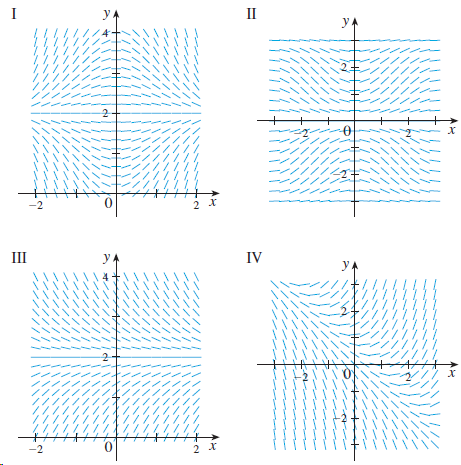
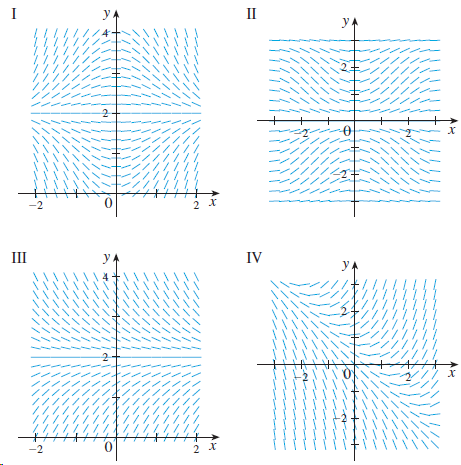
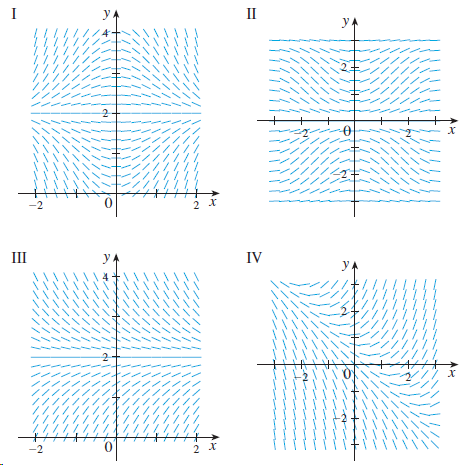
Use the direction field labeled III (above) to sketch the graphs of the solutions that satisfy the given initial conditions.(a) y(0) = 1(b) y(0) = 2.5(c) y(0) = 3.5
Use the direction field labeled I (above) to sketch the graphs of the solutions that satisfy the given initial conditions.(a) y(0) = 1 (b) y(0) = 2.5 (c) y(0) = 3.5
Match the differential equation with its direction field (labeled I–IV). Give reasons for your answer.y' = x + y - 1 II I IV -- -- -- II -- -- -- -2 1. /// ///! ///1|I\ ///||\\ ///||\ ////
Match the differential equation with its direction field (labeled I–IV). Give reasons for your answer.y' = x(2 - y) II I IV -- -- -- II -- -- -- -2 1. /// ///! ///1|I\ ///||\\ ///||\ ////
Match the differential equation with its direction field (labeled I–IV). Give reasons for your answer.y' = 2 - y II I IV -- -- -- II -- -- -- -2 1. /// ///! ///1|I\ ///||\\ ///||\ ////
Von Bertalanffy’s equation states that the rate of growth in length of an individual fish is proportional to the difference between the current length L and the asymptotic length L∞ (in centimeters).(a) Write a differential equation that expresses this idea. (b) Make a rough sketch of the
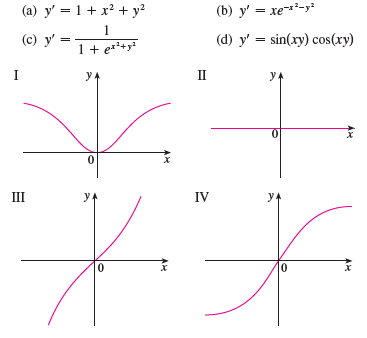
Match the differential equations with the solution graphs labeled I–IV. Give reasons for your choices. (a) y' = 1 + x? + y? (b) у' — хе-т*-у (c) y' (d) y' = sin(xy) cos(ry) y 1+ er*+. II y. УА Ш IV УА х
The Fitzhugh-Nagumo model for the electrical impulse in a neuron states that, in the absence of relaxation effects, the electrical potential in a neuron v(t) obeys the differential equationwhere a is a positive constant such that 0 < a < 1.(a) For what values of v is v unchanging (that is,
Verify that y = -t cos t - t is a solution of the initialvalue problemt dy/dt = y + t2 sin ty(π) = 0
Find the centroid of the region bounded by the given curves.y = 1/2x, y = √x
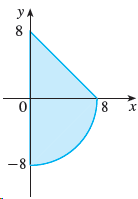
Find the centroid of the region shown. y х -8
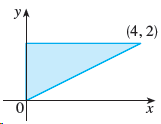
Find the centroid of the region shown. ул (4, 2) х
Find the length of the curve y= Vi - 1 dt 1
Use Simpson’s Rule with n = 10 to estimate the area of the surface obtained by rotating the sine curve in Exercise 7 about the x-axis.
Let C be the arc of the curve y = 2/(x + 1) from the point (0, 2) to (3, 1/2). Use a calculator or other device to find the value of each of the following, correct to four decimal places.(a) The length of C(b) The area of the surface obtained by rotating C about the x-axis(c) The area of the
Find the length of the curve.12x = 4y3 + 3y-1, 1 < y < 3
Find the length of the curve.y = 2 In(sin 1/2x), π/3 < x < π
Show that the probability density function for a normally distributed random variable has inflection points at x = µ ± σ
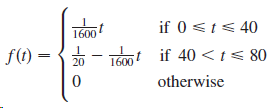
REM sleep is the phase of sleep when most active dreaming occurs. In a study, the amount of REM sleep during the first four hours of sleep was described by a random variable T with probability density functionwhere t is measured in minutes.(a) What is the probability that the amount of REM sleep is
An online retailer has determined that the average time for credit card transactions to be electronically approved is 1.6 seconds.(a) Use an exponential density function to find the probability that a customer waits less than a second for credit card approval.(b) Find the probability that a
Let f (x) = c/(1 + x2).(a) For what value of c is f a probability density function?(b) For that value of c, find P (-1 < X < 1).
The density function f(x) = e3-x/(1 + e3-x)2 is an example of a logistic distribution.(a) Verify that f is a probability density function.(b) Find P(3 < X < 4).(c) Graph f. What does the mean appear to be? What about the median?
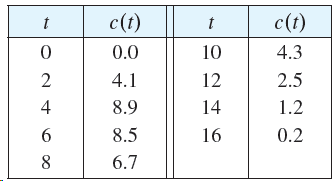
After a 5.5-mg injection of dye, the readings of dye concentration, in mg/L, at two-second intervals are as shown in the table. Use Simpson’s Rule to estimate the cardiac output. c(t) c(t) 0.0 10 4.3 12 4.1 2.5 4 8.9 14 1.2 8.5 16 0.2 6.7 00
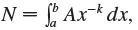
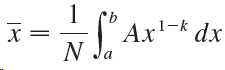
Pareto’s Law of Income states that the number of people with incomes between x = a and x = b is where A and k are constants with A > 0 and k > 1. The average income of these people isCalculate x. Ax'-k dx Ах1-k JA 18
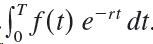
The present value of an income stream is the amount that would need to be invested now to match the future value as described in Exercise 15 and is given by
If revenue flows into a company at a rate of f(t) = 9000√1 + 2t, where t is measured in years and f(t) is measured in dollars per year, find the total revenue obtained in the first four years.
A movie theater has been charging $10.00 per person and selling about 500 tickets on a typical weeknight. After surveying their customers, the theater management estimates that for every 50 cents that they lower the price, the number of moviegoers will increase by 50 per night. Find the demand
A camera company estimates that the demand function forits new digital camera is p(x) = 312e-0.14x and the supply function is estimated to be pS(x) = 26e0.2x, where x is measured in thousands. Compute the maximum total surplus.
If a supply curve is modeled by the equation p = 125 + 0.002x2, find the producer surplus when the selling price is $625.
The demand function for a particular vacation package is p(x) = 2000 - 46√x . Find the consumer surplus when the sales level for the packages is 400. Illustrate by drawing the demand curve and identifying the consumer surplus as an area.
A company estimates that the marginal revenue (in dollars per unit) realized by selling x units of a product is 48 - 0.0012x. Assuming the estimate is accurate, find the increase in revenue if sales increase from 5000 units to 10,000 units.
Use the Second Theorem of Pappus described in Exercise 48 to find the surface area of the torus in Example 7.
Use the Theorem of Pappus to find the volume of the given solid.A sphere of radius r (Use Example 4.)
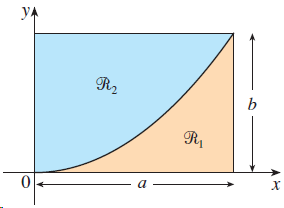
A rectangle 5 with sides a and b is divided into two parts R1 and R2 by an arc of a parabola that has its vertex at one corner of R and passes through the opposite corner. Find the centroids of both R1 and R2. УА R2 R1 х
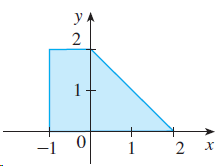
Find the centroid of the region shown, not by integration, but by locating the centroids of the rectangles and triangles (from Exercise 39) and using additivity of moments. y A 1+ 2 х 2.
Use a graph to find approximate x-coordinates of the points of intersection of the curves y = ex and y = 2 - x2. Then find (approximately) the centroid of the region bounded by these curves.
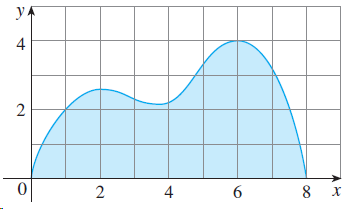
Use Simpson’s Rule to estimate the centroid of the region shown. Ул 4 4
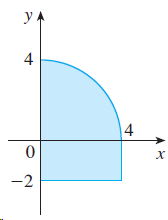
Calculate the moments Mx and My and the center of mass of a lamina with the given density and shape.P = 6 ул 4 х -2
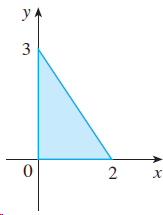
Calculate the moments Mx and My and the center of mass of a lamina with the given density and shape.P = 4 ум У 3 2 х
Find the centroid of the region bounded by the given curves.x + y = 2, x = y2
Find the centroid of the region bounded by the given curves.y = x3, x + y = 2, y = 0
Find the centroid of the region bounded by the given curves.y = 2 - x2, y = x
Sketch the region bounded by the curves, and visually estimate the location of the centroid. Then find the exact coordinates of the centroid.y = sin x, y = 0, 0 < x < π
Sketch the region bounded by the curves, and visually estimate the location of the centroid. Then find the exact coordinates of the centroid.y = √x, y = 0, x = 4
The masses mi are located at the points Pi. Find the moments Mx and My and the center of mass of the system. т — 3, т, тz — 4, тз P:(-4, 2), P2(0, 5), P3(3, 2), Pa(1, –2) 5, — 6;
Sketch the region bounded by the curves, and visually estimate the location of the centroid. Then find the exact coordinates of the centroid.y = 2x. y = 0, x = 1
Point-masses mi are located on the x-axis as shown. Find the moment M of the system about the origin and the center of mass x. m, = 12 + m2=15 2 + M3= 20 -3 х -3
A milk truck carries milk with density 64.6 lb/ft3 in a horizontal cylindrical tank with diameter 6 ft.(a) Find the force exerted by the milk on one end of the tank when the tank is full.(b) What if the tank is half full?
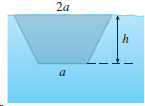
A vertical plate is submerged (or partially submerged) in water and has the indicated shape. Explain how to approximate the hydrostatic force against one side of the plate by a Riemann sum.Then express the force as an integral and evaluate it. 2a h
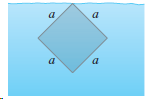
A vertical plate is submerged (or partially submerged) in water and has the indicated shape. Explain how to approximate the hydrostatic force against one side of the plate by a Riemann sum.Then express the force as an integral and evaluate it. a a
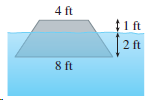
A vertical plate is submerged (or partially submerged) in water and has the indicated shape. Explain how to approximate the hydrostatic force against one side of the plate by a Riemann sum.Then express the force as an integral and evaluate it. 4 ft ț1ft 2 ft 8 ft
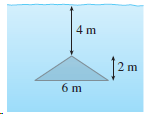
A vertical plate is submerged (or partially submerged) in water and has the indicated shape. Explain how to approximate the hydrostatic force against one side of the plate by a Riemann sum.Then express the force as an integral and evaluate it. |4 m 6 m
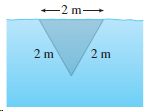
A vertical plate is submerged (or partially submerged) in water and has the indicated shape. Explain how to approximate the hydrostatic force against one side of the plate by a Riemann sum.Then express the force as an integral and evaluate it. -2 m- 2 m 2 m
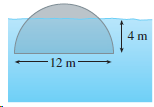
A vertical plate is submerged (or partially submerged) in water and has the indicated shape. Explain how to approximate the hydrostatic force against one side of the plate by a Riemann sum.Then express the force as an integral and evaluate it. 4 m - 12 m
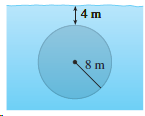
A vertical plate is submerged (or partially submerged) in water and has the indicated shape. Explain how to approximate the hydrostatic force against one side of the plate by a Riemann sum.Then express the force as an integral and evaluate it. 4 m 8 m
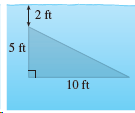
A vertical plate is submerged (or partially submerged) in water and has the indicated shape. Explain how to approximate the hydrostatic force against one side of the plate by a Riemann sum.Then express the force as an integral and evaluate it. 2 ft 5 ft 10 ft
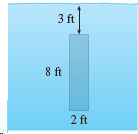
A vertical plate is submerged (or partially submerged) in water and has the indicated shape. Explain how to approximate the hydrostatic force against one side of the plate by a Riemann sum.Then express the force as an integral and evaluate it. 3 ft 8 ft 2 t
A tank is 8 m long, 4 m wide, 2 m high, and contains kerosene with density 820 kg/m3 to a depth of 1.5 m. Find(a) The hydrostatic pressure on the bottom of the tank,(b) The hydrostatic force on the bottom, and(c) The hydrostatic force on one end of the tank.
Show that if we rotate the curve y = ex/2 + e-x/2 about the x-axis, the area of the resulting surface is the same value as the enclosed volume for any interval a < x < b.
Use Simpson’s Rule with n = 10 to approximate the area of the surface obtained by rotating the curve about the x-axis. Compare your answer with the value of the integral produced by a calculator.y = xex, 0 < x < 1
Use Simpson’s Rule with n = 10 to approximate the area of the surface obtained by rotating the curve about the x-axis. Compare your answer with the value of the integral produced by a calculator.y = x + x2 , 0 < x < 1
Use Simpson’s Rule with n = 10 to approximate the area of the surface obtained by rotating the curve about the x-axis. Compare your answer with the value of the integral produced by a calculator.y = 1/5x5, 0 < x < 5
The given curve is rotated about the y-axis. Find the area of the resulting surface.y = 1/4x2 - 1/2, 1 < x < 2
The given curve is rotated about the y-axis. Find the area of the resulting surface.x3/2, + y3/2, = 1, 0 < x < 1
The given curve is rotated about the y-axis. Find the area of the resulting surface.y = 1/3x3/2, 0 < x < 12
Find the exact area of the surface obtained by rotating the curve about the x-axis.x = 1 + 2y2, 1 < y < 2
Find the exact area of the surface obtained by rotating the curve about the x-axis.x = 1/3(y2 +2)3/2, 1 < y < 2
Find the exact area of the surface obtained by rotating the curve about the x-axis.y = x3/6 + 1/2x, 1/2 < x < 1
Find the exact area of the surface obtained by rotating the curve about the x-axis.y = cos(1/2 x), 0 < x < π
Find the exact area of the surface obtained by rotating the curve about the x-axis.y = √1 + ex, 0 < x < 1
Find the exact area of the surface obtained by rotating the curve about the x-axis.y2 = x + 1, 0 < x < 3
Find the exact area of the surface obtained by rotating the curve about the x-axis.y = √5 - x, 3 < x < 5
Find the exact area of the surface obtained by rotating the curve about the x-axis.y = x3, 0 < x < 2
(a) Set up an integral for the area of the surface obtained by rotating the curve about (i) the x-axis and (ii) the y-axis.(b) Use the numerical integration capability of a calculator to evaluate the surface areas correct to four decimal places.y = tan-1 x, 0 < x < 2
(a) Set up an integral for the area of the surface obtained by rotating the curve about (i) the x-axis and (ii) the y-axis.(b) Use the numerical integration capability of a calculator to evaluate the surface areas correct to four decimal places.x = y + y3, 0 < y < 1
(a) Set up an integral for the area of the surface obtained by rotating the curve about (i) the x-axis and (ii) the y-axis.(b) Use the numerical integration capability of a calculator to evaluate the surface areas correct to four decimal places.x = In(2y + 1), 0 < y < 1
(a) Set up an integral for the area of the surface obtained by rotating the curve about (i) the x-axis and (ii) the y-axis.(b) Use the numerical integration capability of a calculator to evaluate the surface areas correct to four decimal places.y = e-x2, -1 < x < 1
(a) Set up an integral for the area of the surface obtained by rotating the curve about (i) the x-axis and (ii) the y-axis.(b) Use the numerical integration capability of a calculator to evaluate the surface areas correct to four decimal places.y = x-2, 1 < x < 2
(a) Set up an integral for the area of the surface obtained by rotating the curve about (i) the x-axis and (ii) the y-axis.(b) Use the numerical integration capability of a calculator to evaluate the surface areas correct to four decimal places.y = tan x, 0 < x < π/3
Find the length of the curve y= 1< x< 4 Vt3 – 1 dt
For the function f (x) = 1/4 ex + e-x, prove that the arc length on any interval has the same value as the area under the curve.
Use either a computer algebra system or a table of integrals to find the exact length of the arc of the curve y = ex that lies between the points (0, 1) and (2, e2).
Repeat Exercise 29 for the curvey = x + sin x 0 < x < 2πExercise 29 (a) Graph the curve y = x 3√4 - x , 0 < x < 4.(b) Compute the lengths of inscribed polygons with n = 1, 2, and 4 sides. (Divide the interval into equal sub-intervals.) Illustrate by sketching these polygons (as
(a) Graph the curve y = x 3√4 - x , 0 < x < 4.(b) Compute the lengths of inscribed polygons with n = 1, 2, and 4 sides. (Divide the interval into equal sub-intervals.) Illustrate by sketching these polygons (as in Figure 6).(c) Set up an integral for the length of the curve.(d) Use your
Use Simpson’s Rule with n = 10 to estimate the arc length of the curve. Compare your answer with the value of the integral produced by a calculator.y = e-x2, 0 < x < 2
Use Simpson’s Rule with n = 10 to estimate the arc length of the curve. Compare your answer with the value of the integral produced by a calculator.y = In (1 + x3), 0 < x < 5
Use Simpson’s Rule with n = 10 to estimate the arc length of the curve. Compare your answer with the value of the integral produced by a calculator.y = 3√x, 1 < x < 6
Use Simpson’s Rule with n = 10 to estimate the arc length of the curve. Compare your answer with the value of the integral produced by a calculator.y = x sin x, 0 < x < 2π
Graph the curve and visually estimate its length. Then use your calculator to find the length correct to four decimal places. y = x + cos x, 0 < x < π/2
Graph the curve and visually estimate its length. Then use your calculator to find the length correct to four decimal places.y = x2 + x3, 1 < x < 2
Showing 19000 - 19100
of 29454
First
184
185
186
187
188
189
190
191
192
193
194
195
196
197
198
Last
Step by Step Answers

 Get 50% OFF
Claim Now
Get 50% OFF
Claim Now


![dv -v[v? – (1 + a)v + a] dt](https://dsd5zvtm8ll6.cloudfront.net/si.question.images/images/question_images/1551/9/7/7/2955c814b4f840c81551960035551.jpg)