New Semester
Started
Get
50% OFF
Study Help!
--h --m --s
Claim Now
Question Answers
Textbooks
Find textbooks, questions and answers
Oops, something went wrong!
Change your search query and then try again
S
Books
FREE
Study Help
Expert Questions
Accounting
General Management
Mathematics
Finance
Organizational Behaviour
Law
Physics
Operating System
Management Leadership
Sociology
Programming
Marketing
Database
Computer Network
Economics
Textbooks Solutions
Accounting
Managerial Accounting
Management Leadership
Cost Accounting
Statistics
Business Law
Corporate Finance
Finance
Economics
Auditing
Tutors
Online Tutors
Find a Tutor
Hire a Tutor
Become a Tutor
AI Tutor
AI Study Planner
NEW
Sell Books
Search
Search
Sign In
Register
study help
mathematics
precalculus
Calculus Early Transcendentals 8th edition James Stewart - Solutions
Find the length of the arc of the curve from point P to point Q.x2 = (y - 4)3, p(1,5), Q(8, 8)
Find the exact length of the curve.y = 1 - e-x, 0 < x < 2
Find the exact length of the curve.y = In(1 - x2), 0 < x < 1/2
Find the exact length of the curve.y = √x - x2 + sin-1 (√x)
Find the exact length of the curve.y = 1/4x2 - 1/2In x, 1 < x < 2
Find the exact length of the curve.y = 3 + 1/2cosh 2x, 0 < x < 1
Find the exact length of the curve.y = In(sec x), 0 < x < π/4
Find the exact length of the curve. y = In(cos x), 0 < x < π/3
Find the exact length of the curve.x = y4/8 + 1/4y2, 1 < y < 2
Find the exact length of the curve.36y2 = (x2 - 4)2, 2 < x < 3, y > 0
Set up an integral that represents the length of the curve. Then use your calculator to find the length correct to four decimal places.y2 = In x, -1 < y < 1
Set up an integral that represents the length of the curve. Then use your calculator to find the length correct to four decimal places.x = √y - y, 1 < y < 4
Set up an integral that represents the length of the curve. Then use your calculator to find the length correct to four decimal places.x = y2 - 2y, 0 < y < 2
Set up an integral that represents the length of the curve. Then use your calculator to find the length correct to four decimal places.y = x - In x, 1 < x < 4
Set up an integral that represents the length of the curve. Then use your calculator to find the length correct to four decimal places.y = xe-x, 0 < x < 2
Set up an integral that represents the length of the curve. Then use your calculator to find the length correct to four decimal places.y = sin x, 0 < x < π
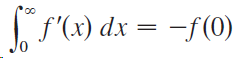
If f' is continuous on [0, ∞) and show that |lim, f(x) = 0, f'(x) dx = -f(0)
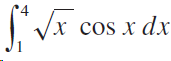
Use (a) the Trapezoidal Rule, (b) the Midpoint Rule, and (c) Simpson’s Rule with n = 10 to approximate the given integral.Round your answers to six decimal places. Vx cos x dx 1
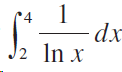
Use (a) the Trapezoidal Rule, (b) the Midpoint Rule, and (c) Simpson’s Rule with n = 10 to approximate the given integral.Round your answers to six decimal places. 1 dx 2 In x
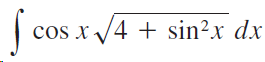
Use the Table of Integrals on the Reference Pages to evaluate the integral. cos x V4 + sin²x dx
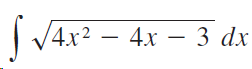
Use the Table of Integrals on the Reference Pages to evaluate the integral. /4x2 — 4х — 3 dx
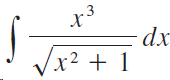
Evaluate the indefinite integral. Illustrate and check that your answer is reasonable by graphing both the function and its antiderivative (take C = 0). dx Vx2 + 1
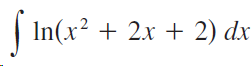
Evaluate the indefinite integral. Illustrate and check that your answer is reasonable by graphing both the function and its antiderivative (take C = 0). In(x² + 2x + 2) dx
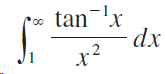
Evaluate the integral or show that it is divergent. tan-'x dx x² J1
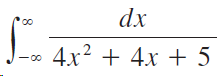
Evaluate the integral or show that it is divergent. dx .2 4x? + 4x + 5 -00
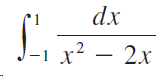
Evaluate the integral or show that it is divergent. dx Г. — 2х -1 X
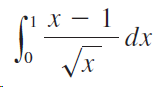
Evaluate the integral or show that it is divergent. х — 1 – dx Jo
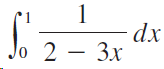
Evaluate the integral or show that it is divergent. 1 dx 2 - 3x
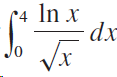
Evaluate the integral or show that it is divergent. *4 In x х
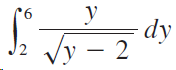
Evaluate the integral or show that it is divergent. 9. dy Уу J2 Vy – 2
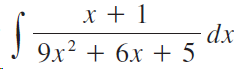
Evaluate the integral. 9x2 + 6x + 5
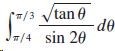
Evaluate the integral. /3 tan e de Sa/4 sin 20
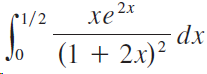
Evaluate the integral. c1/2 Xe2r 2х dx хе (1 + 2х)2
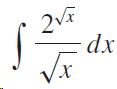
Evaluate the integral. х dx х
Evaluate the integral. (cos x + sin x)² cos 2x dx
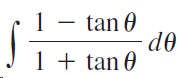
Evaluate the integral. tan 0 de 1 + tan 0
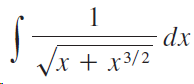
Evaluate the integral. dx Vx + x3/2
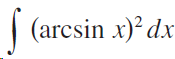
Evaluate the integral. (arcsin x)?dx
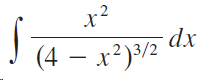
Evaluate the integral. -2 х dx 3/2 (4 — х?)92
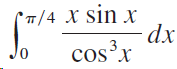
Evaluate the integral. 'T/4 X sin x dx cosx 3.
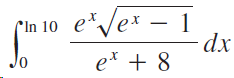
Evaluate the integral. e*Ve* – 1 dx CIn 10 e* + 8
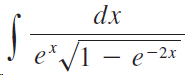
Evaluate the integral. dx e*/1 - e e-2x
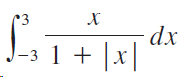
Evaluate the integral. *3 dx |-3 1 + |x|
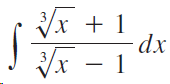
Evaluate the integral. Ух + 1 dx Ух - 1
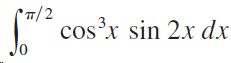
Evaluate the integral. T/2 cos'x sin 2x dx ""
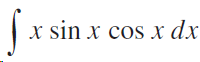
Evaluate the integral. x sin x cos x dx
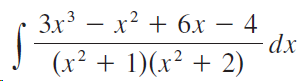
Evaluate the integral. Зх3 Зx3 — х2 + 6х — 4 dx (x² + 1)(x² + 2)
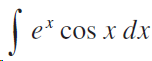
Evaluate the integral. e cos x dxr
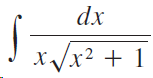
Evaluate the integral. dx XVx2 + 1
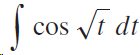
Evaluate the integral. Vī di cos
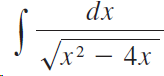
Evaluate the integral. dx Vx2 – 4x X,
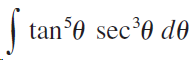
Evaluate the integral. tan°0 sec'0 de tar
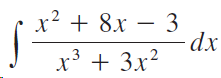
Evaluate the integral. + 8х — 3 .2 3 dx х3 + Зx2
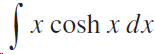
Evaluate the integral. x cosh x dx
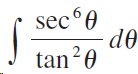
Evaluate the integral. sec°0 do tan²0
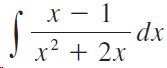
Evaluate the integral. х — 1 dx x? + 2х
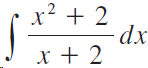
Evaluate the integral. .2 + 2 dx x + 2
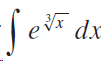
Evaluate the integral. dx х
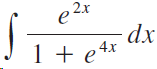
Evaluate the integral. 2х e?x dx 1 + e 4x
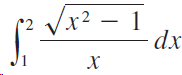
Evaluate the integral. Vx? – 1 dx C2
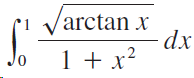
Evaluate the integral. /arctan x dx .2 1 + x?
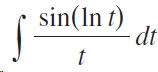
Evaluate the integral. sin(In t) dt
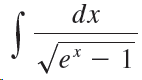
Evaluate the integral. dx le* – 1
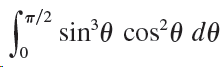
Evaluate the integral. T/2 sir sin'0 cos?0 d0
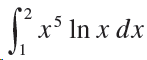
Evaluate the integral. '2 Гx5 In x dx х dx
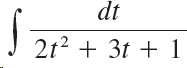
Evaluate the integral. dt 2t2 + 3t + 1
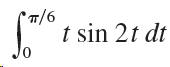
Evaluate the integral. *T/6 t sin 2t dt
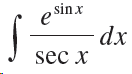
Evaluate the integral. ,sinx dx sec x
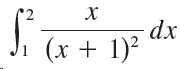
Evaluate the integral. r2 ·dp. (x + 1)? J1
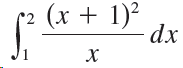
Evaluate the integral. (² (x + 1)² dx х
Determine whether the statement is true or false. If it is true, explain why. If it is false, explain why or give an example thatdisproves the statement.also diverges. If f(x) < g(x) and o g(x) dx diverges, then f, f(x) dx
Determine whether the statement is true or false. If it is true, explain why. If it is false, explain why or give an example that disproves the statement.are both divergent, thenis divergent. If * f(x) dx and * g(x) dx L[f(x) + g(x)] dx
Determine whether the statement is true or false. If it is true, explain why. If it is false, explain why or give an example that disproves the statement.
Determine whether the statement is true or false. If it is true, explain why. If it is false, explain why or give an example that disproves the statement.If f is a continuous, decreasing function on [1, ∞] and
Determine whether the statement is true or false. If it is true, explain why. If it is false, explain why or give an example that disproves the statement.If f is continuous on
Determine whether the statement is true or false. If it is true, explain why. If it is false, explain why or give an example that disproves the statement.(a) Every elementary function has an elementary derivative.(b) Every elementary function has an elementary antiderivative.
Determine whether the statement is true or false. If it is true, explain why. If it is false, explain why or give an example that disproves the statement.The Midpoint Rule is always more accurate than the Trapezoidal Rule.
Determine whether the statement is true or false. If it is true, explain why. If it is false, explain why or give an example that disproves the statement.If f is continuous, then f(x) dx = lim, - , f(x) dx.
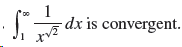
Determine whether the statement is true or false. If it is true, explain why. If it is false, explain why or give an example that disproves the statement. z dx is convergent.
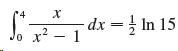
Determine whether the statement is true or false. If it is true, explain why. If it is false, explain why or give an example that disproves the statement. '4 dx = In 15 x? – 1
Determine whether the statement is true or false. If it is true, explain why. If it is false, explain why or give an example that disproves the statement. x? - 4 A - can be put in the form - + x(x² + 4) x² + 4
Determine whether the statement is true or false. If it is true, explain why. If it is false, explain why or give an example that disproves the statement. x? + 4 A can be put in the form x? x*(x – 4) x - 4
Determine whether the statement is true or false. If it is true, explain why. If it is false, explain why or give an example that disproves the statement. x? + 4 can be put in the form x(x? – 4) A B x + 2 х
Determine whether the statement is true or false. If it is true, explain why. If it is false, explain why or give an example that disproves the statement. x(x² + 4) x? - 4 A can be put in the form x + 2
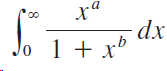
Show that if a > -1 and b > a + 1, then the following integral is convergent. dx Jo 1 + xb
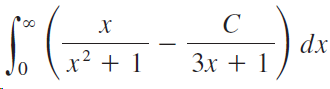
Find the value of the constant C for which the integralconverges. Evaluate the integral for this value of C. o, х dx Зх + 1 х + 1 .2
Show thatby interpreting the integrals as areas. Si e-*dx = {, /-In y dy
Show that So x'e* dx = } S%e*dx. 00
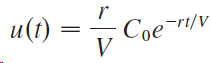
Dialysis treatment removes urea and other waste products from a patient’s blood by diverting some of the bloodflow externally through a machine called a dialyzer. The rate at which urea is removed from the blood (in mg/min) is often well described by the equationwhere r is the rate of flow of
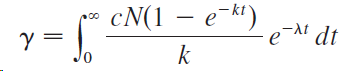
In a study of the spread of illicit drug use from an enthusiastic user to a population of N users, the authors model the number of expected new users by the equationwhere c, k and are positive constants. Evaluate this integral to express λ in terms of c, N, k, and . cN(1 – e-k') e-^ dt 00 k
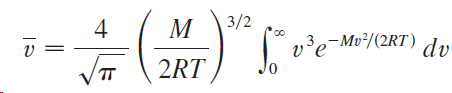
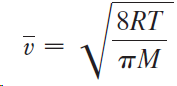
The average speed of molecules in an ideal gas iswhere M is the molecular weight of the gas, R is the gas constant, T is the gas temperature, and v is the molecular speed. Show that 3/2 4 ,3-Mv²/(2RT) dy v³e v'e 2RT TT 8RT пМ
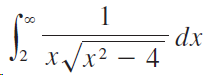
Evaluateby the same method as in Exercise 55. dx x/x? – 4 o, -2 )2 х.
Sketch the region and find its area (if the area is finite). S = {(x, y) | x > 0, 0 < y< xe¯*}
Sketch the region and find its area (if the area is finite). S = {(x, y) | x> 1, 0 < y< 1/(x³ + x)}
Sketch the region and find its area (if the area is finite). S= {(x, y) | x < 0, 0 < y< e*}
Sketch the region and find its area (if the area is finite). S = {(x, y) | x> 1, 0 < y
Determine whether each integral is convergent or divergent. Evaluate those that are convergent.
Determine whether each integral is convergent or divergent. Evaluate those that are convergent. e/x аз .3 -1 X |-1
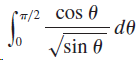
Determine whether each integral is convergent or divergent. Evaluate those that are convergent. *m/2 Cos 0 -de Jo /sin 0
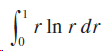
Determine whether each integral is convergent or divergent. Evaluate those that are convergent. r In r dr
Showing 19100 - 19200
of 29454
First
185
186
187
188
189
190
191
192
193
194
195
196
197
198
199
Last
Step by Step Answers

 Get 50% OFF
Claim Now
Get 50% OFF
Claim Now






![L[f(x) + g(x)] dx](https://dsd5zvtm8ll6.cloudfront.net/si.question.images/images/question_images/1551/7/0/4/3255c7d21050fa0a1551687050835.jpg)

![IS) + g(x)]dx](https://dsd5zvtm8ll6.cloudfront.net/si.question.images/images/question_images/1551/7/0/4/3745c7d2136456861551687100067.jpg)