New Semester
Started
Get
50% OFF
Study Help!
--h --m --s
Claim Now
Question Answers
Textbooks
Find textbooks, questions and answers
Oops, something went wrong!
Change your search query and then try again
S
Books
FREE
Study Help
Expert Questions
Accounting
General Management
Mathematics
Finance
Organizational Behaviour
Law
Physics
Operating System
Management Leadership
Sociology
Programming
Marketing
Database
Computer Network
Economics
Textbooks Solutions
Accounting
Managerial Accounting
Management Leadership
Cost Accounting
Statistics
Business Law
Corporate Finance
Finance
Economics
Auditing
Tutors
Online Tutors
Find a Tutor
Hire a Tutor
Become a Tutor
AI Tutor
AI Study Planner
NEW
Sell Books
Search
Search
Sign In
Register
study help
mathematics
precalculus
Precalculus 9th edition Michael Sullivan - Solutions
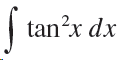
Evaluate the integral. tan?x dx
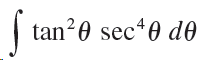
Evaluate the integral. tan?0 sec*0 d0
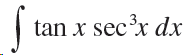
Evaluate the integral. tan x sec' x dx
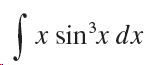
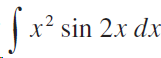
Evaluate the integral. x sin'x dx
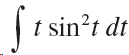
Evaluate the integral. t sin?t dt
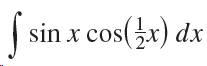
Evaluate the integral. sin x cos(x) dx
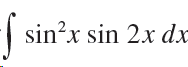
Evaluate the integral. sin?x sin 2x dx
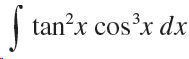
Evaluate the integral. tanʼx cos'x dx
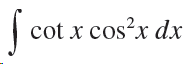
Evaluate the integral. cot x cos?x dx
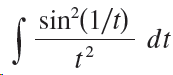
Evaluate the integral. sin°(1/t) dt 2
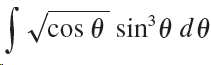
Evaluate the integral. | ycos 0 sin'0 de
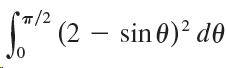
Evaluate the integral.
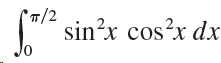
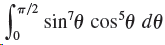
Evaluate the integral. *T/2 sin?x cos?x dxr Jo 5/2 2.
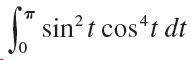
Evaluate the integral. sin?t cos*t dt т
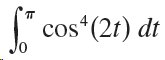
Evaluate the integral. т cos*(2t) dt
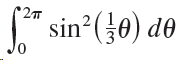
Evaluate the integral. de 2 op (0f).u!
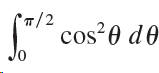
Evaluate the integral. п /2 cos?0 d0
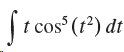
Evaluate the integral. |t cos (t2) dt
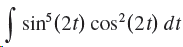
Evaluate the integral. sin (2t) cos (2t) dt
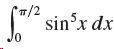
Evaluate the integral. (T/2 sin'x dx
Evaluate the integral. sin'e cos'e de 7/2
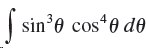
Evaluate the integral. sin'0 cos*e de
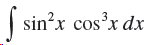
Evaluate the integral. | sin?x cos'x dx
(a) Use integration by parts to show that(b) If f and g are inverse functions and f' is continuous, prove that(c) In the case where f and t are positive functions and b > a > 0, draw a diagram to give a geometric interpretation of part (b).(d) Use part (b) to evaluate ∫e1 ln x dx. | xf'(x)
If f(0) = g(0) = 0 and f'' and g'' are continuous, show that
The Fresnel function was discussed in Example 5.3.3 and is used extensively in the theory of optics. Find ∫ S(x) dx. [Your answer will involve S(x).] S(x) = f* sin(; 11²) dt
Calculate the volume generated by rotating the region bounded by the curves y = ln x, y = 0, and x = 2 about each axis.(a) The y-axis(b) The x-axis
Use the method of cylindrical shells to find the volume generated by rotating the region bounded by the curves about the given axis.y = ex, x = 0, y = 3; about the x-axis
Use the method of cylindrical shells to find the volume generated by rotating the region bounded by the curves about the given axis.y = ex, y − e-x, x = 1; about the y-axis
Use the method of cylindrical shells to find the volume generated by rotating the region bounded by the curves about the given axis.about the y-axis y = cos(Tx/2), y = 0, 0
Use a graph to find approximate x-coordinates of the points of intersection of the given curves. Then find (approximately) the area of the region bounded by the curves. у %3 х In(x + 1), у3 Зх — х*
Use a graph to find approximate x-coordinates of the points of intersection of the given curves. Then find (approximately) the area of the region bounded by the curves. aresin(x), y = 2 – x² y =
Find the area of the region bounded by the given curves. y = x²e*, у — хе
Find the area of the region bounded by the given curves. y=4 ln x y = x² In x,
Use integration by parts to prove the reduction formula.
Use integration by parts to prove the reduction formula. r"e*dx = x"e* – n x-'e*dx х"е*dx — х"е* - -"faт x"-'e*dx — і п
Prove that, for even powers of sine, (2n – 1) 1:3: 5 *T/2 |" sin2"x dx 2·4· 6 2n ... ·
(a) Prove the reduction formula(b) Use part (a) to evaluate ∫ cos2x dx.(c) Use parts (a) and (b) to evaluate ∫ cos4x dx. п — 1 cos"- ·cos"-'x sin x + cos"x dx cos"-2x dx п п
Evaluate the indefinite integral. Illustrate, and check that your answer is reasonable, by graphing both the function and its antiderivative (take C = 0). St sin 2x dx x?
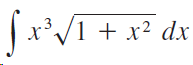
Evaluate the indefinite integral. Illustrate, and check that your answer is reasonable, by graphing both the function and its antiderivative (take C = 0). .3 x'V1 dx + x²
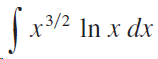
Evaluate the indefinite integral. Illustrate, and check that your answer is reasonable, by graphing both the function and its antiderivative (take C = 0). x3/2 In x dx
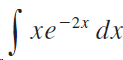
Evaluate the indefinite integral. Illustrate, and check that your answer is reasonable, by graphing both the function and its antiderivative (take C = 0). -2х хе dx
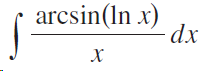
First make a substitution and then use integration by parts to evaluate the integral. arcsin(In x) dx х
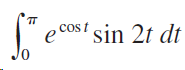
First make a substitution and then use integration by parts to evaluate the integral. cos t sin 2t dt т e°
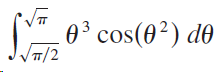
First make a substitution and then use integration by parts to evaluate the integral. УT 0' cos(0?) dө /п/2
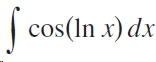
First make a substitution and then use integration by parts to evaluate the integral. cos(In x) dx
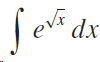
First make a substitution and then use integration by parts to evaluate the integral. х dx
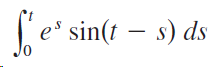
Evaluate the integral. 1. e' sin(t – s) ds
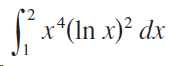
Evaluate the integral. r*(In x)² dx 1x
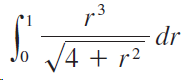
Evaluate the integral. r3 dr 4 + r² V
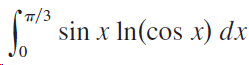
Evaluate the integral. *T/3 sin x In(cos x) dx
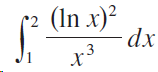
Evaluate the integral. (In x)? — dх '2 л +3
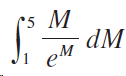
Evaluate the integral. *5 M dM Л ем
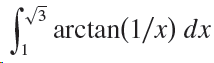
Evaluate the integral. V3 n(1/x) dx arcta
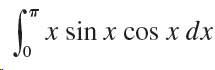
Evaluate the integral. IT x sin x cos x dx
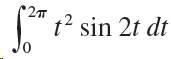
Evaluate the integral. t² sin 2t dt *2
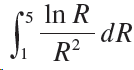
Evaluate the integral. rs In R dR R?
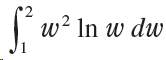
Evaluate the integral. w² In w dw
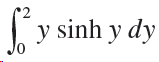
Evaluate the integral. | y sinh y dy
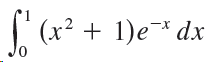
Evaluate the integral. | (x² + 1)e* dx Jo
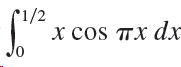
Evaluate the integral. *1/2 х coS TX dx
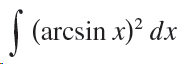
Evaluate the integral. (arcsin x)? dx
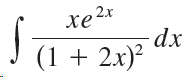
Evaluate the integral. 2х te2x dx J (1 + 2x)?
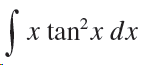
Evaluate the integral. x tan?x dx
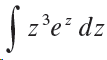
Evaluate the integral.
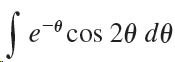
Evaluate the integral. e- cos 20 de
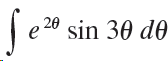
Evaluate the integral. 20 e 20 sin 30 de
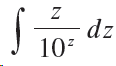
Evaluate the integral. dz 10
A cylindrical container of radius r and height L is partially filled with a liquid whose volume is V. If the container is rotated about its axis of symmetry with constant angular speed, then the container will induce a rotational motion in the liquid around the same axis. Eventually, the liquid
Find the average value of the function f (t) = sec2 t on the interval [0, π/4].
Set up, but do not evaluate, an integral for the volume of the solid obtained by rotating the region bounded by the given curves about the specified axis.y = tan x, y = x, x = π/3; about the y-axis
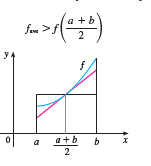
Use the diagram to show that if f is concave upward on [a, b], then +b fon >. a+b 2
Use the result of Exercise 5.5.83 to compute the average volume of inhaled air in the lungs in one respiratory cycle.
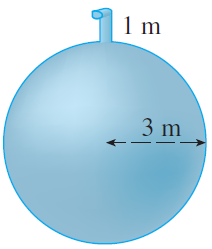
Solve Exercise 24 if the tank is half full of oil that has a density of 900 kg/m3.
A tank is full of water. Find the work required to pump the water out of the spout. In Exercises 25 and 26 use the fact that water weighs 62.5 lb/ft3. 3 m
Find the volume of the solid obtained by rotating the region bounded by the given curves about the specified line. Sketch the region, the solid, and a typical disk or washer.about the y-axis у? — х, х %3D2y;
Sketch the region enclosed by the given curves and find its area.y = x4, y = 2 -|x|
Sketch the region enclosed by the given curves and find its area.y = x3, y = x
If f is continuous and ∫20 f (x) dx = 6, evaluate ∫20 f (2 sinθ) cos θ d θ.
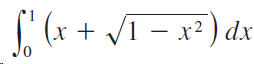
Evaluateby interpreting it in terms of areas. C (r + VI - x² ) dx 0.
Determine whether the statement is true or false. If it is true, explain why. If it is false, explain why or give an example that disproves the statement.If f has a discontinuity at 0, then ∫1-1 f (x) dx does not exist.
Determine whether the statement is true or false. If it is true, explain why. If it is false, explain why or give an example that disproves the statement.∫1-2 1/x4 dx = - 3/8
Determine whether the statement is true or false. If it is true, explain why. If it is false, explain why or give an example that disproves the statement.∫20 (x - x3) dx represents the area under the curve y = x - x3 from 0 to 2.
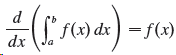
Determine whether the statement is true or false. If it is true, explain why. If it is false, explain why or give an example that disproves the statement.If f is continuous on [a, b], then ) =f(x) f(x) dx dx
Determine whether the statement is true or false. If it is true, explain why. If it is false, explain why or give an example that disproves the statement.If ∫10 f (x) dx = 0, then f (x) = 0 for 0 < x < 1.
Determine whether the statement is true or false. If it is true, explain why. If it is false, explain why or give an example that disproves the statement.∫30 ex2 + dx = ∫50 ex2 + dx + ∫35 ex2 + dx
Determine whether the statement is true or false. If it is true, explain why. If it is false, explain why or give an example that disproves the statement.All continuous functions have antiderivatives.
Determine whether the statement is true or false. If it is true, explain why. If it is false, explain why or give an example that disproves the statement.All continuous functions have derivatives.
Determine whether the statement is true or false. If it is true, explain why. If it is false, explain why or give an example that disproves the statement.∫5-5(ax2 + bx + c) dx = 2 ∫50 (x4 + c) dx
Determine whether the statement is true or false. If it is true, explain why. If it is false, explain why or give an example that disproves the statement.∫1-1(x5 - 6x9 + sin x/(1 + x4)2 ) dx = 0
Determine whether the statement is true or false. If it is true, explain why. If it is false, explain why or give an example that disproves the statement.If f and g are differentiable and f (x) > g(x) for a < x < b, then f' (x) > g' (x) for a < x < b.
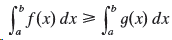
Determine whether the statement is true or false. If it is true, explain why. If it is false, explain why or give an example that disproves the statement.If f and g are continuous and f (x) > g(x) for a < x < b, then 9. Sf(x) dx > g(x) dx
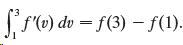
Determine whether the statement is true or false. If it is true, explain why. If it is false, explain why or give an example that disproves the statement.If f' is continuous on [1, 3], then Sf(e) dv = f(3) – f(1).
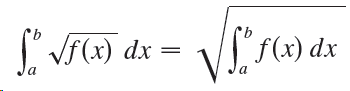
Determine whether the statement is true or false. If it is true, explain why. If it is false, explain why or give an example that disproves the statement.If f is continuous on [a, b] and f (x) > 0, then
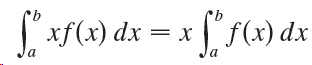
Determine whether the statement is true or false. If it is true, explain why. If it is false, explain why or give an example that disproves the statement.If f is continuous on [a, b], then xf(x) dx = x f(x) dx
Determine whether the statement is true or false. If it is true, explain why. If it is false, explain why or give an example that disproves the statement.If f and t are continuous on [a, b], then [fx) + g(x)] dx = f(x) dx + g(x) dx
True or False.The solution of the equation 3x - 8 = 0 is 3/8.
True or False.Squaring both sides of an equation results in an equivalent equation.
True or False.√x2 = |x|.
An equation that is satisfied for every choice of the variable for which both sides are defined is called a(n) __________.
Showing 19500 - 19600
of 29454
First
189
190
191
192
193
194
195
196
197
198
199
200
201
202
203
Last
Step by Step Answers

 Get 50% OFF
Claim Now
Get 50% OFF
Claim Now
















![[fx) + g(x)] dx = f(x) dx + g(x) dx](https://dsd5zvtm8ll6.cloudfront.net/si.question.images/images/question_images/1550/7/4/5/1025c6e7e0edc9b11550727814822.jpg)


