New Semester
Started
Get
50% OFF
Study Help!
--h --m --s
Claim Now
Question Answers
Textbooks
Find textbooks, questions and answers
Oops, something went wrong!
Change your search query and then try again
S
Books
FREE
Study Help
Expert Questions
Accounting
General Management
Mathematics
Finance
Organizational Behaviour
Law
Physics
Operating System
Management Leadership
Sociology
Programming
Marketing
Database
Computer Network
Economics
Textbooks Solutions
Accounting
Managerial Accounting
Management Leadership
Cost Accounting
Statistics
Business Law
Corporate Finance
Finance
Economics
Auditing
Tutors
Online Tutors
Find a Tutor
Hire a Tutor
Become a Tutor
AI Tutor
AI Study Planner
NEW
Sell Books
Search
Search
Sign In
Register
study help
mathematics
precalculus
Precalculus 9th edition Michael Sullivan - Solutions
Write each statement as an inequality.y is greater than -5
Write each statement as an inequality.x is less than 2
Write each statement as an inequality.z is negative
Write each statement as an inequality.x is positive
Replace the question mark by <, > or = whichever is correct.1/4 ? 0.25
Replace the question mark by <, > or = whichever is correct.2/3 ? 0.67
Replace the question mark by <, > or = whichever is correct.1/3 ? 0.33
Replace the question mark by <, > or = whichever is correct.1/2 ? 0.5
Replace the question mark by <, > or = whichever is correct.√2 ? 1.41
Replace the question mark by <, > or = whichever is correct.π ? 3.14
Replace the question mark by <, > or = whichever is correct.-3 ? -5/2
Replace the question mark by <, > or = whichever is correct.-1 ? -2
Replace the question mark by <, > or = whichever is correct.5 ? 6
Replace the question mark by <, > or = whichever is correct.1/2 ? 0
On the real number line, label the points with coordinates 0, -2, 2, -1.5, 3/2, 1/3 and 2/3.
On the real number line, label the points with coordinates 0, 1, -1, -2.5, 3/4 and 0.25.
Use U universal set = {0, 1, 2, 3, 4, 5, 6, 7, 8, 9}, A = {1, 3, 4, 5, 9}, and C = {1,3,4,6} to find the set. (A̅ ∩ B̅)
Use U universal set = {0, 1, 2, 3, 4, 5, 6, 7, 8, 9}, A = {1, 3, 4, 5, 9}, and C = {1,3,4,6} to find the set. (A̅ ∪ B̅)
Use U universal set = {0, 1, 2, 3, 4, 5, 6, 7, 8, 9}, A = {1, 3, 4, 5, 9}, and C = {1,3,4,6} to find the set. BUC
Use U universal set = {0, 1, 2, 3, 4, 5, 6, 7, 8, 9}, A = {1, 3, 4, 5, 9}, and C = {1,3,4,6} to find the set. ANB
Use U universal set = {0, 1, 2, 3, 4, 5, 6, 7, 8, 9}, A = {1, 3, 4, 5, 9}, and C = {1,3,4,6} to find the set. C̅
Use U universal set = {0, 1, 2, 3, 4, 5, 6, 7, 8, 9}, A = {1, 3, 4, 5, 9}, and C = {1,3,4,6} to find the set. A̅
Use U universal set = {0, 1, 2, 3, 4, 5, 6, 7, 8, 9}, A = {1, 3, 4, 5, 9}, and C = {1,3,4,6} to find the set. (A ∩ B) ∪ C
Use U universal set = {0, 1, 2, 3, 4, 5, 6, 7, 8, 9}, A = {1, 3, 4, 5, 9}, and C = {1,3,4,6} to find the set. (A ∪ B) ∩ C
Use U universal set = {0, 1, 2, 3, 4, 5, 6, 7, 8, 9}, A = {1, 3, 4, 5, 9}, and C = {1,3,4,6} to find the set. A ∩ C
Use U universal set = {0, 1, 2, 3, 4, 5, 6, 7, 8, 9}, A = {1, 3, 4, 5, 9}, and C = {1,3,4,6} to find the set. A ∩ B
Use U universal set = {0, 1, 2, 3, 4, 5, 6, 7, 8, 9}, A = {1, 3, 4, 5, 9}, and C = {1,3,4,6} to find the set. A ∪ C
Use U universal set = {0, 1, 2, 3, 4, 5, 6, 7, 8, 9}, A = {1, 3, 4, 5, 9}, and C = {1,3,4,6} to find the set. A ∪ B
True or False.To multiply two expressions having the same base, retain the base and multiply the exponents.
True or False.The absolute value of a real number is always greater than zero.
True or False.The distance between two distinct points on the real number line is always greater than zero.
True or False.The product of two negative real numbers is always greater than zero.
In the expression 24, the number 2 is called the______and 4 is called the_______.
An inequality of the form a > b is called a(n)________inequality.
On the real number line, the real number zero is the coordinate of the _______.
A(n) ______is a letter used in algebra to represent any number from a given set of numbers
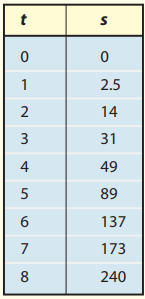
A particle is moving along a straight line according to some position function s(t). The distance (in feet) of the particle, s, from its starting point after t seconds is given in the table. Find the average rate of change of distance from t = 3 to t = 6 seconds. 2.5 14 3 31 49 89 137 173 8
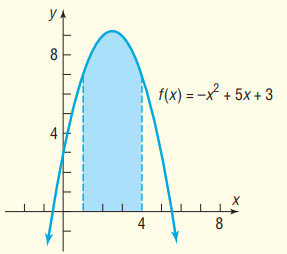
Write the integral that represents the shaded area. Do not attempt to evaluate. УА 8 f(x) = -x + 5x + 3 4 8
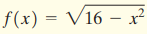
The function is defined on the interval [0, 4].(a) Graph f.(b) Partition [0, 4] into eight subintervals of equal length and choose u as the left endpoint of each subinterval. Use the partition to approximate the area under the graph of f and above the x-axis from x - 0 to x =
For the function f(x) = 4x2 – 11x – 3:(a) Find the derivative of f at x = 2.(b) Find the equation of the tangent line to the graph of f at the point (2, -9).(c) Graph f and the tangent line.
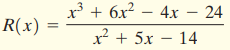
Determine where the rational function is undefined. Determine whether an asymptote or a hole appears at such numbers. 4x x + 6x? – 4r – 24 R(x) x + 5x – 14 %3D
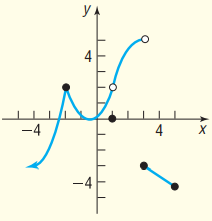
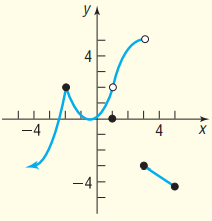
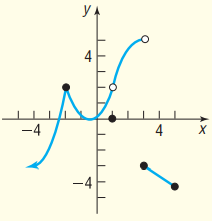
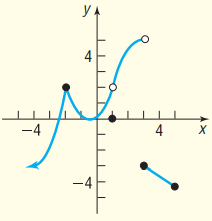
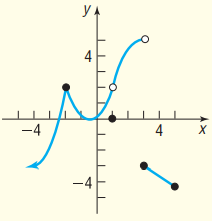
Use the accompanying graph of y = f(x). Determine whether f is continuous at each of the following numbers. If it is not, explain why not. (a) x = -2(b) x = 1(c) x = 3 (d) x = 4 УА -4 4 4, 4.
Use the accompanying graph of y = f(x). Does exist? If so, what is it? If not, explain why not. УА -4 4 4, 4. lim f(x)
Use the accompanying graph of y = f(x). Find УА -4 4 4, 4. lim f(x)
Use the accompanying graph of y = f(x). Find УА -4 4 4, 4. lim f(x) 3'
Use the accompanying graph of y = f(x). Find
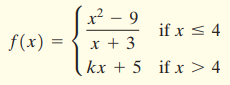
Determine the value for k that will make the function continuous at c = 4. x? – 9 x + 3 kx + 5 if x > 4 if x < 4 f(x) =
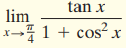
Find the limit. tan x lim r→1 + cos².x
Find the limit. lim (3x)(x – 2)2]|
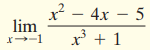
Find the limit. Find each limit. x — 4х — 5 х + 1 lim х>-1
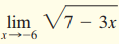
Find the limit. lim V7 - 3x
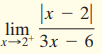
Find the limit.
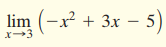
Find the limit. lim (-x + 3x – 5) x² + 3x · lim Зх
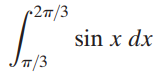
An integral is given. (a) What area does the integral represent? (b) Provide a graph that illustrates this area. (c) Use a graphing utility to approximate this area. -2п/3 sin x dx T/3
An integral is given. (a) What area does the integral represent? (b) Provide a graph that illustrates this area. (c) Use a graphing utility to approximate this area. Г- e* dx J-1
An integral is given. (a) What area does the integral represent? (b) Provide a graph that illustrates this area. (c) Use a graphing utility to approximate this area. Vx dx
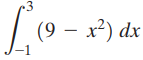
An integral is given. (a) What area does the integral represent? (b) Provide a graph that illustrates this area. (c) Use a graphing utility to approximate this area. (9 — х') dx -1
A function is defined over an interval [a, b].(a) Graph indicating the area A under from a to b. (b) Approximate the area A by partitioning [a, b] into three subintervals of equal length and choosing u as the left endpoint of each subinterval. (c) Approximate the area A by partitioning
A function is defined over an interval [a, b].(a) Graph indicating the area A under from a to b. (b) Approximate the area A by partitioning [a, b] into three subintervals of equal length and choosing u as the left endpoint of each subinterval. (c) Approximate the area A by partitioning
A function is defined over an interval [a, b].(a) Graph indicating the area A under from a to b. (b) Approximate the area A by partitioning [a, b] into three subintervals of equal length and choosing u as the left endpoint of each subinterval. (c) Approximate the area A by partitioning
A function is defined over an interval [a, b].(a) Graph indicating the area A under from a to b. (b) Approximate the area A by partitioning [a, b] into three subintervals of equal length and choosing u as the left endpoint of each subinterval. (c) Approximate the area A by partitioning
Repeat Problem 75 for f(x) = -2x + 9.Data From problem 75.The function f(x) = 2x + 3 is is defined on the interval [0, 4].(a) Graph In (b)–(e), approximate the area A under from to as follows: (b) Partition [0, 4] into four subintervals of equal length and choose u as the left endpoint of
The function f(x) = 2x + 3 is is defined on the interval [0, 4].(a) Graph In (b)–(e), approximate the area A under from to as follows: (b) Partition [0, 4] into four subintervals of equal length and choose u as the left endpoint of each subinterval. (c) Partition [0, 4] into four
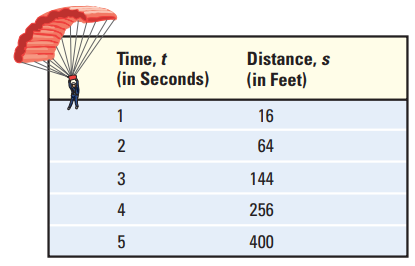
The following data represent the distance s (in feet) that a parachutist has fallen over time t (in seconds). (a) Find the average speed from t = 1 to t = 4 seconds. (b) Find the average speed from t = 1 to t = 3 seconds. (c) Find the average speed from t = 1 to t = 2
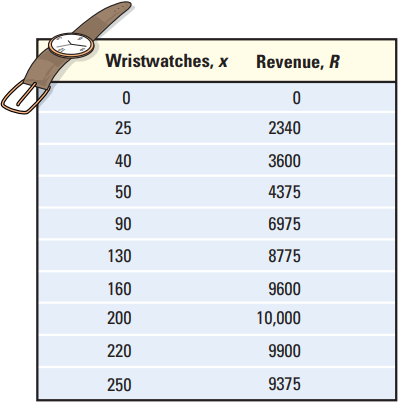
The following data represent the revenue R (in dollars) received from selling x wristwatches at Wilk’s Watch Shop(a) Find the average rate of change of revenue from x = 25 to x = 130 wristwatches. (b) Find the average rate of change of revenue from x = 25 to x = 90 wristwatches. (c)
The area A of a circle is πr2. Find the instantaneous rate of change of area with respect r at r = 2 feet. What is the average rate of change from r = 2 to r = 3? What is the average rate of change from r = 2 to r = 2.5? From r = 2 to r = 2.1?
In physics, it is shown that the height s of a ball thrown straight up with an initial speed of 96 ft sec from a rooftop 112 feet high iss = s(t) = -16 t2 + 96t + 112where t is the elapsed time that the ball is in the air. The ball misses the rooftop on its way down and eventually strikes the
Find the derivative of each function at the number indicated using a graphing utility.f(x) = x secx at π/6
Find the derivative of each function at the number indicated using a graphing utility.f(x) = x3 tanx at π/6
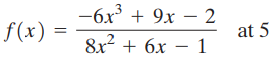
Find the derivative of each function at the number indicated using a graphing utility. -6x + 9x – 2 at 5 8x2 + 6x – 1 f(x)
Find the derivative of each function at the number indicated using a graphing utility.f(x) = 4x4 – 3x3 + 6x – 9 at -2
Find the derivative of each function at the number indicated. f(x) = 3x2 – 4x + 1 at 2
Find the derivative of each function at the number indicated. f(x) = 2x2 + 3x + 2 at 1
Find the derivative of each function at the number indicated. f(x) = 2x2 + 4x at -1
Find the derivative of each function at the number indicated. f(x) = x2 – 3x at 0
Find the derivative of each function at the number indicated. f(x) = -4 + 3x2 at 1
Find the derivative of each function at the number indicated. f(x) = -4x2 + 5 at 3
Find the slope of the tangent line to the graph of at the given point. Graph and the tangent line. f(x) = x3 – x2 at (1, 0)
Find the slope of the tangent line to the graph of at the given point. Graph and the tangent line. f(x) = x3 + x2 at (2, 12)
Find the slope of the tangent line to the graph of at the given point. Graph and the tangent line. f(x) = 2x2 + 5x – 3 at (1, 4)
Find the slope of the tangent line to the graph of at the given point. Graph and the tangent line. f(x) = x2 + 2x – 3x – 3 at (-1, -4)
Find the slope of the tangent line to the graph of at the given point. Graph and the tangent line. f(x) = 3x2 – 6x at (0, 0)
Find the slope of the tangent line to the graph of at the given point. Graph and the tangent line. f(x) = 2x2 + 8x at (1, 10)
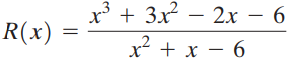
Determine where each rational function is undefined. Determine whether an asymptote or a hole appears at such numbers. x' + 3x – 2x – 6 R(x) x² + x – 6
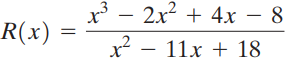
Determine where each rational function is undefined. Determine whether an asymptote or a hole appears at such numbers. x' - 2x? + 4x – 8 R(x) x? - 11x + 18
Discuss whether R is continuous at c. Use limits to analyze the graph of R at c. 3x2 + 6x at c = -2 and c = 2 R(x)
Discuss whether R is continuous at c. Use limits to analyze the graph of R at c. x + 4 R(x) at c = -4 and c = 4 2 – 16 х
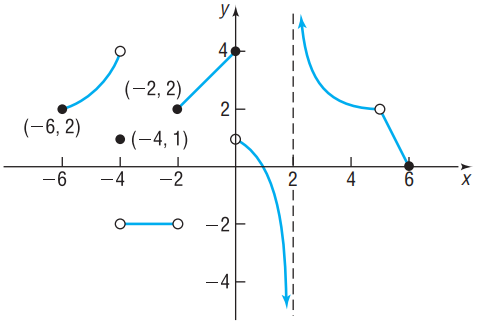
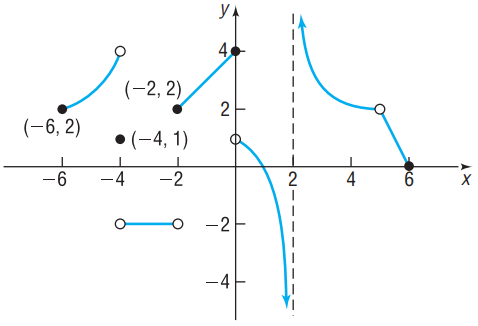
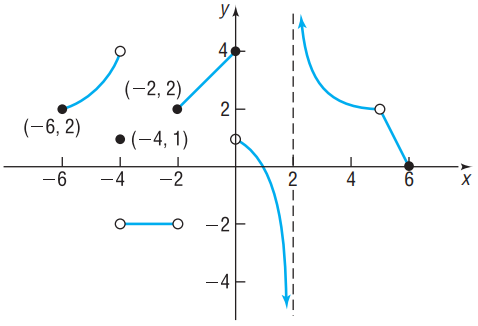
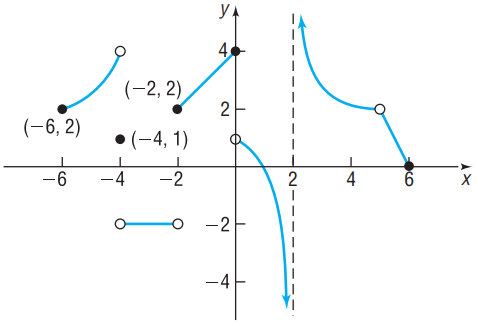
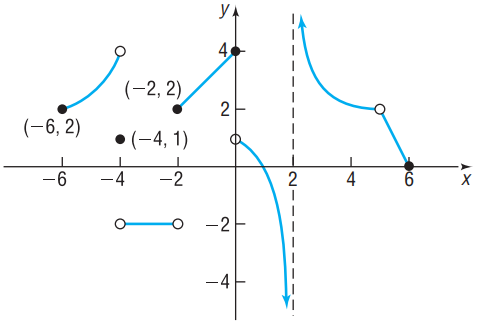
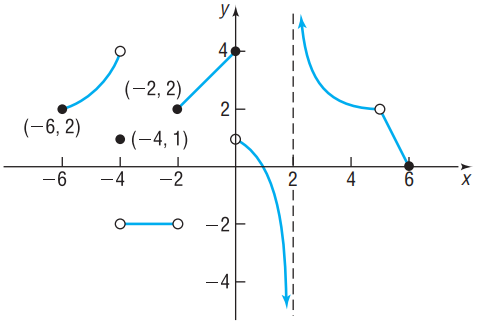
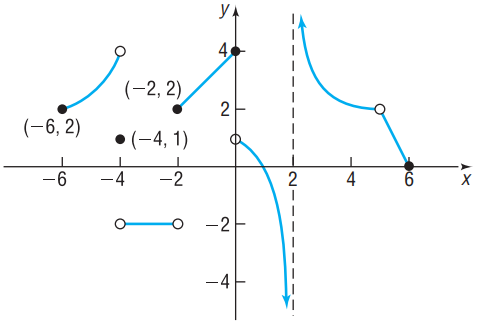
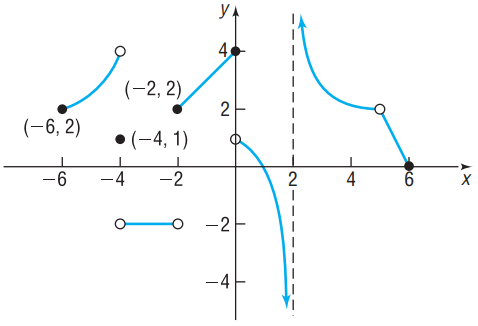
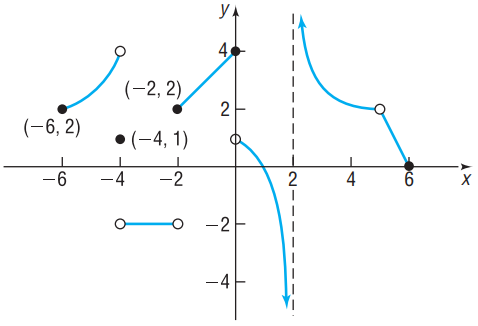
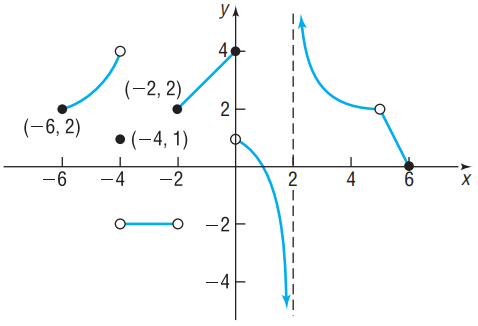
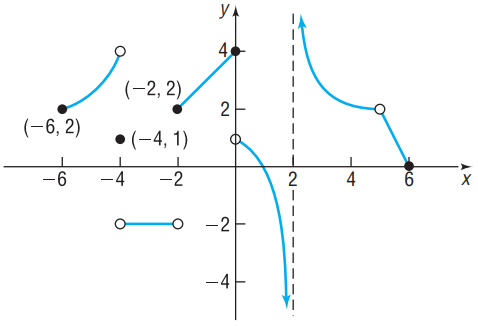
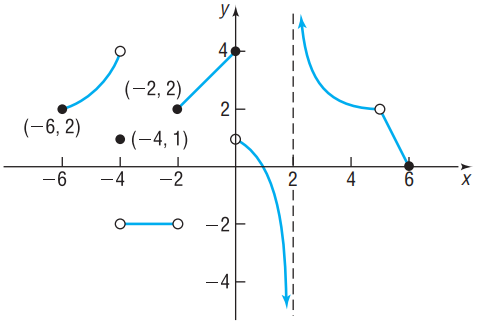
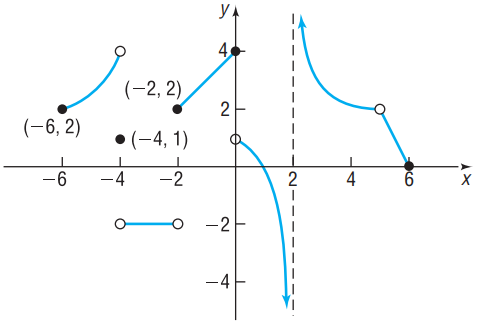
Use the accompanying graph of y = f(x).Is f continuous at 5? УА 4 (-2, 2) (-6, 2) • (-4, 1) -6 -4 -2 4 -2 -4
Use the accompanying graph of y = f(x).Is f continuous at 4? УА 4 (-2, 2) (-6, 2) • (-4, 1) -6 -4 -2 4 -2 -4
Use the accompanying graph of y = f(x).Is f continuous at 2? УА 4 (-2, 2) (-6, 2) • (-4, 1) -6 -4 -2 4 -2 -4
Use the accompanying graph of y = f(x).Is f continuous at 0? УА 4 (-2, 2) (-6, 2) • (-4, 1) -6 -4 -2 4 -2 -4
Use the accompanying graph of y = f(x).Is f continuous at -4? УА 4 (-2, 2) (-6, 2) • (-4, 1) -6 -4 -2 4 -2 -4
Use the accompanying graph of y = f(x).Is f continuous at -2? УА 4 (-2, 2) (-6, 2) • (-4, 1) -6 -4 -2 4 -2 -4
Use the accompanying graph of y = f(x).Does exist? If it does, what is it? lim f(x) УА 4 (-2, 2) (-6, 2) • (-4, 1) -6 -4 -2 4 -2 -4
Use the accompanying graph of y = f(x).Does exist? If it does, what is it? lim f(x) УА 4 (-2, 2) (-6, 2) • (-4, 1) -6 -4 -2 4 -2 -4
Use the accompanying graph of y = f(x).Find . | lim f(x) r→2* УА 4 (-2, 2) (-6, 2) • (-4, 1) -6 -4 -2 4 -2 -4
Use the accompanying graph of y = f(x).Find . lim f(x) x-2 УА 4 (-2, 2) (-6, 2) • (-4, 1) -6 -4 -2 4 -2 -4
Use the accompanying graph of y = f(x).Find . lim f(x) -2' lin УА 4 (-2, 2) (-6, 2) • (-4, 1) -6 -4 -2 4 -2 -4
Use the accompanying graph of y = f(x).Find . lim f(x) r→-2- УА 4 (-2, 2) (-6, 2) • (-4, 1) -6 -4 -2 4 -2 -4
Use the accompanying graph of y = f(x).Find . lim f(x) x), УА 4 (-2, 2) (-6, 2) • (-4, 1) -6 -4 -2 4 -2 -4
Showing 20100 - 20200
of 29454
First
195
196
197
198
199
200
201
202
203
204
205
206
207
208
209
Last
Step by Step Answers

 Get 50% OFF
Claim Now
Get 50% OFF
Claim Now








![lim (3x)(x – 2)2]|](https://dsd5zvtm8ll6.cloudfront.net/si.question.images/images/question_images/1552/4/7/4/2165c88e068c5ca01552456972612.jpg)