New Semester
Started
Get
50% OFF
Study Help!
--h --m --s
Claim Now
Question Answers
Textbooks
Find textbooks, questions and answers
Oops, something went wrong!
Change your search query and then try again
S
Books
FREE
Study Help
Expert Questions
Accounting
General Management
Mathematics
Finance
Organizational Behaviour
Law
Physics
Operating System
Management Leadership
Sociology
Programming
Marketing
Database
Computer Network
Economics
Textbooks Solutions
Accounting
Managerial Accounting
Management Leadership
Cost Accounting
Statistics
Business Law
Corporate Finance
Finance
Economics
Auditing
Tutors
Online Tutors
Find a Tutor
Hire a Tutor
Become a Tutor
AI Tutor
AI Study Planner
NEW
Sell Books
Search
Search
Sign In
Register
study help
mathematics
precalculus
Precalculus 9th edition Michael Sullivan - Solutions
Expressions that occur in calculus are given. Factor completely each expression. 5(2x + 1)2 + (5x – 6) • 2(2x + 1) • 2
Expressions that occur in calculus are given. Factor completely each expression.2(3x + 4)2 + (2x + 3) • 2(3 x + 4) • 3
Determine the number that should be added to complete the square of each expression. Then factor each expression. x² + 3
Determine the number that should be added to complete the square of each expression. Then factor each expression. 2°
Determine the number that should be added to complete the square of each expression. Then factor each expression.x2 – 4x
Determine the number that should be added to complete the square of each expression. Then factor each expression. y2 – 6y
Determine the number that should be added to complete the square of each expression. Then factor each expression. p2 + 14p
Determine the number that should be added to complete the square of each expression. Then factor each expression. x2 + 10
Factor completely each polynomial. If the polynomial cannot be factored, say it is prime. 2 – 8x2
Factor completely each polynomial. If the polynomial cannot be factored, say it is prime. x4 + x3 + x + 1
Factor completely each polynomial. If the polynomial cannot be factored, say it is prime. x4 –x3 + x – 1
Factor completely each polynomial. If the polynomial cannot be factored, say it is prime. x3 – 3x2 – x + 3
Factor completely each polynomial. If the polynomial cannot be factored, say it is prime. x3 + 2x2 – x – 2
Factor completely each polynomial. If the polynomial cannot be factored, say it is prime. 7(x2 – 6x + 9) + 5(x – 3)
Factor completely each polynomial. If the polynomial cannot be factored, say it is prime. 3(x2 + 10x + 25) – 4(x + 5)
Factor completely each polynomial. If the polynomial cannot be factored, say it is prime. (5x + 1)3 – 1
Factor completely each polynomial. If the polynomial cannot be factored, say it is prime.(13x - 2)3 - 27
Factor completely each polynomial. If the polynomial cannot be factored, say it is prime. (x – 1)2 -2(x - 1)
Factor completely each polynomial. If the polynomial cannot be factored, say it is prime. (x + 2)2 -5(x + 2)
Factor completely each polynomial. If the polynomial cannot be factored, say it is prime. 5(3x – 7) + x(3x – 7)
Factor completely each polynomial. If the polynomial cannot be factored, say it is prime. x(x + 3) – 6(x + 3)
Factor completely each polynomial. If the polynomial cannot be factored, say it is prime. 4 – 14x2 – 8x4
Factor completely each polynomial. If the polynomial cannot be factored, say it is prime. 1 – 8x2 – 9x4
Factor completely each polynomial. If the polynomial cannot be factored, say it is prime. 9y2 + 9y – 4
Factor completely each polynomial. If the polynomial cannot be factored, say it is prime. 4y2 – 16y + 15
Factor completely each polynomial. If the polynomial cannot be factored, say it is prime. 5 + 11x – 16x2
Factor completely each polynomial. If the polynomial cannot be factored, say it is prime. 5 + 16x – 16x2
Factor completely each polynomial. If the polynomial cannot be factored, say it is prime. 9y2 – 24x + 16
Factor completely each polynomial. If the polynomial cannot be factored, say it is prime. 16x2 -24y + 9
Factor completely each polynomial. If the polynomial cannot be factored, say it is prime. x8 – x5
Factor completely each polynomial. If the polynomial cannot be factored, say it is prime. x7 – x5
Factor completely each polynomial. If the polynomial cannot be factored, say it is prime. x6 + 2x3 + 1
Factor completely each polynomial. If the polynomial cannot be factored, say it is prime. x6 – 2x3 + 1
Factor completely each polynomial. If the polynomial cannot be factored, say it is prime. x4 – 1
Factor completely each polynomial. If the polynomial cannot be factored, say it is prime. x4 – 81
Factor completely each polynomial. If the polynomial cannot be factored, say it is prime. 8x2 + 6x – 2
Factor completely each polynomial. If the polynomial cannot be factored, say it is prime. 6x2 + 8x + 2
Factor completely each polynomial. If the polynomial cannot be factored, say it is prime. 9x2 – 12x + 4
Factor completely each polynomial. If the polynomial cannot be factored, say it is prime. 4x2 + 12x + 9
Factor completely each polynomial. If the polynomial cannot be factored, say it is prime. 3y3 – 18y2 – 48y
Factor completely each polynomial. If the polynomial cannot be factored, say it is prime. y4 + 11y3 + 30y2
Factor completely each polynomial. If the polynomial cannot be factored, say it is prime. x3 + 8x2 – 20x
Factor completely each polynomial. If the polynomial cannot be factored, say it is prime. 3x2 – 12x – 36
Factor completely each polynomial. If the polynomial cannot be factored, say it is prime. 14 + 6x – x2a
Factor completely each polynomial. If the polynomial cannot be factored, say it is prime. 15 + 2x –x2
Factor completely each polynomial. If the polynomial cannot be factored, say it is prime. x2 + 12x + 36
Factor completely each polynomial. If the polynomial cannot be factored, say it is prime. x2 + 4x + 16
Factor completely each polynomial. If the polynomial cannot be factored, say it is prime. 3x2 – 12x + 15
Factor completely each polynomial. If the polynomial cannot be factored, say it is prime. 4x2 – 8x + 32
Factor completely each polynomial. If the polynomial cannot be factored, say it is prime. x2 – 6x + 8
Factor completely each polynomial. If the polynomial cannot be factored, say it is prime. x2 – 10x + 21
Factor completely each polynomial. If the polynomial cannot be factored, say it is prime. x2 + 5x + 4
Factor completely each polynomial. If the polynomial cannot be factored, say it is prime. x2 + 11x + 10
Factor completely each polynomial. If the polynomial cannot be factored, say it is prime. 3 – 27x2
Factor completely each polynomial. If the polynomial cannot be factored, say it is prime. x2 – 9
Factor completely each polynomial. If the polynomial cannot be factored, say it is prime. x2 – 36
Find the quotient and the remainder. Check your work by verifying that (Quotient)(Divisor) + Remainder = Dividend x5 – a5 divided by x – a
Find the quotient and the remainder. Check your work by verifying that (Quotient)(Divisor) + Remainder = Dividend x3 – a3 divided by x – a
Find the quotient and the remainder. Check your work by verifying that (Quotient)(Divisor) + Remainder = Dividend 1 – x2 + x4 divided by x2 – x + 1
Find the quotient and the remainder. Check your work by verifying that (Quotient)(Divisor) + Remainder = Dividend 1 – x2 + x4 divided by x2 + x + 1
Find the quotient and the remainder. Check your work by verifying that (Quotient)(Divisor) + Remainder = Dividend -3x4 – 2x – 1 divided by x – 1
Find the quotient and the remainder. Check your work by verifying that (Quotient)(Divisor) + Remainder = Dividend -4x3 + x2 – 4 divided by x2 + x + 1
Find the quotient and the remainder. Check your work by verifying that (Quotient)(Divisor) + Remainder = Dividend 3x4 – x3 + x – 2 divided by 3x2 + x + 1
Find the quotient and the remainder. Check your work by verifying that (Quotient)(Divisor) + Remainder = Dividend 2x4 – 3x3 + x+ 1 divided by 2x3 + x + 1
Find the quotient and the remainder. Check your work by verifying that (Quotient)(Divisor) + Remainder = Dividend 3x5 –x2 + x - 2 divided by 3x3 – 1
Find the quotient and the remainder. Check your work by verifying that (Quotient)(Divisor) + Remainder = Dividend 4x5 – 3x2 + x + 1 divided by 2x3 – 1
Find the quotient and the remainder. Check your work by verifying that (Quotient)(Divisor) + Remainder = Dividend 5x4 – x2 + x – 2 divided by x2 + 2
Find the quotient and the remainder. Check your work by verifying that (Quotient)(Divisor) + Remainder = Dividend 5x4 -3x2 + x + 1 divided by x2 + 2.
Find the quotient and the remainder. Check your work by verifying that (Quotient)(Divisor) + Remainder = Dividend 3x3 – x2 + x - 2 divided by x2
Find the quotient and the remainder. Check your work by verifying that (Quotient)(Divisor) + Remainder = Dividend 4x3 – 3x2 + x + 1 divided by x2
Find the quotient and the remainder. Check your work by verifying that (Quotient)(Divisor) + Remainder = Dividend 3x3 – x2 + x - 2 divided by x+ 2
Find the quotient and the remainder. Check your work by verifying that (Quotient)(Divisor) + Remainder = Dividend 4x3 – 3x2 + x + 1 divided by x + 2
Add, subtract, or multiple, as indicated. Express your answer as a single polynomial in standard form.(3x – 2)3
Add, subtract, or multiple, as indicated. Express your answer as a single polynomial in standard form.(2x + 1)3
Add, subtract, or multiple, as indicated. Express your answer as a single polynomial in standard form.(x + 1)3
Add, subtract, or multiple, as indicated. Express your answer as a single polynomial in standard form.(x – 2) 3
Add, subtract, or multiple, as indicated. Express your answer as a single polynomial in standard form.(3x – 4)2
Add, subtract, or multiple, as indicated. Express your answer as a single polynomial in standard form.(2x - 3)2
Add, subtract, or multiple, as indicated. Express your answer as a single polynomial in standard form.(x – 5)2
Add, subtract, or multiple, as indicated. Express your answer as a single polynomial in standard form.(x + 4)2
Add, subtract, or multiple, as indicated. Express your answer as a single polynomial in standard form.(3x + 2)(3x – 2)
Add, subtract, or multiple, as indicated. Express your answer as a single polynomial in standard form.(2x + 3)(2x - 3)
Add, subtract, or multiple, as indicated. Express your answer as a single polynomial in standard form.(x – 1)(x + 1)
Add, subtract, or multiple, as indicated. Express your answer as a single polynomial in standard form. (x – 7) (x + 7)
Add, subtract, or multiple, as indicated. Express your answer as a single polynomial in standard form.(3x + 1)(2x + 1)
Add, subtract, or multiple, as indicated. Express your answer as a single polynomial in standard form.(2x + 5)(x + 2)
Add, subtract, or multiple, as indicated. Express your answer as a single polynomial in standard form.(x + 3)(x + 5)
Add, subtract, or multiple, as indicated. Express your answer as a single polynomial in standard form.(x + 2)(x + 4)
Add, subtract, or multiple, as indicated. Express your answer as a single polynomial in standard form.4x2(x3 –x + 2)
Add, subtract, or multiple, as indicated. Express your answer as a single polynomial in standard form.x(x2 + x – 4)
Add, subtract, or multiple, as indicated. Express your answer as a single polynomial in standard form.8(1 – y3) + 4(1 + y + y2 + y3)
Add, subtract, or multiple, as indicated. Express your answer as a single polynomial in standard form.9(y2 – 3y + 4) – 6( 1 – y2)
Add, subtract, or multiple, as indicated. Express your answer as a single polynomial in standard form.8(4x3 - 3x2 – 1) – 6(4x3 +8x – 2)
Add, subtract, or multiple, as indicated. Express your answer as a single polynomial in standard form.6(x3 + x2 – 3) – 4(2x3 – 3x2)
Add, subtract, or multiple, as indicated. Express your answer as a single polynomial in standard form.(x2 – 3x – 4) – (x3 -3x2 + x + 5)
Add, subtract, or multiple, as indicated. Express your answer as a single polynomial in standard form.(x3 – 2x2 + 5x + 10) - (2x2 -4x +3)
Add, subtract, or multiple, as indicated. Express your answer as a single polynomial in standard form.(x3 + 3x2 + 2) + (x2 – 4x + 4)
Add, subtract, or multiple, as indicated. Express your answer as a single polynomial in standard form.(x2 + 4x = 5) + (3x – 3)
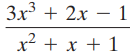
Tell whether the expression is a polynomial. If it is, give its degree. If it is not, state why not. 3x + 2x – 1 x² + x + 1
Tell whether the expression is a polynomial. If it is, give its degree. If it is not, state why not. x² + 5 x3 – 1
Showing 19800 - 19900
of 29454
First
192
193
194
195
196
197
198
199
200
201
202
203
204
205
206
Last
Step by Step Answers

 Get 50% OFF
Claim Now
Get 50% OFF
Claim Now