New Semester
Started
Get
50% OFF
Study Help!
--h --m --s
Claim Now
Question Answers
Textbooks
Find textbooks, questions and answers
Oops, something went wrong!
Change your search query and then try again
S
Books
FREE
Study Help
Expert Questions
Accounting
General Management
Mathematics
Finance
Organizational Behaviour
Law
Physics
Operating System
Management Leadership
Sociology
Programming
Marketing
Database
Computer Network
Economics
Textbooks Solutions
Accounting
Managerial Accounting
Management Leadership
Cost Accounting
Statistics
Business Law
Corporate Finance
Finance
Economics
Auditing
Tutors
Online Tutors
Find a Tutor
Hire a Tutor
Become a Tutor
AI Tutor
AI Study Planner
NEW
Sell Books
Search
Search
Sign In
Register
study help
mathematics
precalculus
Precalculus 9th edition Michael Sullivan - Solutions
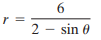
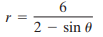
Convert each polar equation to a rectangular equation. sin 0 2 - sin 0
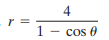
Convert each polar equation to a rectangular equation. r 1 - cos 0 4.
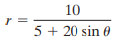
Identify the conic that each polar equation represents and graph it. 10 5 + 20 sin 0
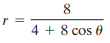
Identify the conic that each polar equation represents and graph it. 4 + 8 cos 0
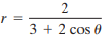
Identify the conic that each polar equation represents and graph it. 3 + 2 cos 6
Identify the conic that each polar equation represents and graph it. 6. 2 - sin 0
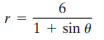
Identify the conic that each polar equation represents and graph it. 1 + sin 0
Identify the conic that each polar equation represents and graph it. 4 1 - cos 0
Rotate the axes so that the new equation contains no xy-term. Analyze and graph the new equation. 9x2 – 24xy + 16y2 + 80x + 60y = 0
Rotate the axes so that the new equation contains no xy-term. Analyze and graph the new equation. 4x2 – 12xy + 9xy2 + 12x + 8y = 0
Rotate the axes so that the new equation contains no xy-term. Analyze and graph the new equation. x2 + 4xy + 4y2 + 16√5x – 8√5y = 0
Rotate the axes so that the new equation contains no xy-term. Analyze and graph the new equation. 6x2 + 4xy + 9y2 – 20 = 0
Rotate the axes so that the new equation contains no xy-term. Analyze and graph the new equation. 2x2 – 5xy + 2y2 – 9/2 = 0
Rotate the axes so that the new equation contains no xy-term. Analyze and graph the new equation. 2x2 + 5xy + 2y2 – 9/2 = 0
Identify each conic without completing the squares and without applying a rotation of axes. 4x2 + 12xy – 10y2 + x + y – 10 = 0
Identify each conic without completing the squares and without applying a rotation of axes. x2 – 2xy + 3y2 + 2x + 4y – 1 = 0
Identify each conic without completing the squares and without applying a rotation of axes. 4x2 – 10xy + 4y2 – 9 = 0
Identify each conic without completing the squares and without applying a rotation of axes. 4x2 + 10xy + 4y2 – 9 = 0
Identify each conic without completing the squares and without applying a rotation of axes. 4x2 + 4xy + y2 – 8√5x + 16√5y = 0
Identify each conic without completing the squares and without applying a rotation of axes. 9x2 – 12xy + 4y2 + 8x + 12y = 0
Identify each conic without completing the squares and without applying a rotation of axes. x2 – 8y2 – x – 2y = 0
Identify each conic without completing the squares and without applying a rotation of axes. x2 + 2y2 + 4x – 8y + 2 = 0
Identify each conic without completing the squares and without applying a rotation of axes. 2x2 – y + 8x =0
Identify each conic without completing the squares and without applying a rotation of axes. y2 + 4x + 3y – 8 = 0
Find an equation of the conic described. Graph the equation. Vertices at (0, 1) and (6, 1); asymptote the line 3y + 2x = 9
Find an equation of the conic described. Graph the equation. Vertices at (4, 0) and (4, 4); asymptote the line y + 2x = 10
Find an equation of the conic Find an equation of the conic described. Graph the equation. described. Graph the equation. Center at (4, -2); a = 1; c = 4; tranverse axis parallel to the y-axis
Find an equation of the conic described. Graph the equation. Center at (-1, 2); a = 3; c = 4
Find an equation of the conic described. Graph the equation. Hyperbola; vertices at (-3, 3) and (5, 3); focus at (7, 3)
Find an equation of the conic described. Graph the equation. Ellipse; foci at (-4, 2) and (-4, 8); vertex at (-4, 10)
Find an equation of the conic described. Graph the equation. Parabola; focus at (3, 6); directrix the line y = 8
Find an equation of the conic described. Graph the equation. Hyperbola; center at (-2, -3); focus at(-4, -3); vertex at (-3, -3)
Find an equation of the conic described. Graph the equation. Ellipse; center at (-1, 2) focus at (0, 2) vertex at (2, 2)
Find an equation of the conic described. Graph the equation. Parabola; vertex at (2, -3) focus at (2, -4)
Find an equation of the conic described. Graph the equation. Hyperbola; vertices at (-2, 0) and (2, 0) focus at (4, 0)
Find an equation of the conic described. Graph the equation. Ellipse; foci at (-3, 0) and (3, 0) vertex at (4, 0)
Find an equation of the conic described. Graph the equation. Parabola; vertex at (0, 0) directrix the line; y = -3
Find an equation of the conic described. Graph the equation. Hyperbola; center at (0, 0) focus at (0, 4) vertex at (0, -2)
Find an equation of the conic described. Graph the equation. Ellipse; center at (0, 0) focus at (0, 3) vertex at (0, 5)
Find an equation of the conic described. Graph the equation. Parabola; focus at (-2, 0) directrix the line ; x = 2
Identify the equation. If it is a parabola, give its vertex, focus, and directrix; if it is an ellipse, give its center, vertices, and foci; if it is a hyperbola, give its center, vertices, foci, and asymptotes. x2 – y2 – 2x – 2y = 1
Identify the equation. If it is a parabola, give its vertex, focus, and directrix; if it is an ellipse, give its center, vertices, and foci; if it is a hyperbola, give its center, vertices, foci, and asymptotes. 9x2 + 4y2 – 18x + 8y = 23
Identify the equation. If it is a parabola, give its vertex, focus, and directrix; if it is an ellipse, give its center, vertices, and foci; if it is a hyperbola, give its center, vertices, foci, and asymptotes. 4y2 + 3x – 16y + 19 = 0
Identify the equation. If it is a parabola, give its vertex, focus, and directrix; if it is an ellipse, give its center, vertices, and foci; if it is a hyperbola, give its center, vertices, foci, and asymptotes. 4x2 – 16x + 16y + 32 = 0
Identify the equation. If it is a parabola, give its vertex, focus, and directrix; if it is an ellipse, give its center, vertices, and foci; if it is a hyperbola, give its center, vertices, foci, and asymptotes. 4x2 + 9y2 – 16x + 18y = 11
Identify the equation. If it is a parabola, give its vertex, focus, and directrix; if it is an ellipse, give its center, vertices, and foci; if it is a hyperbola, give its center, vertices, foci, and asymptotes. 4x2 + 9y2 – 16x – 18y = 11
Identify the equation. If it is a parabola, give its vertex, focus, and directrix; if it is an ellipse, give its center, vertices, and foci; if it is a hyperbola, give its center, vertices, foci, and asymptotes. 4x2 + y2 + 8x – 4y + 4 = 0
Identify the equation. If it is a parabola, give its vertex, focus, and directrix; if it is an ellipse, give its center, vertices, and foci; if it is a hyperbola, give its center, vertices, foci, and asymptotes. y2 – 4y – 4x2 + 8x = 4
Identify the equation. If it is a parabola, give its vertex, focus, and directrix; if it is an ellipse, give its center, vertices, and foci; if it is a hyperbola, give its center, vertices, foci, and asymptotes. 2y2 – 4y = x – 2
Identify the equation. If it is a parabola, give its vertex, focus, and directrix; if it is an ellipse, give its center, vertices, and foci; if it is a hyperbola, give its center, vertices, foci, and asymptotes. x2 – 4x = 2y
Identify the equation. If it is a parabola, give its vertex, focus, and directrix; if it is an ellipse, give its center, vertices, and foci; if it is a hyperbola, give its center, vertices, foci, and asymptotes. 9x2 + 4y2 = 36
Identify the equation. If it is a parabola, give its vertex, focus, and directrix; if it is an ellipse, give its center, vertices, and foci; if it is a hyperbola, give its center, vertices, foci, and asymptotes. 4x2 – y2 = 8
Identify the equation. If it is a parabola, give its vertex, focus, and directrix; if it is an ellipse, give its center, vertices, and foci; if it is a hyperbola, give its center, vertices, foci, and asymptotes. 3y2 – x2 = 9
Identify the equation. If it is a parabola, give its vertex, focus, and directrix; if it is an ellipse, give its center, vertices, and foci; if it is a hyperbola, give its center, vertices, foci, and asymptotes. x2 + 4y = 4
Identify the equation. If it is a parabola, give its vertex, focus, and directrix; if it is an ellipse, give its center, vertices, and foci; if it is a hyperbola, give its center, vertices, foci, and asymptotes. x2/9 + y2/16 = 1
Identify the equation. If it is a parabola, give its vertex, focus, and directrix; if it is an ellipse, give its center, vertices, and foci; if it is a hyperbola, give its center, vertices, foci, and asymptotes. y2/25 + x2/16 = 1
Identify the equation. If it is a parabola, give its vertex, focus, and directrix; if it is an ellipse, give its center, vertices, and foci; if it is a hyperbola, give its center, vertices, foci, and asymptotes. y2/25 – x2 = 1
Identify the equation. If it is a parabola, give its vertex, focus, and directrix; if it is an ellipse, give its center, vertices, and foci; if it is a hyperbola, give its center, vertices, foci, and asymptotes. x2/25 – y2 = 1
Identify the equation. If it is a parabola, give its vertex, focus, and directrix; if it is an ellipse, give its center, vertices, and foci; if it is a hyperbola, give its center, vertices, foci, and asymptotes. 16x2 = y
Identify the equation. If it is a parabola, give its vertex, focus, and directrix; if it is an ellipse, give its center, vertices, and foci; if it is a hyperbola, give its center, vertices, foci, and asymptotes. y2 = -16x
The hypocycloid is a curve defined by the parametric equations x(t) = cos3t, y(t) = sin3 t, 0 ≤ t ≤ 2π(a) Graph the hypocycloid using a graphing utility. (b) Find a rectangular equation of the hypocycloid.
Show that the parametric equations for a line passing through the points (x1, y1) and (x2, y2) are What is the orientation of this line? х%D (х, — х,)t + x1 у %3D (У2 — У1)r + У, -оо < t
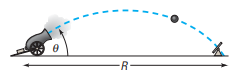
The position of a projectile fired with an initial velocity v0 feet per second and at an angle to the horizontal at the end of t seconds is given by the parametric equations See the illustration. (a) Obtain the rectangular equation of the trajectory and identify the curve. (b) Show
The left field wall at Fenway Park is 310 feet from home plate; the wall itself (affectionately named the Green Monster) is 37 feet high. A batted ball must clear the wall to be a home run. Suppose a ball leaves the bat 3 feet off the ground, at an angle of 45º. Use g 32 feet per second2 as the
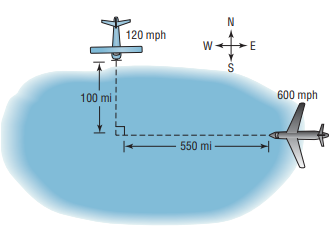
A Cessna (heading south at 120 mph) and a Boeing 747 (heading west at 600 mph) are flying toward the same point at the same altitude. The Cessna is 100 miles from the point where the flight patterns intersect, and the 747 is 550 miles from this intersection point. See the figure. (a) Find
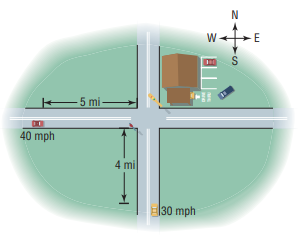
A Toyota Camry (traveling east at 40 mph) and a Chevy Impala (traveling north at 30 mph) are heading toward the same intersection. The Camry is 5 miles from the intersection when the Impala is 4 miles from the intersection. See the figure. (a) Find parametric equations that model the motion of
Suppose that Karla hits a golf ball off a cliff 300 meters high with an initial speed of 40 meters per second at an angle of 45° to the horizontal on the Moon (gravity on the Moon is one-sixth of that on Earth). (a) Find parametric equations that model the position of the ball as a function
Suppose that Adam hits a golf ball off a cliff 300 meters high with an initial speed of 40 meters per second at an angle of 45° to the horizontal. (a) Find parametric equations that model the position of the ball as a function of time. (b) How long is the ball in the air? (c)
Mark Texeira hit a baseball with an initial speed of 125 feet per second at an angle of 40° to the horizontal. The ball was hit at a height of 3 feet off the ground. (a) Find parametric equations that model the position of the ball as a function of time. (b) How long was the ball in the
Ichiro throws a baseball with an initial speed of 145 feet per second at an angle of 20° to the horizontal. The ball leaves Ichiro’s hand at a height of 5 feet. (a) Find parametric equations that model the position of the ball as a function of time. (b) How long is the ball in the
Jodi’s bus leaves at 5:30 PM and accelerates at the rate of 3 meters per second per second. Jodi, who can run 5 meters per second, arrives at the bus station 2 seconds after the bus has left and runs for the bus. The position s at time t of an object having an acceleration a is s
Bill’s train leaves at 8:06 AM and accelerates at the rate of 2 meters per second per second. Bill, who can run 5 meters per second, arrives at the train station 5 seconds after the train has left and runs for the train. (a) Find parametric equations that model the motions of the train and
Alice throws a ball straight up with an initial speed of 40 feet per second from a height of 5 feet. (a) Find parametric equations that model the motion of the ball as a function of time. (b) How long is the ball in the air? (c) When is the ball at its maximum height? Determine the
Bob throws a ball straight up with an initial speed of 50 feet per second from a height of 6 feet. (a) Find parametric equations that model the motion of the ball as a function of time. (b) How long is the ball in the air? (c) When is the ball at its maximum height? Determine the
Use a graphing utility to graph the curve defined by the given parametric equations.x = 4 sin t + 2 sin(2t) y = 4 cos t + 2 cos(2t)
Use a graphing utility to graph the curve defined by the given parametric equations.x = 4 sin t - 2 sin(2t)y = 4 cos t - 2 cos(2t)
Use a graphing utility to graph the curve defined by the given parametric equations.x = sin t + cos t y = sin t - cos t
Use a graphing utility to graph the curve defined by the given parametric equations.x = t sin t, y = t cos t, t >7 0
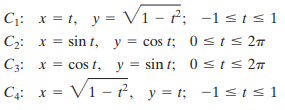
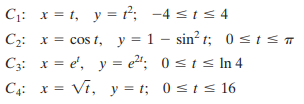
The parametric equations of the four curves are given. Graph each of them, indicating the orientation. C: x = t, y = V1 - ť; -1 st< 1 |C2: x = sin t, y= cos t; 0
The parametric equations of the four curves are given. Graph each of them, indicating the orientation.
Find parametric equations for an object that moves along the ellipse x2/4 + y2/9 = 1 with the motion described. The motion begins at (2, 0) is counterclockwise, and requires 3 seconds for a complete revolution.
Find parametric equations for an object that moves along the ellipse x2/4 + y2/9 = 1 with the motion described. The motion begins at (0, 3) is clockwise, and requires 1 second for a complete revolution.
Find parametric equations for an object that moves along the ellipse x2/4 + y2/9 = 1 with the motion described.The motion begins at (0, 3) is counterclockwise, and requires 1 second for a complete revolution.
Find parametric equations for an object that moves along the ellipse x2/4 + y2/9 = 1 with the motion described. The motion begins at (2, 0) is clockwise, and requires 2 seconds for a complete revolution.
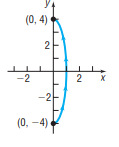
Find parametric equations that define the curve shown. (0, 4) -2 х -2- (0, -4) 2.
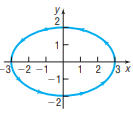
Find parametric equations that define the curve shown. y. 2 1 2 3х -1 -3-2 -1 -21
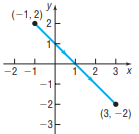
Find parametric equations that define the curve shown. (-1,2) 2 -2 -1 2 3 x -2- (3, -2) -3-
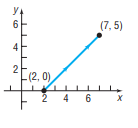
Find parametric equations that define the curve shown. (7, 5) 6 4 2E2. 0) 2 4 6
Find two different parametric equations for each rectangular equation. x = √y
Find two different parametric equations for each rectangular equation. x = y3/2
Find two different parametric equations for each rectangular equation. y = x4 + 1
Find two different parametric equations for each rectangular equation. y = x3
Find two different parametric equations for each rectangular equation. y = 2x2 + 1
Find two different parametric equations for each rectangular equation. y = x2 + 1
Find two different parametric equations for each rectangular equation. y = -8x + 3
Find two different parametric equations for each rectangular equation. y = 4x - 1
Graph the curve whose parametric equations are given and show its orientation. Find the rectangular equation of each curve.x = t2, y = ln t; t > 0
Graph the curve whose parametric equations are given and show its orientation. Find the rectangular equation of each curve. x = sin2t, y = cos2t; 0 ≤ t ≤ 2π
Graph the curve whose parametric equations are given and show its orientation. Find the rectangular equation of each curve.x = csct, y = cot t; π/4 ≤ t ≤ π/2
Graph the curve whose parametric equations are given and show its orientation. Find the rectangular equation of each curve.x = sec t, y = tan t; 0 ≤ t ≤ π/4
Showing 22200 - 22300
of 29454
First
216
217
218
219
220
221
222
223
224
225
226
227
228
229
230
Last
Step by Step Answers

 Get 50% OFF
Claim Now
Get 50% OFF
Claim Now