New Semester
Started
Get
50% OFF
Study Help!
--h --m --s
Claim Now
Question Answers
Textbooks
Find textbooks, questions and answers
Oops, something went wrong!
Change your search query and then try again
S
Books
FREE
Study Help
Expert Questions
Accounting
General Management
Mathematics
Finance
Organizational Behaviour
Law
Physics
Operating System
Management Leadership
Sociology
Programming
Marketing
Database
Computer Network
Economics
Textbooks Solutions
Accounting
Managerial Accounting
Management Leadership
Cost Accounting
Statistics
Business Law
Corporate Finance
Finance
Economics
Auditing
Tutors
Online Tutors
Find a Tutor
Hire a Tutor
Become a Tutor
AI Tutor
AI Study Planner
NEW
Sell Books
Search
Search
Sign In
Register
study help
mathematics
precalculus
Precalculus 9th edition Michael Sullivan - Solutions
In problem, use a graphing utility to graph each function over the indicated interval and approximate any local maximum values and local minimum values. Determine where the function is increasing and where it is decreasing. Round answers to two decimal places.f(x) = x3 - 3x2 + 5 (-1, 3)
In problem, sketch the graph of each function. Be sure to label at least three points.f(x) = 1/x
In problem, find the domain of each function.G(x) = x + 4/x3 - 4x
Holders of credit cards issued by banks, department stores, oil companies, and so on, receive bills each month that state minimum amounts that must be paid by a certain due date. The minimum due depends on the total amount owed. One such credit card company uses the following rules: For a bill of
In problem, use a graphing utility to graph each function over the indicated interval and approximate any local maximum values and local minimum values. Determine where the function is increasing and where it is decreasing. Round answers to two decimal places.f(x) = x5 - x3 (-2, 2)
In problem, graph each function using the techniques of shifting, compressing, stretching, and/or reflecting. Start with the graph of the basic function (for example, y = x2) and show all stages. Be sure to show at least three key points. Find the domain and the range of each function.h(x) = √-x
In problem, find the domain of each function.h(x) = √3x - 12
Refer to Problem 55. The card holder may pay any amount between the minimum due and the total owed. The organization issuing the card charges the card holder interest of 1.5% per month for the first $1000 owed and 1% per month on any unpaid balance over $1000. Find the function g that gives the
In problem, use a graphing utility to graph each function over the indicated interval and approximate any local maximum values and local minimum values. Determine where the function is increasing and where it is decreasing. Round answers to two decimal places.f(x) = x4 - x2 (-2, 2)
In problem, graph each function using the techniques of shifting, compressing or stretching, and reflections. Identify any intercepts on the graph. State the domain and, based on the graph, find the range.f(x) = |x| + 4
In problem, graph each function using the techniques of shifting, compressing, stretching, and/or reflecting. Start with the graph of the basic function (for example, y = x2) and show all stages. Be sure to show at least three key points. Find the domain and the range of each function.g(x) = 4√2
In problem, graph each function using the techniques of shifting, compressing, stretching, and/or reflecting. Start with the graph of the basic function (for example, y = x2) and show all stages. Be sure to show at least three key points. Find the domain and the range of each function.h(x) = 4/x + 2
In problem, find the domain of each function.G(x) = √1 - x
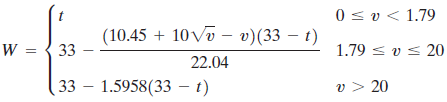
The wind chill factor represents the equivalent air temperature at a standard wind speed that would produce the same heat loss as the given temperature and wind speed. One formula for computing the equivalent temperature iswhere Ï… represents the wind speed (in meters per second) and t
In problem, use a graphing utility to graph each function over the indicated interval and approximate any local maximum values and local minimum values. Determine where the function is increasing and where it is decreasing. Round answers to two decimal places.f(x) = -0.2x3 - 0.6x2 + 4x - 6 (-6, 4)
In problem, graph each function using the techniques of shifting, compressing or stretching, and reflections. Identify any intercepts on the graph. State the domain and, based on the graph, find the range.g(x) = -2|x|
In problem, graph each function using the techniques of shifting, compressing, stretching, and/or reflecting. Start with the graph of the basic function (for example, y = x2) and show all stages. Be sure to show at least three key points. Find the domain and the range of each function.f(x) = - (x +
In problem, find the domain of each function.f(x) = 4/√2x - 9
In problem, use a graphing utility to graph each function over the indicated interval and approximate any local maximum values and local minimum values. Determine where the function is increasing and where it is decreasing. Round answers to two decimal places.f(x) = -0.4x3 + 0.6x2 + 3x - 2 (-4, 5)
In problem, graph each function using the techniques of shifting, compressing or stretching, and reflections. Identify any intercepts on the graph. State the domain and, based on the graph, find the range.g(x) = 1/2|x|
In problem, graph each function using the techniques of shifting, compressing, stretching, and/or reflecting. Start with the graph of the basic function (for example, y = x2) and show all stages. Be sure to show at least three key points. Find the domain and the range of each function.f(x) = -
In problem, find the domain of each function.f(x) = x/√2x - 4
In 2009 the U.S. Postal Service charged $1.17 postage for first-class mail retail flats (such as an 8.5'' by 11 envelope) weighing up to 1 ounce, plus $0.17 for each additional ounce up to 13 ounces. First-class rates do not apply to flats weighing more than 13 ounces. Develop a model that relates
In problem, use a graphing utility to graph each function over the indicated interval and approximate any local maximum values and local minimum values. Determine where the function is increasing and where it is decreasing. Round answers to two decimal places.f(x) = 0.25x4 + 0.3x3 - 0.9x2 + 3 (-3,
In problem, graph each function using the techniques of shifting, compressing or stretching, and reflections. Identify any intercepts on the graph. State the domain and, based on the graph, find the range.
In problem, graph each function using the techniques of shifting, compressing, stretching, and/or reflecting. Start with the graph of the basic function (for example, y = x2) and show all stages. Be sure to show at least three key points. Find the domain and the range of each function.g(x) = 2|1 -
In problem, find the domain of each function.p(x) = √2/x - 1
Exploration Graph y = x2. Then on the same screen graph y = (x - 2) 2, followed by y = (x - 4) 2, followed by y = (x + 2) 2. What pattern do you observe? Can you predict the graph of y = (x + 4) 2? Of y = (x - 5) 2?
Exploration Graph y = x2. Then on the same screen graph y = x2 + 2, followed by y = x2 + 4, followed by y = x2 - 2. What pattern do you observe? Can you predict the graph of y = x2 - 4? Of y = x2 + 5?
In problem, use a graphing utility to graph each function over the indicated interval and approximate any local maximum values and local minimum values. Determine where the function is increasing and where it is decreasing. Round answers to two decimal places.f(x) = -0.4x4 - 0.5x3 + 0.8x2 - 2 (-3,
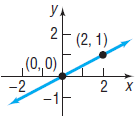
In problem,(a) Find the slope of the line and(b) Interpret the slope. Ул - (2, 1) „(0,0) -2 -1H 2 X 2.
The coordinate axes divide the xy-plane into four sections called __________ .
Two nonvertical lines have slopes m1 and m2 respectively. The lines are parallel if ________ and the ________ are unequal; the lines are perpendicular if ________.
True or FalseThe radius of the circle is x2 + y2 = 9 is 3.
In problem, find the domain of each function.p(t) = √2t – 4/3t - 21
Exploration Graph y = |x|. Then on the same screen graph y = 2|x|, followed by y = 4|x|, followed by y = ½ |x|. What pattern do you observe? Can you predict the graph of y = ¼ |x|? Of y = 5|x|?
Find the average rate of change of f(x) = -x3 + 1(a) From 0 to 2(b) From 1 to 3(c) From -1 to 1
In problem, graph each function using the techniques of shifting, compressing or stretching, and reflections. Identify any intercepts on the graph. State the domain and, based on the graph, find the range.f(x) = - √x + 3
In problem, graph each function using the techniques of shifting, compressing, stretching, and/or reflecting. Start with the graph of the basic function (for example, y = x2) and show all stages. Be sure to show at least three key points. Find the domain and the range of each function.h(x) = int
In problem, find the domain of each function.h(z) = √z + 3/z - 2
Exploration Graph y = x2. Then on the same screen graph y = -x2. What pattern do you observe? Now try y = |x| and y = -|x|. What do you conclude?
Find the average rate of change of g(x) = x3 - 2x + 1(a) From -3 to -2(b) From -1 to 1(c) From 1 to 3
In problem, graph each function using the techniques of shifting, compressing or stretching, and reflections. Identify any intercepts on the graph. State the domain and, based on the graph, find the range.h(x) = (x - 1)2 + 2
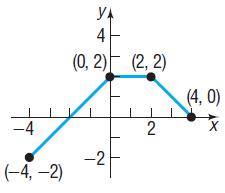
In problem, the graph of a function f is illustrated. Use the graph of f as the first step toward graphing each of the following functions:(a) F(x) = f(x) + 3(b) G(x) = f(x + 2)(c) P(x) = -f(x)(d) H(x) = f(x + 1) - 2(e) Q(x) = 1/2 f(x)(f) g(x) = f(-x)(g) h(x) = f(2x) YA (0, 2) (2, 2) (4, 0) -4 (-4,
In problem, for the given functions and g, find the following. For parts (a)–(d), also find the domain.(a) (f + g) (x)(b) (f – g) (x)(c) (f ∙ g)(x)(d) (f/g) (x)(e) (f + g)(3)(f) (f - g) (4)(g) (f ∙ g) (2)(h) (f/g) (1)f(x) = 3x + 4; g(x) = 2x - 3
Exploration Graph y = √x. Then on the same screen graph y = √-x. What pattern do you observe? Now try y = 2x + 1 and y = 2(-x) + 1. What do you conclude?
Find the average rate of change of h(x) = x2 - 2x + 3(a) From -1 to 1(b) From 0 to 2(c) From 2 to 5
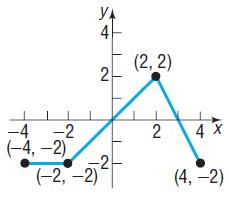
In problem, the graph of a function f is illustrated. Use the graph of f as the first step toward graphing each of the following functions:(a) F(x) = f(x) + 3(b) G(x) = f(x + 2)(c) P(x) = -f(x)(d) H(x) = f(x + 1) - 2(e) Q(x) = 1/2 f(x)(f) g(x) = f(-x)(g) h(x) = f(2x) YA 4 (2, 2) 2 4 x -2 (-4, –2)
In problem, for the given functions and g, find the following. For parts (a)–(d), also find the domain.(a) (f + g) (x)(b) (f – g) (x)(c) (f ∙ g)(x)(d) (f/g) (x)(e) (f + g)(3)(f) (f - g) (4)(g) (f ∙ g) (2)(h) (f/g) (1)f(x) = 2x + 1g(x) = 3x - 2
Exploration Graph y = x3. Then on the same screen graph y = (x - 1)3 + 2. Could you have predicted the result?
(a) Find the average rate of change from 1 to 3.(b) Find an equation of the secant line containing (1, f (1)) and (3, f(3)).f(x) = 5x - 2
In problem, graph each function using the techniques of shifting, compressing or stretching, and reflections. Identify any intercepts on the graph. State the domain and, based on the graph, find the range.g(x) = 3(x - 1)3 + 1
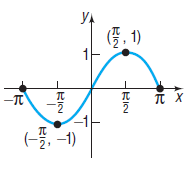
In problem, the graph of a function f is illustrated. Use the graph of f as the first step toward graphing each of the following functions:(a) F(x) = f(x) + 3(b) G(x) = f(x + 2)(c) P(x) = -f(x)(d) H(x) = f(x + 1) - 2(e) Q(x) = 1/2 f(x)(f) g(x) = f(-x)(g) h(x) = f(2x) Уд E, 1) (5. -1) RIN RIN
In problem, for the given functions and g, find the following. For parts (a)–(d), also find the domain.(a) (f + g) (x)(b) (f – g) (x)(c) (f ∙ g)(x)(d) (f/g) (x)(e) (f + g)(3)(f) (f - g) (4)(g) (f ∙ g) (2)(h) (f/g) (1)f(x) = x - 1; g(x) = 2x2
In problem, for the given functions and g, find the following. For parts (a)–(d), also find the domain.(a) (f + g) (x)(b) (f – g) (x)(c) (f ∙ g)(x)(d) (f/g) (x)(e) (f + g)(3)(f) (f - g) (4)(g) (f ∙ g) (2)(h) (f/g) (1)f(x) = 2x2 + 3; g(x) = 4x3 + 1
Exploration Graph y = x2, y = x4, and y = x6 on the same screen. What do you notice is the same about each graph? What do you notice that is different?
(a) Find the average rate of change from 2 to 5.(b) Find an equation of the secant line containing (2, f(2)) and (5, f(5)).f(x) = -4x + 1
In problem, graph each function using the techniques of shifting, compressing or stretching, and reflections. Identify any intercepts on the graph. State the domain and, based on the graph, find the range.g(x) = -2(x + 2)3 - 8
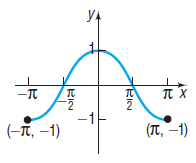
In problem, the graph of a function f is illustrated. Use the graph of f as the first step toward graphing each of the following functions:(a) F(x) = f(x) + 3(b) G(x) = f(x + 2)(c) P(x) = -f(x)(d) H(x) = f(x + 1) - 2(e) Q(x) = 1/2 f(x)(f) g(x) = f(-x)(g) h(x) = f(2x) Уд -1- (-ī, –1) (T, –1)
In problem, for the given functions and g, find the following. For parts (a)–(d), also find the domain.(a) (f + g) (x)(b) (f – g) (x)(c) (f ∙ g)(x)(d) (f/g) (x)(e) (f + g)(3)(f) (f - g) (4)(g) (f ∙ g) (2)(h) (f/g) (1)f(x) = √x; g(x) = 3x - 5
In problem, complete the square of each quadratic expression. Then graph each function using the technique of shifting. (If necessary, refer to Appendix A, Section A.3 to review completing the square.)f(x) = x2 + 2x
(a) Find the average rate of change from -2 to 1.(b) Find an equation of the secant line containing (-2, g(-2)) and (1, g(1)).g(x) = x2 - 2
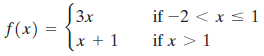
In problem,(a) Find the domain of each function.(b) Locate any intercepts.(c) Graph each function.(d) Based on the graph, find the range.(e) Is f continuous on its domain? Зx if -2 < x < 1 f(x) = (x + 1 if x > 1
In problem, for the given functions and g, find the following. For parts (a)–(d), also find the domain.(a) (f + g) (x)(b) (f – g) (x)(c) (f ∙ g)(x)(d) (f/g) (x)(e) (f + g)(3)(f) (f - g) (4)(g) (f ∙ g) (2)(h) (f/g) (1)f(x) = |x|; g(x) = x
In problem, complete the square of each quadratic expression. Then graph each function using the technique of shifting. (If necessary, refer to Appendix A, Section A.3 to review completing the square.)f(x) = x2 - 6x
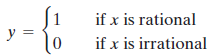
Consider the equationIs this a function? What is its domain? What is its range?What is its y-intercept, if any? What are its x-intercepts, if any? Is it even, odd, or neither? How would you describe its graph? y = [1 0 if x is rational if x is irrational
(a) Find the average rate of change from -1 to 2.(b) Find an equation of the secant line containing (-1, g(-1)) and (2, g(2)).g(x) = x2 + 1
In problem,(a) Find the domain of each function.(b) Locate any intercepts.(c) Graph each function.(d) Based on the graph, find the range.(e) Is f continuous on its domain? f(x) = Jx-1 if -3 < x < 0 3x - 1 if x 0
In problem, for the given functions and g, find the following. For parts (a)–(d), also find the domain.(a) (f + g) (x)(b) (f – g) (x)(c) (f ∙ g)(x)(d) (f/g) (x)(e) (f + g)(3)(f) (f - g) (4)(g) (f ∙ g) (2)(h) (f/g) (1)f(x) = 1+ 1/x; g(x) = 1/x
In problem, complete the square of each quadratic expression. Then graph each function using the technique of shifting. (If necessary, refer to Appendix A, Section A.3 to review completing the square.)f(x) = x2 - 8x + 1
Define some functions that pass through (0, 0) and (1, 1) and are increasing for x ≥ 0. Begin your list with y = √x, y = x, and y = x2. Can you propose a general result about such functions?
(a) Find the average rate of change from 2 to 4.(b) Find an equation of the secant line containing (2, h(2)) and (4, h(4)).h(x) = x2 - 2x
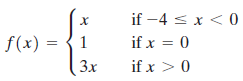
In problem,(a) Find the domain of each function.(b) Locate any intercepts.(c) Graph each function.(d) Based on the graph, find the range.(e) Is f continuous on its domain? f(x) = X 1 3x if -4 < x < 0 if x = 0 if x > 0
In problem, complete the square of each quadratic expression. Then graph each function using the technique of shifting. (If necessary, refer to Appendix A, Section A.3 to review completing the square.)f(x) = x2 + 4x + 2
(a) Find the average rate of change from 0 to 3.(b) Find an equation of the secant line containing (0, h(0)) and (3, h(3)).h(x) = -2x2 + x
In problem,(a) Find the domain of each function.(b) Locate any intercepts.(c) Graph each function.(d) Based on the graph, find the range.(e) Is f continuous on its domain? f(x) = [x if -2 x 2 2x - 1 if x > 2
In problem, for the given functions and g, find the following. For parts (a)–(d), also find the domain.(a) (f + g) (x)(b) (f – g) (x)(c) (f ∙ g)(x)(d) (f/g) (x)(e) (f + g)(3)(f) (f - g) (4)(g) (f ∙ g) (2)(h) (f/g) (1)f(x) = 2x + 3/3x - 2; g(x) = 4x/3x - 2
In problem, complete the square of each quadratic expression. Then graph each function using the technique of shifting. (If necessary, refer to Appendix A, Section A.3 to review completing the square.)f(x) = 2x2 - 12x + 19
(a) Determine whether g is even, odd, or neither.(b) There is a local minimum value of -54 at 3.Determine the local maximum value.g(x) = x3 - 27x
In problem, for the given functions and g, find the following. For parts (a)–(d), also find the domain.(a) (f + g) (x)(b) (f – g) (x)(c) (f ∙ g)(x)(d) (f/g) (x)(e) (f + g)(3)(f) (f - g) (4)(g) (f ∙ g) (2)(h) (f/g) (1)f(x) = √x + 1; g(x) = 2/x
In problem, complete the square of each quadratic expression. Then graph each function using the technique of shifting. (If necessary, refer to Appendix A, Section A.3 to review completing the square.)f(x) = 3x2 + 6x + 1
f(x) = -x3 + 12x(a) Determine whether f is even, odd, or neither.(b) There is a local maximum value of 16 at 2.Determine the local minimum value.
In problem, complete the square of each quadratic expression. Then graph each function using the technique of shifting. (If necessary, refer to Appendix A, Section A.3 to review completing the square.)f(x)= -3x2 - 12x – 17
F(x) = -x4 + 8x2 + 8(a) Determine whether F is even, odd, or neither.(b) There is a local maximum value of 24 at x = 2.Determine a second local maximum value.(c) Suppose the area under the graph of F between x = 0 and x = 3 that is bounded below by the x-axis is 47.4 square units. Using the result
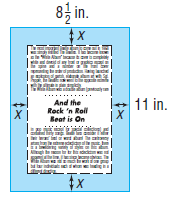
A page with dimensions of 8 ½ by inches has a border of uniform width x surrounding the printed matter of the page, as shown in the figure.(a) Develop a model that expresses the area A of the printed part of the page as a function of the width x of the border.(b) Give the domain and
In problem, complete the square of each quadratic expression. Then graph each function using the technique of shifting. (If necessary, refer to Appendix A, Section A.3 to review completing the square.)f(x) = -2x2 - 12x - 13
G(x) = -x4 + 32x2 + 144(a) Determine whether G is even, odd, or neither.(b) There is a local maximum value of 400 at x = 4.Determine a second local maximum value.(c) Suppose the area under the graph of G between x = 0 and x = 6 that is bounded below by the x-axis is 1612.8 square units. Using the
A closed box with a square base is required to have a volume of 10 cubic feet.(a) Build a model that expresses the amount A of material used to make such a box as a function of the length x of a side of the square base.(b) How much material is required for a base 1 foot by 1 foot?(c) How much
The equation y = (x - c)2 defines a family of parabolas, one parabola for each value of c. On one set of coordinate axes, graph the members of the family for c = 0, c = 3, and c = -2.
The average cost per hour in dollars, CÌ…, of producing x riding lawn mowers can be modeled by the function(a) Use a graphing utility to graph CÌ… = CÌ…(x).(b) Determine the number of riding lawn mowers to produce in order to minimize average cost.(c) What is the minimum average cost? T(x)
A rectangle has one vertex in quadrant I on the graph of y = 10 – x2, another at the origin, one on the positive x-axis, and one on the positive y-axis.(a) Express the area A of the rectangle as a function of x.(b) Find the largest area A that can be enclosed by the rectangle.
Repeat Problem 75 for the family of parabolas y = x2 + c.Data from problem 75The equation y = (x - c)2 defines a family of parabolas, one parabola for each value of c. On one set of coordinate axes, graph the members of the family for c = 0, c = 3, and c = -2.
The concentration C of a medication in the bloodstream t hours after being administered is modeled by the function(a) After how many hours will the concentration be highest?(b) A woman nursing a child must wait until the concentration is below 0.5 before she can feed him. After taking the
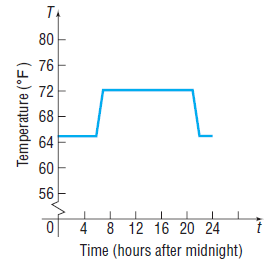
Energy conservation experts estimate that homeowners can save 5% to 10% on winter heating bills by programming their thermostats 5 to 10 degrees lower while sleeping. In the given graph, the temperature T (in degrees Fahrenheit) of a home is given as a function of time t (in hours after midnight)
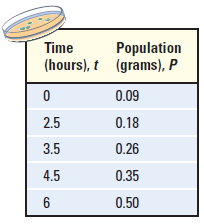
A strain of E-coli Beu 397-recA441 is placed into a nutrient broth at 30° Celsius and allowed to grow. The data shown in the table are collected. The population is measured in grams and the time in hours. Since population P depends on time t and each input corresponds to exactly one output, we
Digital Music Revenues The total projected worldwide digital music revenues R, in millions of dollars, for the years 2005 through 2010 can be estimated by the functionR(x) = 170.7x2 + 1373x + 1080where x is the number of years after 2005.(a) Fmd R(0), R(3), and R(5) and explain what each value
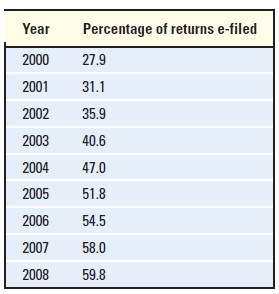
The Internal Revenue Service Restructuring and Reform Act (RRA) was signed into law by President Bill Clinton in 1998. A major objective of the RRA was to promote electronic filing of tax returns. The data in the table that follows show the percentage of individual income tax returns filed
The relationship between the Celsius (°C) and Fahrenheit (°F) scales for measuring temperature is given by the equationF = 9/5 C + 32The relationship between the Celsius (°C) and Kelvin (K) scales is K = C + 273. Graph the equation F = 9/5 C + 32 using degrees Fahrenheit on the y-axis and
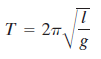
The period T (in seconds) of a simple pendulum is a function of its length l (in feet) defined by the equationwhere g ≈ 32.2 feet per second per second is the acceleration of gravity.(a) Use a graphing utility to graph the function T = T(I).(b) Now graph the functions T = T(I + 1),T = T(I + 2),
For the function f(x) = x2, compute each average rate of change:(a) From 1 to 2(b) From 1 to 1.5(c) From 1 to 1.1(d) From 1 to 1.01(e) From 1 to 1.001(f) Use a graphing utility to graph each of the secant lines along with .(g) What do you think is happening to the secant lines?(h) What is happening
Showing 28900 - 29000
of 29454
First
281
282
283
284
285
286
287
288
289
290
291
292
293
294
295
Step by Step Answers

 Get 50% OFF
Claim Now
Get 50% OFF
Claim Now