New Semester
Started
Get
50% OFF
Study Help!
--h --m --s
Claim Now
Question Answers
Textbooks
Find textbooks, questions and answers
Oops, something went wrong!
Change your search query and then try again
S
Books
FREE
Study Help
Expert Questions
Accounting
General Management
Mathematics
Finance
Organizational Behaviour
Law
Physics
Operating System
Management Leadership
Sociology
Programming
Marketing
Database
Computer Network
Economics
Textbooks Solutions
Accounting
Managerial Accounting
Management Leadership
Cost Accounting
Statistics
Business Law
Corporate Finance
Finance
Economics
Auditing
Tutors
Online Tutors
Find a Tutor
Hire a Tutor
Become a Tutor
AI Tutor
AI Study Planner
NEW
Sell Books
Search
Search
Sign In
Register
study help
mathematics
probability with applications
Probability With Applications and R 1st edition Robert P. Dobrow - Solutions
Suppose P(ABC) = 0.05, P(AB) = 0.15, P(AC) = 0.2, P(BC) = 0.25, P(A) = P(B) = P(C) = 0.5. For each of the events given next, write the event using set notation in terms of A, B, and C, and compute the corresponding probability.(a) At least one of the three events A,B,C occur.(b) At most one of the
An exam had three questions. One-fifth of the students answered the first question correctly; one-fourth answered the second question correctly; and one-third answered the third question correctly. For each pair of questions, one-tenth of the students got that pair correct. No one got all three
The odds in favor of an event is the ratio of the probability that the event occurs to the probability that it will not occur. For example, the odds that you were born on a Friday, assuming birth days are equally likely, is 1 to 6, often written 16 or 1 to 6.(a) In Texas Hold’em Poker, the odds
Let A, B, C be three events. Find expressions for the events:(a) At least one of the events occurs.(b) Only B occurs.(c) At most one of the events occurs.(d) All of the events occur.(e) None of the events occur.
The functionis a probability function for some choice of c. Find c. 3k = C- P(k) for k = 0, 1, 2, ..., P(k) = c k!
Let(a) Show that Q is a probability function. That is, show that the terms are non-negative and sum to 1.(b) Let X be a random variable such that P(X = k) = Q(k), for k = 0, 1, 2, . . . . Find P(X > 2) without summing an infinite series. 2 for k = 0, 1, 2, .... 3k+1 Q(k) = %|
A tetrahedron dice is four-sided and labeled with 1, 2, 3, and 4. When rolled it lands on the base of a pyramid and the number rolled is the number on the base. In five rolls, what is the probability of rolling at least one 2?
Two dice are rolled. Let X be the maximum number obtained. (Thus, if 1 and 2 are rolled, X = 2; if 5 and 5 are rolled, X = 5.) Assume that all 36 elements of the sample space are equally likely. Find the probability function for X. That is, find P(X = x), for x = 1, 2, 3, 4, 5, 6.
Four coins are tossed. Let A be the event that the first two coins comes up heads. Let B be the event that the number of heads is odd. Assume that all 16 elements of the sample space are equally likely. Describe and find the probabilities of (i) AB,(ii) A ˆª B,(iii) ABc. в
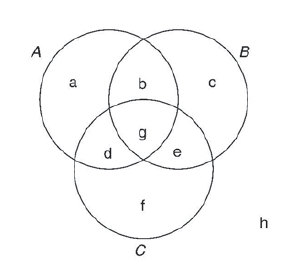
See the assignment of probabilities to the Venn diagram in Figure 1.4. Find the following:(a) P(No events occur).(b) P(Exactly one event occurs).(c) P(Exactly two events occur).(d) P(Exactly three events occur).(e) P(At least one event occurs).(f) P(At least two events occur).(g) P(At most one
Let A, B, C, be three events. At least one event always occurs. But it never happens that exactly one event occurs. Nor does it ever happen that all three events occur. If P(AB) = 0.10 and P(AC) = 0.20, find P(B).
Suppose X is a random variable that takes values on {0, 0.01, 0.02, . . . , 0.99, 1}. If each outcome is equally likely, find(a) P(X ≤ 0.33).(b) P(0.55 ≤ X ≤ .66).
Suppose X is a random variable that takes values on all positive integers. Let A = {2 ≤ X ≤ 4} and B = {X ≥ 4}. Describe the events (i) Ac(ii) Bc(iii) AB(iv) A ∪ B
Suppose P(A ∪ B) = 0.6 and P(A ∪ Bc) = 0.8. Find P(A).
Suppose A and B are mutually exclusive, with P(A) = 0.30 and P(B) = 0.60. Find the probability that(a) At least one of the two events occurs(b) Both of the events occur(c) Neither event occurs(d) Exactly one of the two events occur
Suppose P(A) = 0.40, P(B) = 0.60, and P(A or B) = 0.80. Find(a) P(neither A nor B occur).(b) P(AB).(c) P(one of the two events occurs, and the other does not).
Suppose k numbers are chosen from {1, . . . , n}, where k < n, sampling without replacement. All outcomes are equally likely. What is the probability that the numbers chosen are in increasing order?
Amy is picking her fall term classes. She needs to fill three time slots, and there are 20 distinct courses to choose from, including probability 101, 102, and 103. She will pick her classes at random so that all outcomes are equally likely.(a) What is the probability that she will get probability
Suppose you throw five dice and all outcomes are equally likely.(a) What is the probability that all dice are the same?(b) What is the probability of getting at least one 4?(c) What is the probability that all the dice are different?
Suppose that license plates can be two, three, four, or five letters long, taken from the alphabets A to Z. All letters are possible, including repeats. A license plate is chosen at random in such a way so that all plates are equally likely.(a) What is the probability that the plate is
Let P1 and P2 be two probability functions on Ω. Define a new function P such that P(A) = (P1(A)+P2(A))/2. Show the P is a probability function.
A fair coin is flipped six times. What is the probability that the first two flips are heads and the last two flips are tails? Use the multiplication principle.
A club has 10 members and is choosing a president, vice-president, and treasurer. All selections are equally likely.(a) What is the probability that Tom is selected president?(b) What is the probability that Brenda is chosen president and Liz is chosen treasurer?
Let P be a probability function on Ω = {a, b} such that P(a) = p and P(b) = 1 − p for 0 ≤ p ≤ 1. Let Q be a function on Ω defined by Q(ω) = [P(ω)]2. For what value(s) of p will Q be a valid probability function?
A random experiment has three possible outcomes a, b, and c, with P(a) = p, P(b) = p2, and P(c) = p. What choice(s) of p makes this a valid probability model?
A sample space has four elements ω1, . . . , ω4 such that ω1 is twice as likely as ω2, which is three times as likely as ω3, which is four times as likely as ω4. Find the probability function.
A couple plans to continue having children until they have a girl or until they have six children, whichever comes first. Describe a sample space and a reasonable random variable for this random experiment.
A bag contains r red and b blue balls. You reach into the bag and take k balls. Let R be the number of red balls you take. Let B be the number of blue balls. Express the following events in terms of the random variables R and B:(a) You pick no red balls.(b) You pick one red and two blue balls.(c)
In two dice rolls, let X be the outcome of the first die, and Y the outcome of the second die. Then X + Y is the sum of the two dice. Describe the following events in terms of simple outcomes of the random experiment:(a) {X + Y = 4}.(b) {X + Y = 9}.(c) {Y = 3}.(d) {X = Y}.(e) {X > 2Y}.
Bored one day, you decide to play the video game Angry Birds until you win.Every time you lose, you start over. Consider the probability that you win in less than 1000 tries.(i) The random experiment (ii) Sample space (iii) Event(iv) Random variable Express the probability in
Your friend was sick and unable to make today’s class. Explain to your friend, using your own words, the meaning of the terms: (i) Random experiment, (ii) Sample space, (iii) Event, and (iv) Random variable.
In Angel’s garden, there is a 3% chance that a tomato will be bad. Angel harvests 100 tomatoes and wants to know the probability that at most five tomatoes are bad.(i) The random experiment.(ii) Sample space. (iii) Event.(iv) Random variable. Express the probability in question in terms
Roll four dice. Consider the probability of getting all fives.(i) The random experiment, (ii) Sample space, (iii) Event, and (iv) Random variable. Express the probability in question in terms of the defined random variable, but do not compute the probability.
A pizza shop offers three toppings: pineapple, peppers, and pepperoni. A pizza can have 0, 1, 2, or 3 toppings. Consider the probability that a random customer asks for two toppings.(i) The random experiment (ii) Sample space (iii) Event(iv) Random variable. Express the probability
Showing 400 - 500
of 434
1
2
3
4
5
Step by Step Answers

 Get 50% OFF
Claim Now
Get 50% OFF
Claim Now