New Semester
Started
Get
50% OFF
Study Help!
--h --m --s
Claim Now
Question Answers
Textbooks
Find textbooks, questions and answers
Oops, something went wrong!
Change your search query and then try again
S
Books
FREE
Study Help
Expert Questions
Accounting
General Management
Mathematics
Finance
Organizational Behaviour
Law
Physics
Operating System
Management Leadership
Sociology
Programming
Marketing
Database
Computer Network
Economics
Textbooks Solutions
Accounting
Managerial Accounting
Management Leadership
Cost Accounting
Statistics
Business Law
Corporate Finance
Finance
Economics
Auditing
Tutors
Online Tutors
Find a Tutor
Hire a Tutor
Become a Tutor
AI Tutor
AI Study Planner
NEW
Sell Books
Search
Search
Sign In
Register
study help
mathematics
probability with applications
Probability With Applications and R 1st edition Robert P. Dobrow - Solutions
Suppose X and Y are independent and positive random variables with density functions fX and fY, respectively. Use conditioning to find a general expression for the density function of(a) XY(b) X/Y(c) X − Y
Suppose the density of X is proportional to x2(1 − x) for 0 < x < 1. If X = x, then Y ∼ Binom(10, x). Find P(Y = 6) by conditioning on X.
Let X ∼ Unif(0, 1). If X = x, then Y ∼ Unif(x).(a) Find P(Y < 1/4) by conditioning on X.(b) Find P(Y < 1/4) by using the marginal density of Y .(c) Approximate P(Y < 1/4) by simulation.
Let X ∼ Unif(0, 1). If X = x, then Y ∼ Exp(x). Find P(Y > 1) by conditioning on X.
Repeat the last exercise. Only this time at each step the walker either moves left, moves right, or stays put, each with probability 1/3. Staying put counts as one step.Data from last Exercise.A random walker starts at one vertex of a triangle, moving left or right with probability 1/2 at each
A random walker starts at one vertex of a triangle, moving left or right with probability 1/2 at each step. The triangle is covered when the walker visits all three vertices. Find the expected number of steps for the walker to cover the triangle.
Let X1, X2 be the rolls of two four-sided tetrahedron dice. Let S = X1 + X2 be the sum of the dice. Let M = max(X1, X2) be the largest of the two numbers rolled. Find the following:(a) E[X1|X2](b) E[X1|S](c) E[M|X1 = x](d) E[X1X2|X1]
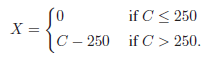
Given an event A, define the conditional expectation of Y given A as where IA is the indicator random variable.(a) Let Y ˆ¼ Exp(λ). Find E[Y|Y >1].(b) An insurance company has a $250 deductible on a claim. Suppose C is the amount of damages claimed by a customer.
Let X and Y be independent and uniformly distributed on (0,1). Let M = min(X, Y) and N = max(X, Y).(a) Find the joint density of M and N. (For 0 < m < n < 1, show that M ≤ m and N > n if and only if either {X ≤ m and Y > n} or {Y ≤ m and X >n}.)(b) Find the conditional
Let A and B be events such that P(A) = 0.3, P(B) = 0.5, and P(AB) = 0.2.(a) Find E[IA|IB = 0] and E[IA|IB = 1].(b) Show that E[E[IA|IB]] = E[IA].
Let P(X = 0, Y = 0) = 0.1, P(X = 0, Y = 1) = 0.2, P(X = 1, Y = 0) = 0.3, and P(X = 1, Y = 1) = 0.4. Show that E[X\Y] = 12
Let X and Y have joint densityf(x, y) = x + y, 0 < x < 1, 0 < y < 1.Find E[X|Y = y].
If X and Y are independent standard normal random variables, show that X2 + Y2 has an exponential distribution.
Let X and Y have joint density function 0,0 < y < e – 1. " style="" class="fr-fic fr-dib">(a) Find and describe the conditional distribution of X given Y = y.(b) Find E[X|Y = y] and E[X|Y].(c) Find E[X] in two ways: (i) Using the law of total expectation,(ii) Using the distribution of X.
On one block of “Eat Street” in downtown Minneapolis there are 10 restaurants to choose from. The waiting time for each restaurant is exponentially distributed with respective parameters λ1, . . . , λ10. Bob will decide to eat at restaurant i with probability pi for i = 1, . . . , 10 (p1 + ·
Show that E[E[Y|X]] = E[Y] in the continuous case.
Explain carefully the difference between E[Y|X] and E[Y|X = x].
Let Z ∼ Gamma(a, λ), where a is an integer. Conditional on Z = z, let X ∼ Pois(z). Show that X has a negative binomial distribution with the following interpretation. For k = 0, 1, . . . , P(X = k) is equal to the number of failures before a successes in a sequence of i.i.d. Bernoulli trials
Let X and Y have joint density(a) By examining the joint density function can you guess the conditional density of X given Y = y? (Treat y as a constant.) Confirm your guess.(b) Similarly, first conjecture about the conditional distribution of Y given X = x. Find the conditional density.(c) Find
Let X and Y be i.i.d. exponential random variables with parameter λ. Find the conditional density function of X +Y given X = x. Describe the conditional distribution.
Let X and Y be uniformly distributed on the triangle with vertices (0,0), (1,0), and (1,1).(a) Find the joint and marginal densities of X and Y.(b) Find the conditional density of Y given X = x. Describe the conditional distribution.
Let X and Y have joint densityf(x, y) = 4e−2x, for 0 < y < x < ∞.Find P(1 < Y < 2|X = 3).
Let X ∼ Unif(0, 2). If X = x, let Y be uniformly distributed on (0, x).(a) Find the joint density of X and Y.(b) Find the marginal densities of X and Y.(c) Find the conditional densities of X and Y.
Let X and Y have joint densityf(x, y) = 12x(1 − x), for 0 < x < y < 1.(a) Find the marginal densities of X and Y.(b) Find the conditional density of Y given X = x. Describe the conditional distribution.(c) Find P(X < 1/4|Y = 0.5)
The “99-10” rule on the Internet says that 99% of the content generated in Internet chat rooms is created by 10% of the users. If the amount of chat room content has a Pareto distribution, find the value of the parameter a.
Zipf€™s law is a discrete distribution related to the Pareto distribution. If X has a Zipf€™s law distribution with parameters s > 0 and n ˆˆ {1, 2, . . .}, thenThe distribution is used to model frequencies of words in languages.(a) Show that Zipf€™s law
Let X ∼ Exp(a). Let Y = meX. Show that Y ∼ Pareto(m, a).
A spatial Poisson process is a model for the distribution of points in two dimensional space. For a set A Š† R2, let NAdenote the number of points in A. The two defining properties of a spatial Poisson process with parameter λ are1. If A and B are disjoint sets, then NA and
Starting at 9 a.m., students arrive to class according to a Poisson process with parameter λ = 2 (units are minutes). Class begins at 9:15 a.m. There are 30 students.(a) What is the expectation and variance of the number of students in class by 9:15 a.m.?(b) Find the probability there will be at
Let X ∼ Gamma(a, λ). Find V[X] using the methods of Section 7.2.1.
Using integration by parts, show that the gamma function satisfiesΓ(a) = (a − 1)Γ(a − 1).
If X, Y, Z are independent standard normal random variables, find the distribution of X2 + Y2 + Z2. (Think spherical coordinates.)
If Z has a standard normal distribution, find the density of Z2.
Let Z ∼ Norm(0, 1). Find E[|Z|].
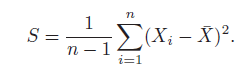
Let X1, . . . , Xnbe i.i.d. normal random variables with mean μ and standard deviation σ. Recall that XÌ… = (X1+ · · · + Xn)/n is the sample average. LetShow that E[S] = σ2. In statistics, S is called the sample variance. -E(X; -
Let X ∼ Norm(μ, σ2). Suppose a ≠ 0 and b are constants. Show that Y = aX + b is normally distributed.
Let X1, . . . , Xn be an i.i.d. sequence of normal random variables with mean μ and variance σ2. Let Sn = X1 + · · · + Xn.(a) Suppose μ = 5 and σ2 = 1. Find P(|X1 − μ| ≤ σ).(b) Suppose μ = 5, σ2 = 1, and n = 9. Find P(|Sn/n − μ| ≤ σ).
Suppose Xi ∼ Norm(i, i) for i = 1, 2, 3, 4. Further assume all the Xi’s are independent. Find P(X1 + X3 < X2 + X4).
Find all the inflection points of a normal density curve. Show how this information can be used to draw a normal curve given values of μ and σ.
Let X ∼ Norm(μ, σ2). Show that E[X] = μ.
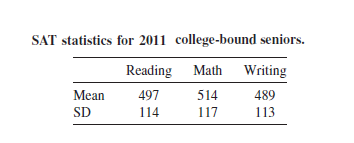
The SAT exam is a composite of three exams€”in reading, math, and writing. For 2011 college-bound high school seniors, Table 7.2 gives the mean and standard deviation of the three exams. The data are from the College Board (2011).Let R,M, and W denote the reading, math, and writing
The two main standardized tests in the United States for high school students are the ACT and SAT. ACT scores are normally distributed with mean 18 and standard deviation 6. SAT scores are normally distributed with mean 500 and standard deviation 100. Suppose Jill takes an SAT exam and scores 680.
The rates of return of ten stocks are normally distributed with mean μ = 2 and standard deviation σ = 4 (units are percentages). Rates of return are independent from stock to stock. Each stock sells for $10 a share. Amy, Bill, and Carrie have $100 each to spend on their stock portfolio. Amy buys
An elevator’s weight capacity is 1000 pounds. Three men and three women are riding the elevator. Adult male weight is normally distributed with mean 172 pounds and standard deviation 29 pounds. Adult female weight is normally distributed with mean 143 pounds and standard deviation 29 pounds. Find
Babies’ birth weights are normally distributed with mean 120 ounces and standard deviation 20 ounces. Low birth weight is an important indicator of a newborn baby’s chances of survival. One definition of low birth weight is that it is the fifth percentile of the weight distribution.(a) Babies
Let X ∼ Norm(4, 4). Find the following probabilities using R:(a) P(|X| < 2).(b) P(eX < 1).(c) P(X2 > 3).
Let X ∼ Norm(−4, 25). Find the following probabilities without using software:(a) P(X > 6).(b) P(−9 < X < 1).(c) P(√X > 1).
Let X be a random variable with density function f(x) = 1/x2, for 1 < x < 4, and 0, otherwise. Simulate E[X] using the inverse transform method. Compare to the exact value.
Let R ∼ Unif(1, 4). Let A be the area of the circle of radius R. Use R to simulate R. Simulate the mean and pdf of A and compare to the exact results. Create one graph with both the theoretical density and the simulated distribution.
Use the accept–reject method to simulate points uniformly distributed on the circle of radius 1 centered at the origin. Use your simulation to approximate the expected distance of a point inside the circle to the origin.
Let X and Y be independent exponential random variables with parameter λ = 1. Simulate P(X/Y < 1).
Simulate the expected length of the hypotenuse of the isosceles right triangle in Exercise 6.8.Data from Exercise 6.8.An isosceles right triangle has side length uniformly distributed on (0, 1). Find the expectation and variance of the length of the hypotenuse.
Suppose X and Y are independent random variables uniformly distributed on (0, 1). Use geometric arguments to find the density of Z = X/Y.
Suppose you use Buffon’s needle problem to simulate π. Let n be the number of needles you drop on the floor. Let X be the number of needles that cross a line. Find the distribution, expectation and variance of X.
Solve Buffon’s needle problem for a “short” needle. That is, suppose the length of the needle is x < 1.
Suppose (X, Y, Z) is uniformly distributed on the sphere of radius 1 centered at the origin. Find the probability that (X, Y, Z) is contained in the inscribed cube.
Suppose (X, Y) is uniformly distributed on the region in the plane between the curves y = sinx and y = cosx, for 0 < x < π/2. Find P(Y >1/2).
Suppose X and Y are independent random variables, each uniformly distributed on (0, 2).(a) Find P(X2 < Y).(b) Find P(X2 < Y|X +Y < 2).
Let X, Y, and Z be i.i.d. random variables uniformly distributed on (0, 1). Find the density of X + Y + Z.
See the joint density in Exercise 6.32. Find the covariance of X and Y.Data from Exercise 6.32.The joint density of X and Y is f(x, y) = ce−2y, for 0 < x < y < ∞.
Let A = UV, where U and V are independent and uniformly distributed on (0,1).(a) Find the density of A.(b) Find E[A] two ways: (i) Using the density of A and (ii) Not using the density of A.
Consider the following attempt at generating a point uniformly distributed in the circle of radius 1 centered at the origin. In polar coordinates, pick R uniformly at random on (0,1). Pick Θ uniformly at random on (0, 2π), independently of R. Show that this method does not work. That is show (R,
Suppose X and Y have joint probability density f(x, y) = g(x)h(y) for some functions g and h which depend only on x and y, respectively. Show that X and Y are independent with fX(x) ∝ g(x) and fY(y) ∝ h(y).
Suppose (X, Y) are distributed uniformly on the circle of radius 1 centered at the origin. Find the marginal densities of X and Y. Are X and Y independent?
Suppose X and Y are i.i.d. exponential random variables with λ = 1. Find the density of X/Y and use it to compute P(X/Y < 1).
Let X1 and X2 be independent exponential random variables with parameter λ. Show that Y = |X1 − X2| is also exponentially distributed with parameter λ.
Let X1, . . . , Xn be an i.i.d. sequence of Uniform (0, 1) random variables. Let M = max(X1, . . . , Xn).(a) Find the density function of M.(b) Find E[M] and V[M].
Tom and Danny each pick uniformly random real numbers between 0 and 1. Find the expected value of the smaller number.
Suppose X has density functionf(x) = 1/(1 + x)2 , for x > 0.Show how to use the inverse transform method to simulate X.
Let X be a continuous random variable with cdf F. Since F(x) is a function of x, F(X) is a random variable which is a function of X. Suppose F is invertible. Find the distribution of F(X).
Suppose B and C are independent random variables each uniformly distributed on (0,1). Find the probability that the roots of the equation x2 + Bx + C = 0 are real.
In Example 6.33 we found the distribution of the sum of two i.i.d. exponential variables with parameter λ. Call the sum X. Let Y be a third independent exponential variable with parameter λ. Use the convolution formula 6.8 to find the sum of three independent exponential
A stick of unit length is broken into two pieces. The break occurs at a location uniformly at random on the stick. What is the expected length of the longer piece?
The time each student takes to finish an exam has an exponential distribution with mean 45 minutes. In a class of 10 students, what is the probability that at least one student will finish in less than 20 minutes? Assume students’ times are independent.
Let (X, Y, Z) be uniformly distributed on a three-dimensional box with side lengths 3, 4, and 5. Find P(X < Y < Z).
The time until the light in Bob’s office fails is exponentially distributed with mean 2 hours. The time until the computer crashes in Bob’s office is exponentially distributed with mean 3 hours. Failure and crash times are independent.(a) Find the probability that neither the light nor computer
Suppose the joint density function of X and Y is f(x, y) = 2e−6x, for x > 0, 1 < y < 4. By noting the form of the joint density and without doing any calculations show that X and Y are independent. Describe their marginal distributions.
The joint density of X and Y is f(x, y) = ce−2y, for 0 < x < y < ∞.(a) Find c.(b) Find the marginal densities of X and Y . Do you recognize either of these distributions?(c) Find P(Y < 2X).
The joint density of X and Y is f(x, y) = 2e−(x+2y), for x > 0, y > 0.(a) Find the joint cumulative distribution function.(b) Find the cumulative distribution function of X.(c) Find P(X < Y).
The joint density of X and Y is f(x, y) = 2x/9y, for 0 < x < 3, 1 < y < e.(a) Are X and Y independent?(b) Find the joint cumulative distribution function.(c) Find P(1 < X < 2, Y > 2).
If r is a real number, the ceiling of r, denoted ⌈r⌉, is the smallest integer not less than r. For instance, ⌈0.25⌉ = 1 and ⌈4⌉ = 4. Suppose X ∼ Exp(λ). Let Y = ⌈X⌉. Show that Y has a geometric distribution.
Suppose X has density function
Let X ∼ Unif(a, b). Suppose Y is a linear function of X. That is Y = mX + n. Where m and n are constants. Assume also that m > 0. Show that Y is uniformly distributed on the interval (ma + n, mb + n).
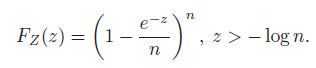
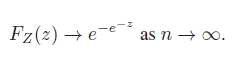
Suppose X1, . . . , Xnis an independent sequence of exponential random variables with parameter λ = 1. Let Z = max(X1, . . . , Xn) ˆ’ log n.(a) Show that the cdf of Z is(b) Show that for all z, The limit is a probability distribution called an extreme value
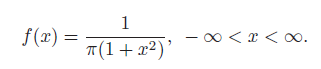
Let X have a Cauchy distribution. That is, the density of X isShow that 1/X has a Cauchy distribution. f(x) = O
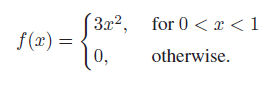
The density of a random variable X is given byLet Y = eX.(a) Find the density function of Y(b) Find E[Y] two ways: (i) Using the density of Y and (ii) Using the density of X. 3x2, for 0 < r < 1 f(x) = otherwise. 0,
Let X ∼ Unif(0, 1). Find E[eX] two ways:(a) By finding the density of eX and then computing the expectation with respect to that distribution.(b) By using the law of the unconscious statistician.
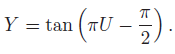
Suppose U ˆ¼ Unif(0, 1). Find the density of Y = tan ( TU 2
Suppose X ∼ Exp(λ). Find the density of Y = cX for c > 0. Describe the distribution of Y.
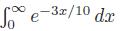
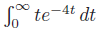
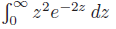
Solve these integrals without calculus.(a) (b) (c) e-3z/10 dx –4t dt te-4t dt
Find the probability that an exponential random variable is within two standard deviations of the mean. That is, compute P(|X − μ| ≤ 2σ), where μ = E[X] and σ = SD[X].
For a continuous random variable X, the number m such thatP(X ≤ m) = 1/2is called the median of X.(a) Find the median of an Exp(λ) distribution.(b) Give a simplified expression for the difference between the mean and the median. Is the difference positive or negative?
Let X have an exponential distribution conditioned to be greater than 1. That is, for t > 1, P(X ≤ t) = P(Y ≤ t|Y > 1), where Y ∼ Exp(λ).(a) Find the density of X.(b) Find E[X].
Derive the variance of the exponential distribution with parameter λ.
Derive the mean of the exponential distribution with parameter λ.
Please consult with developer "Hassan". "Not-greater than sign" not supported in editor.Let X ∼ Exp(λ). Suppose 0 < s < t. Since X is memory less, is it true that {X > s + t} are {X > t} are independent events?
It is 9:00 p.m. The time until Joe receives his next text message has an exponential distribution with mean 5 minutes.(a) Find the probability that he will not receive a text in the next 10 minutes.(b) Find the probability that the next text arrives between 9:07 and 9:10 p.m.(c) Find the
For continuous random variable X and constants a and b, prove that E[aX + b] = aE[X] + b.
Some authors take the following as the definition of continuous random variables: A random variable is continuous if the cumulative distribution function F(x) is continuous for all real x. Show that if X is a discrete random variable, then the cdf of X is not continuous.
Suppose f(x) and g(x) are probability density functions. Under what conditions on the constants α and β will the function αf(x) + βg(x) be a probability density function?
Showing 100 - 200
of 434
1
2
3
4
5
Step by Step Answers

 Get 50% OFF
Claim Now
Get 50% OFF
Claim Now


![E[YI] P(A) E[Y|A] =](https://dsd5zvtm8ll6.cloudfront.net/si.question.images/images/question_images/1539/8/6/2/0065bc86df6283421539844440680.jpg)
![E[X\Y] = 12](https://dsd5zvtm8ll6.cloudfront.net/si.question.images/images/question_images/1539/8/6/1/7315bc86ce3ad2891539844166175.jpg)