



Question: A motor under load generates heat internally at a constant rate H and radiates heat, in accordance with Newtons law of cooling, at a rate
A motor under load generates heat internally at a constant rate H and radiates heat, in accordance with Newton’s law of cooling, at a rate kθ, where k is a constant and θ is the temperature difference of the motor over its surroundings. With suitable non-dimensionalization of time the temperature of the motor is given by the differential equation
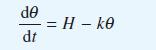
Given that θ = 0 and dθ/dt = 10 when t = 0 and θ = 60 when t = 10 show that
(a) The ultimate rise in temperature is θ = 10/k;
(b) K is a solution of the equation e–10k = 1 – 6k;
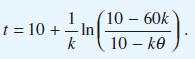
(c)
- H = p
Step by Step Solution
3.50 Rating (163 Votes )
There are 3 Steps involved in it
a b c The temperature is governed by the differential equation de ... View full answer

Get step-by-step solutions from verified subject matter experts