







Question: A matrix A R n,n is said to be nonnegative (resp. positive) if a ij 0 (resp. a ij > 0) for all
A matrix A ∈ Rn,n is said to be nonnegative (resp. positive) if aij ≥ 0 (resp. aij > 0) for all i, j = 1, . . . , n. The notation A ≥ 0 (resp. A > 0) is used to denote nonnegative (resp. positive) matrices. A nonnegative matrix is said to be column (resp. row) stochastic, if the sum of the elements along each column (resp. row) is equal to one, that is if 1TA = 1T(resp. A1 = 1). Similarly, a vector x ∈ Rn is said to be nonnegative if x ≥ 0 (element-wise), and it is said to be a probability vector, if it is nonnegative and 1Tx = 1. The set of probability vectors in Rn is thus the set S = {x ∈ Rn : x ≥ 0, 1Tx = 1}, which is called the probability simplex. The following points you are requested to prove are part of a body of results known as the Perron-Frobenius theory of nonnegative matrices.
1. Prove that a nonnegative matrix A maps nonnegative vectors into nonnegative vectors (i.e., that A x ≥ 0 whenever x ≥ 0), and that a column stochastic matrix A ≥ 0 maps probability vectors into probability vectors.
2. Prove that if A > 0, then its spectral radius ρ(A) is positive.
3. Show that it holds for any matrix A and vector x that
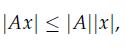
where ΙAΙ (resp. ΙxΙ) denotes the matrix (resp. vector) of moduli of the entries of A (resp. x). Then, show that if A > 0 and li, vi is an eigenvalue/eigenvector pair for A, then
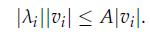
4. Prove that if A > 0 then r(A) is actually an eigenvalue of A (i.e., A has a positive real eigenvalue λ = ρ(A), and all other eigenvalues of A have modulus no larger than this “dominant” eigenvalue), and that there exist a corresponding eigenvector ν > 0. Further, the dominant eigenvalue is simple (i.e., it has unit algebraic multiplicity), but you are not requested to prove this latter fact.
5. Prove that if A > 0 and it is column or row stochastic, then its dominant eigenvalue is λ = 1.
|Ax| |A||x|,
Step by Step Solution
3.52 Rating (166 Votes )
There are 3 Steps involved in it
1 Let A 0 x 0 y Ax and denote with a T i the ith row of A Then obviously which shows that a nonnegat... View full answer

Get step-by-step solutions from verified subject matter experts
 Study Help