







Question: Let x i , i = 1, . . . , n, be given real numbers, which we assume without loss of generality to be
Let xi, i = 1, . . . , n, be given real numbers, which we assume without loss of generality to be ordered as x1 ≤ x2 ≤ .........≤ xn, and consider the scalar equation in variable n that we encountered in Section 12.3.3.3:

1. Show that f is continuous and strictly decreasing for ν ≤ xn.
2. Show that a solution ν* to this equation exists, it is unique, and it must belong to the interval 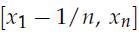
3. This scalar equation could be easily solved for n using, e.g., the bisection method. Describe a simpler, “closed-form” method for finding the optimal n.
n f(v) = 1, where f(v) = [max(x - v, 0). i=1
Step by Step Solution
3.47 Rating (180 Votes )
There are 3 Steps involved in it
Let us denote with s k the sum of the kth largest e... View full answer

Get step-by-step solutions from verified subject matter experts
 Study Help