New Semester
Started
Get
50% OFF
Study Help!
--h --m --s
Claim Now
Question Answers
Textbooks
Find textbooks, questions and answers
Oops, something went wrong!
Change your search query and then try again
S
Books
FREE
Study Help
Expert Questions
Accounting
General Management
Mathematics
Finance
Organizational Behaviour
Law
Physics
Operating System
Management Leadership
Sociology
Programming
Marketing
Database
Computer Network
Economics
Textbooks Solutions
Accounting
Managerial Accounting
Management Leadership
Cost Accounting
Statistics
Business Law
Corporate Finance
Finance
Economics
Auditing
Tutors
Online Tutors
Find a Tutor
Hire a Tutor
Become a Tutor
AI Tutor
AI Study Planner
NEW
Sell Books
Search
Search
Sign In
Register
study help
physics
quantum mechanics a graduate course
Quantum Mechanics A Graduate Course 1st Edition Horatiu Nastase - Solutions
For the case in exercise 6, write down the probability and identify the exchange terms.Data From Exercise 6:-Consider three particles of spin \(1 / 2\). Write the possible spin wave functions for the three-particle states, and construct the possible total wave functions, for the spatial wave
Consider the LagrangianApproximate the system by two harmonic oscillators, and quantize it in the creation and annihilation operator (occupation number) representation. - 2 L= + sin(191)-sin (8292) - 12 sin (812(91 +42)). (B12(91+92)). (8.106)
Consider the Hamiltonian for a (large) number \(N\) of oscillators \(\hat{a}_{i}, \hat{a}_{i}^{\dagger}\) (with \(\left[\hat{a}_{i}, \hat{a}_{j}^{\dagger}\right]=\delta_{i j}\) ):where \(\hat{a}_{N+1} \equiv \hat{a}_{1}, \hat{a}_{N+1}^{\dagger} \equiv \hat{a}_{1}\). Diagonalize it and find its
Show that the completeness relation for coherent states is (8.48).Data From Equation 8.48:- = da da* 1-2mi -e-aa \a\\a\, (8.48)
Calculate (in terms of a single ket state and no operators) exp{ila a+ B(a+a)]}|a). (8.108)
Calculate \(\left\langle x^{2}\rightangle_{n}\) and \(\left\langle x^{3}\rightangle_{n}\) in the state \(|nangle\) of the harmonic oscillator.
Use the Sommerfeld method for a particle in one dimension with a quartic potential, instead of a quadratic one, \(V(x)=\lambda x^{4}\). What is the resulting reduced equation, and can you describe the quantization condition for bound states?
Consider two harmonic oscillators, one with frequency \(\omega\) and one with frequency \(2 \omega\). Calculate the symmetric wave function (in \(x\) space) corresponding to the energy \(E=(15 / 2) \hbar \omega\).
Write down the time evolution operator and the differential equation that it satisfies for a onedimensional particle in a potential \(V(x)\).
Write down the time evolution equation for Heisenberg operators, calculating explicitly the evolution Hamiltonian, in the case of a free particle, and then calculate explicit expressions for \(\hat{x}(t)\) and \(\hat{p}(t)\).
For a harmonic oscillator of frequency \(\omega\), calculate the explicit time-dependent \(a(t), a^{\dagger}(t)\) operators in the picture with \(\hat{W}(t)=\exp \left[2 i \omega \hat{a}^{\dagger} \hat{a}\left(t-t_{0}\right)\right]\), and the explicit differential equations for a general operator
Consider a harmonic oscillator perturbed by \(H_{1}=\lambda\left(a+a^{\dagger}\right)^{3}\). Write down the explicit evolution equations for states (the first two terms in the expansion in \(\omega\) ) and the \(a, a^{\dagger}\) operators in the interaction picture.
Calculate the evolution operator for the interaction picture in the case in exercise 4.Data From Exercise 4:-Consider a harmonic oscillator perturbed by \(H_{1}=\lambda\left(a+a^{\dagger}\right)^{3}\). Write down the explicit evolution equations for states (the first two terms in the expansion in
Consider a Hamiltonian \(\hat{H}(p)\) only (no \(x\) dependence). What are the operators in the theory that evolve nontrivially in the Heisenberg picture? What about in a possible interaction picture, if \(\hat{H}(p)\) can be separated into two parts?
Can one have a picture in which operators don't evolve in time other than the Schrödinger picture?
We have used the idea of Gaussian integration around the classical solution for the action to argue that the first-order result for the path integral is \(\exp \left\{\frac{i}{\hbar} S_{\mathrm{cl}}\left[x_{\mathrm{cl}}(t)\right]\right\}\). However, is Gaussian integration, and more generally the
For the path integral in phase space, we have assumed that the \(P \mathrm{~s}\) are always on the left of the \(X \mathrm{~s}\) in the Hamiltonian. Consider a case where this is not true, for instance having an extra term in the Hamiltonian of the type \(\alpha\left(\hat{P} \hat{X}^{2}+\hat{X}
Consider the case when \(H=\frac{3}{4} p^{4 / 3}+V(x)\) and the path integral is in phase space. Is the resulting path integral in coordinate space approximated in any way by the usual expression \(\int \mathcal{D} x(t) e^{\frac{i}{\hbar} S[x(t)]} ?\)
Consider the Hamiltonian, in terms of \(a, a^{\dagger}\) (with \(\left[a, a^{\dagger}\right]=1\) ),Derive the harmonic path integral in phase space for it (without calculating the path integral, which is not Gaussian). H = hw (a'a + ) + (a + a). (10.63)
Consider a generating functionalCalculate the two-point, three-point, and four-point functions. Z[J(t)] 2[100)] = N cxp|-} } & { arnau.970)]. dt (10.64)
Consider a harmonic oscillator, with Lagrangian \(L=\left(\dot{q}^{2}-\omega^{2} q^{2}\right) / 2\). Using a naive generalization of the Gaussian integration, show that the generating functional is of the type given in exercise 5. Write a formal expression for \(\Delta\left(t, t^{\prime}\right)\).
Consider the generating functionalCalculate the four-point function. Z[J(t)] = N exp +1 dt `dt' J(t)A(t,t')J(t') dt [ dt; [ dtz dtz [ dt41(1;)I(12)J(13)J(14)] (10.65)
Consider the Hamiltonianand the observableFind the equation of motion for \(A\) in the Hamiltonian formalism and the corresponding quantum version of this equation of motion. H = + Ax+ 2 (11.60)
Consider a radial (central) potential for motion in three dimensions, \(V(r)\). Write the quantum version of the Hamilton-Jacobi equation, and reduce it to a single equation for the radial motion (in \(r\) ).
Consider the classical Hamilton-Jacobi formalism, for the case of the motion of a particle in three spatial dimensions, in a central potential \(V(r)=-B / r\). Solve the Hamilton-Jacobi equation for the motion of a particle coming in from infinity and being deflected, and find the deflection angle.
In the parametrization \(\psi=A \exp \left[\frac{i}{\hbar} W(\vec{r})-\frac{i}{\hbar} E t\right]\), what is the equation of motion for \(A\) ? What happens to it in the geometrical optics approximation? If also \(V(\vec{r})=0\), solve the equation for \(A\).
Consider a one-dimensional harmonic oscillator. Can one apply the WKB approximation to it? If so, why, and when?
Write down the WKB approximation for the one-dimensional potential \(V=-B / x, B>0\), and find the domain of validity for it.
For the case in exercise 6, write down the explicit equations for the wave function outside the geometrical optics approximation, and find a way to introduce the next-order corrections to the WKB approximation that are based on the geometrical optics approximation.Data From Exercise 6:-Write down
Consider the Lagrangian \((q, \tilde{q} \in \mathbb{C})\)What are its symmetries? What are the representations of the group in which \(q, \tilde{q}\) belong? m L = (191 + l) - V ((a + q)). (12.70)
Calculate the Noether charge for the continuous symmetry(ies) in exercise 1, and check that the infinitesimal variations of \(q, \tilde{q}\) are indeed generated by the Noether charge via the Poisson bracket with \(q, \tilde{q}\).Data From Exercise 1:-Consider the Lagrangian \((q, \tilde{q} \in
Consider two harmonic oscillators of the same mass and frequency, with HamiltonianFind the continuous symmetries of the system and write down the resulting conserved charges as a function of the phase space variables. Then quantize the system, and show that the charges do indeed commute with the
For the system in exercise 3, write down the equation of motion for \(x_{1}^{2}+x_{2}^{2} \equiv r^{2}\) and then the corresponding Ehrenfest theorem equation and its transformed version under the continuous symmetries, in both the active and the passive sense.Data From Exercise 3:-Consider two
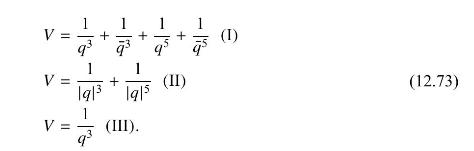
Consider the Lagrangian for \(q \in \mathbb{C}\)in the casesWhat are the symmetries in each case? m L = 191 - V(q), (12.72)
Consider the matrices(a) Do they form a representation of \(\mathbb{Z}_{2}\) ? Why?(b) If so, is the representation reducible?(c) If so, is this a regular representation?(d) If so, is this equivalent with the roots of unity representation? 1 0 0 ~ - 6 : 9 - - 6 : A = 0 10 0 0 1 1 (12.74) 10 0 0
Write down the generalization of the regular representation for \(\mathbb{Z}_{3}\) to the \(\mathbb{Z}_{N}\) case, for a cyclic permutation by one step of the basis elements.
Consider a three-dimensional harmonic oscillator (a harmonic oscillator with the same mass and frequency in each direction). Is it parity invariant? If so, what is the parity of a generic state?
Consider the probability density of the \(n\)th state of the one-dimensional harmonic oscillator. Is it invariant under time-reversal invariance? How about under parity?
Consider a system with two degrees of freedom in one dimension, \(q_{1}\) and \(q_{2}\), and HamiltonianDoes it have any continuous internal symmetries? H + 2 2 +V(91) + V(92) + V12 (191-921). (13.58)
Consider the algebra for three generators \(A, B, C\),Is it a Lie algebra? If so, write its adjoint representation in terms of matrices. [A, B]=C, [B, C]=A, [C, A] = B. (13.59)
Consider a Hamiltonian for two spins, Ha(+2)+S- $2. (13.60)
What is the dimension of the adjoint representation of \(S U(N), N>2\) ? Is this adjoint representation equivalent to the fundamental representation?
Consider the following Lagrangian for \(N\) degrees of freedom \(q_{i}\),If \(q_{i} \in \mathbb{R}\), what is the internal continuous symmetry group? What about if \(q_{i} \in \mathbb{C}\) ? L = = N i=1 1il 2 - V N 19:12) i=1 (13.61)
Write explicitly the matrices of the spin 1 representation and the adjoint representation of \(S U(2)\), and relate them.
Write explicitly the \(2 \times 2\) matrices \(g=e^{i \alpha_{i} \sigma_{i} / 2}\), where \(\sigma_{i}\) are the Pauli matrices, and compare with \(g(\theta, \phi, \psi)\) for \(S O(3)\), to find an explicit map between \(\alpha_{i}\) and the Euler angles \((\theta, \phi, \psi)\).
For a general matrixbelonging to \(S U(2)\), i.e., such that \(A^{\dagger}=A^{-1}\) and \(\operatorname{det} A=1\), find the Euler angles in terms of \(a,b, c, d\). a A = (22) (14.81) d
Consider the complex degrees of freedom \(q_{1}, q_{2} \in \mathbb{C}\) forming a doublet \(q=\left(\begin{array}{l}q_{1} \\ q_{2}\end{array}\right)\), \(A=\sum_{i=1}^{3} a_{i} \sigma_{i} \in \mathbb{C}\), where \(\sigma_{i}\) are the Pauli matrices, and the LagrangianShow that \(L\) is invariant
Write explicitly the matrices for the generators of the group \(S U(2)\) in the \(j=3 / 2\) representation, and check that they satisfy the Lie algebra of \(S U(2)\).
In the classical limit for the angular momentum, i.e., for large \(j\), we expect to see quantum averages \(\left\langle J_{1}\rightangle,\left\langle J_{2}\rightangle,\left\langle J_{3}\rightangle\) close to the classical values, as well as a small quantum fluctuation for these angular momenta.
Consider a three-dimensional rotationally invariant harmonic oscillator. What quantum numbers describe a state of the oscillator, viewed as a system with a potential \(V=V(r)\) ?
Calculatewhere \(\sigma_{i}\) are the Pauli matrices. Tre/2 (15.56)
Decompose the product of two spin 1 representations into (irreducible) representations of \(S U(2)\), and list explicitly the relation between the basis elements for the two bases in terms of Clebsch-Gordan coefficients.
For the case in exercise 2, find all the Clebsch-Gordan coefficients for the lowest value of the total spin \(j\), using the recursion relations and the normalization conditions.Data From Exercise 2:-Decompose the product of two spin 1 representations into (irreducible) representations of \(S
For the sum of three spin 1 representation, in the case where the final spin is 2 , write explicitly the three decompositions of the final basis in terms of the tensor product basis (with a product of two Clebsch-Gordan coefficients) and also write explicitly the resulting Racah coefficients.
Rewrite the relation between the two bases in exercise 2 in terms of Schwinger oscillators.
Consider the Lie algebra for \(J_{i}, K_{i}, i=1,2,3\),Write it in terms of Schwinger oscillators, and give the general representation in terms of Schwinger oscillators acting on a vacuum. [Ji, Jj] = iijk Jk, [Ki, Kj] = iijk Jk, [Ji, Ki] = iijk Kk. (15.57)
Decompose the product of four spin 1 representations of \(S U(2), 1 \otimes 1 \otimes 1 \otimes 1\), into irreducible \(S U(2)\) representations.
Write formally for a general vector space the triangle inequality for three vectors, generalized from vectors in a three-dimensional space, with \(\vec{c}=\vec{a}+\vec{b}\).
Considering three linearly independent vectors in a three-dimensional Euclidean space, \(\vec{a}, \vec{b}, \vec{c}\), construct an orthonormal basis out of them.
Using the bra-ket Dirac notation for operators, show that we can put the product \(\hat{A} \cdot \hat{B}\) into the same form and that the product is associated with the matrix product of the associated matrices.
Show that the trace of a product of Hermitian operators is real.
What is the trace of a tensor product of two operators?
Show that, modulo some discrete symmetries, \(U(n)\) can be split up into \(S U(n)\) times a group \(U(1)\) of complex phases \(e^{i \alpha}\) (and show that these phases do form a group).
Find the two eigenvalues of an operator associated with a \(2 \times 2\) matrix with arbitrary elements.
Discretize the product of two functions, as compared to discretizing each function independently, and describe what that means in the language of kets.
For a tensor product of kets, describe what the norm is in the abstract sense, and then in the function form (with integrals).
Is the square of the "delta function" a distribution? If so, prove it using Dirac's bra-ket notation.
Show how \(\delta^{\prime \prime}(x-y)\) (the second derivative with respect to \(x\) ) acts as a distribution on functions.
Is a real function of a Hermitian operator \(\hat{A}, f(\hat{A})\), also Hermitian? Give examples.
Consider the unitary operator \(e^{i \hat{A}}\), with \(\hat{A}\) Hermitian and acting on function space. Can it be diagonalized? If so, write an expression for its diagonal elements.
Diagonalize \(e^{\sigma_{1}}\), where \(\sigma_{1}\) is the first Pauli matrix \(\left(\begin{array}{ll}0 & 1 \\ 1 & 0\end{array}\right)\).
Suppose that the probability of finding some particle 1 at \(x_{1}\) is a Gaussian around \(x_{1}\), with standard deviation \(\sigma_{1}\), and the probability of finding another particle 2 at \(x_{2}\) is a Gaussian around \(x_{2}\) with standard deviation \(\sigma_{2}\). What is the condition on
Consider the classical HamiltonianWrite a quantum Hamiltonian that is ordering-symmetric with respect to \(\hat{Q}\) and \(\hat{P}\), taking into account that \([\hat{Q}, \hat{P}]\) is a constant. Hap+ Bq+pf (q). = (3.55)
Consider infinite and discrete energy spectra \(E_{n}\). If the spectrum extends by a finite amount, between \(E_{\min }\) and \(E_{\max }\), what conditions can you impose on the \(E_{n}\) very close to either of these values? What if \(E_{\max }=+\infty\) or \(E_{\min }=-\infty\) ?
Consider a (spinless) particle in a three-dimensional potential. How many commuting operators associated with observables are there?
Consider the HamiltonianSolve the Schrödinger equation and find the time evolution operator. H = x. (3.56)
Consider the density matrixwhere \(|1angle\) and \(|2angle \pm|3angle\) are eigenstates of some operator \(\hat{A}\). Calculate the average value of \(A\). = (11) (1| + |2), (2| + |3) (31), (3.57)
In exercise 6 , if the states \(|1angle,|2angle,|3angle\) are eigenstates of the Hamiltonian \(\hat{H}\), write the evolution in time of the density matrix \(\hat{ho}\).Data From Exercise 6:-Consider the density matrixwhere \(|1angle\) and \(|2angle \pm|3angle\) are eigenstates of some operator
Using the Pauli matrices \(\sigma_{i}:\left(\sigma_{1}, \sigma_{2}, \sigma_{3}\right)\), show that we can construct four matrices \(\gamma_{a}\), \(a=1,2,3,4\), as tensor products of Pauli matrices, \(\gamma_{a}=\sigma_{i} \otimes \sigma_{j}\), such that \(\gamma_{a} \gamma_{b}+\gamma_{b}
Consider a system with two spin \(1 / 2\) electrons in a constant magnetic field parallel to the \(z\) direction, \(B_{z}\). Assume there is no other degree of freedom (not even momentum). Solve the Schrödinger equation and find the eigenstates of the system.
Consider the Hamiltonian for a two-level systemCalculate its eigenstates and the associated energies. H = ao 1 + 3 (4.68) i=1
(Neutrino oscillations). Consider a two-level system with eigenstates of the Hamiltonian \(\left|\psi_{1}\rightangle\) and \(\left|\psi_{2}\rightangle\), of energies \(E_{1}\) and \(E_{2}\), respectively \(\left(E_{2}>E_{1}\right)\), corresponding to the mass (and, of course, momentum) eigenstates
Find the unitary evolution operator corresponding to the previous case, that of neutrino oscillations.
Consider the two-qubit statewhere \(C\) is a normalization constant. Find \(C\) as a function of \(a\). When is the state entangled (at what values of \(a\) ), and when is it not entangled? |o) C[|)]1) + 10) |1) + a|1) 0)+10) 10)], (4.69)
Calculate the density matrix of system \(A\) for the two-qubit state above (in exercise 6), when the trace is taken over system \(B\), as a function of \(a\). Find the maximum and minimum probabilities that system \(A\) is in state \(|1angle\), independently of system \(B\).Data From Exercise
Consider possible terms in the (quantum) Hamiltonian for a one-dimensional system,where \(\psi(x)\) is a continuous complex function of the spatial variable \(x\), and \(1 /\left(d^{2} / d x^{2}\right)\) is understood as the inverse of an operator, acting on the function. Can these terms be
Consider the angular momentum of a classical particle, \(\vec{L}=\vec{r} \times \vec{p}\), and a system for which it is invariant. Use it as a generating function to define the relevant canonical transformations.
Consider a system with LagrangianWrite down the Hamiltonian and Poisson brackets, and canonically quantize the system. L=1+ +9192 + k(q1 + 92). (5.64) 2 2
Consider a system of \(N\) free particles in one spatial dimension \(x\). Write down the general eigenstate and eigenenergy, its degeneracy and time evolution.
Consider a system with HamiltonianWrite down its Schrödinger equation for wave functions in coordinate space. If \(\beta=\gamma=0\), write down its general eigenstate wave function and time evolution, for a given energy \(E\). H = 2m + ap + Bx + yx. (5.65)
Consider a free particle in three spatial dimensions, and a system of coordinates relative to a point \(O\) not on the path of the particle. Write down the integrals of motion conjugate to Cartesian, polar, and spherical coordinates respectively, and the canonical quantization for each set of
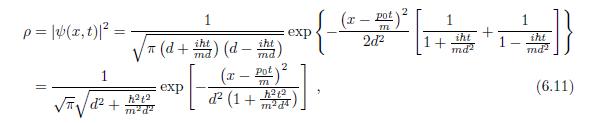
Consider a Gaussian wave packet in momentum space, equation (6.11). Calculate \((\Delta x)^{2}\) and \((\Delta p)^{2}\) in this \(p\) space, and check again the saturation of Heisenberg's uncertainty relations.Equation 6.11:- p = |(x,t)| = 1 md (d+) (dt) (x - Pot) 2 exp d (1+ 771 h212 m2d4 (x-
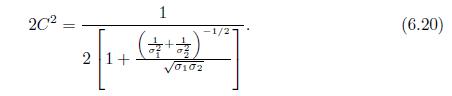
Do the integral for the Gaussian wave packet with evolution operator, to prove (6.18), and calculate \(\Delta x(t)\) for it, to prove (6.20).Equation 6.18:-Equation 6.20:- h AT Tmin. (6.18) 0.5eV
Can we measure simultaneously the momentum and the angular momentum in three spatial dimensions and, if not, what are the Heisenberg uncertainty relations corresponding to them?
Consider a system with HamiltonianCan we measure simultaneously the energy and the momentum of the system? H = p + px. 2m (6.46)
Consider two energy levels of an atomic system, \(E_{1}=E_{*}\) and \(E_{2}=E_{*}+0.5 \mathrm{eV}\). What is the minimum possible decay time from \(E_{2}\) to \(E_{1}\) ?
Consider a superposition of two Gaussian wave packets with the same momentum \(p_{0}\), initially (at time \(t_{0}\) ) at the same position \(x_{0}\), but with different variances, \(\sigma_{1}=d_{1}\) and \(\sigma_{2}=d_{2}\). Calculate \(\left\langle(\Delta x)^{2}\rightangle\) and
Consider a potential that depends only on the radial direction \(r\) in a three-dimensional space, \(V(r)\), with \(V(r\) such that \(\rightarrow \infty)=0\) while \(V(0)=-V_{0}0\), reached at \(r=r_{1}\), and there is a unique solution \(r_{0}\) to the equation \(V\left(r_{0}\right)=0\). Describe
Repeat the previous exercise in the case \(V(r \rightarrow 0) \rightarrow-\infty\).Data From Previous Exercise:-Consider a potential that depends only on the radial direction \(r\) in a three-dimensional space, \(V(r)\), with \(V(r\) such that \(\rightarrow \infty)=0\) while \(V(0)=-V_{0}0\),
Consider the delta function potential in one dimension,Calculate its bound state spectrum. V = -Vo8(x). (7.94)
Showing 300 - 400
of 404
1
2
3
4
5
Step by Step Answers

 Get 50% OFF
Claim Now
Get 50% OFF
Claim Now