New Semester
Started
Get
50% OFF
Study Help!
--h --m --s
Claim Now
Question Answers
Textbooks
Find textbooks, questions and answers
Oops, something went wrong!
Change your search query and then try again
S
Books
FREE
Study Help
Expert Questions
Accounting
General Management
Mathematics
Finance
Organizational Behaviour
Law
Physics
Operating System
Management Leadership
Sociology
Programming
Marketing
Database
Computer Network
Economics
Textbooks Solutions
Accounting
Managerial Accounting
Management Leadership
Cost Accounting
Statistics
Business Law
Corporate Finance
Finance
Economics
Auditing
Tutors
Online Tutors
Find a Tutor
Hire a Tutor
Become a Tutor
AI Tutor
AI Study Planner
NEW
Sell Books
Search
Search
Sign In
Register
study help
physics
quantum mechanics a graduate course
Quantum Mechanics A Graduate Course 1st Edition Horatiu Nastase - Solutions
Explain why a small permanent magnet brought down along the (vertical) axis of a superconducting ring levitates (i.e., it doesn't fall under gravity).
Consider a plane electromagnetic wave incident in a perpendicular direction onto a planar material containing electrons bound in it. Does the wave induce (leading-order) transitions in the electronic states?
Calculate the spin-orbit interaction for a hydrogen atom in the ground state.
Consider a figure-eight loop made of conductor, mostly in a single plane (with just enough nonplanarity for the loop to not cross itself, but to slightly avoid it), and a constant magnetic field perpendicular to this plane. Do we have an Aharonov-Bohm phase for the electrons in the conducting loop?
What happens to the wave function of the electrons moving around the loop in exercise 1 (or to the interference pattern if we shoot electrons at a point on the loop in opposite directions on the loop and measure their interference when they cross again) as we undo the figure-eight into a circle in
Consider a system depending on \(N\) time-dependent vectors \(\vec{R}_{i}, i=1,2, \ldots, N\), for instance a molecule with \(N\) nuclei with such positions. How do we construct its generic Berry phase?
Consider an \(\mathrm{H}_{2}\) molecule moving slowly, in the Born-Oppenheimer approximation, in a constant electric field \(\vec{E}\). What Berry connection does one define, and how can we have a nontrivial Berry phase?
Consider a molecule with fixed dipole \(\vec{d}\) in a time-dependent electric field \(\vec{E}(t)\). Calculate the Berry connection and Berry magnetic field in this case. Do we have a geometrical phase in this case?
Prove that for a spin \(1 / 2\) particle in a magnetic field the Berry curvature is given by (23.56). B=mh- B B2 (23.56)
How would you define the Berry curvature in the nonabelian case, in such a way that it transforms covariantly under \(U(N)\), i.e., with \(U\) acting from the left and \(U^{-1}\) from the right?
Consider a stationary gauge transformation \(\Lambda(x, y)\) in the plane transverse to a magnetic field \(B_{z}\). Calculate the effect it has on the Schrödinger equation and its solutions.
For the case in exercise 1, specialize to an infinitesimal gauge transformation that rotates \(\vec{A}\) in its plane (transverse to \(\vec{B}\) ), and interpret this in terms of the classical motion.Data From Exercise 1:-Consider a stationary gauge transformation \(\Lambda(x, y)\) in the plane
For a (2+1)-dimensional system of sides \(L_{x}\) and \(L_{y}\) under the IQHE, calculate the length of the plateau in \(R_{H}\) as \(B\) is increased.
In the FQHE, how many occupied states can there be in a Landau level? What do you deduce about the description of the states of the electron?
In some more complicated materials, we can have both a Hall conductivity and a longitudinal, usually isotropic, conductivity. Calculate the resistivity matrix \(R_{i j}\). Consider a transformation that acts by exchanging the values of the electric field components \(E_{i}\) and those of the
For a multi-electron atom, with total angular momentum \(L>1\) and total spin 1, what are the possible values of the Landé \(g\) factor? Specialize to the classical limit of large \(L\).
Consider a multi-electron atom, with spin \(S\), orbital angular momentum \(L\), and total angular momentum \(J\) in a slowly varying magnetic field \(B(t)\) moving on a closed curve \(C\). Calculate the Berry phase of the quantum state of the atom.
Write down the equation for \(s_{2}\) in terms of \(s_{0}\) and \(s_{1}=t_{0}\), and substitute into it the values of \(s_{0}\) and \(s_{1}\) from the WKB solution in one dimension.
Write down the connection formulas at the turning points for a harmonic oscillator in one dimension.
Write down the connection formulas at the turning points for a potential \(V=V_{0} \cos (a x)\left(V_{0}>0\right)\), for \(E
Consider the potential barrier given by \(V_{\text {eff }}(r)\) for the radial motion in a potential \(V=-|\alpha| / r^{3}\) with a positive energy smaller than the barrier. Write down the connection formulas or the turning points in this case.
In the case in exercise 4, calculate the transmission coefficient.Data From Exercise 4:-Consider the potential barrier given by \(V_{\text {eff }}(r)\) for the radial motion in a potential \(V=-|\alpha| / r^{3}\) with a positive energy smaller than the barrier. Write down the connection formulas or
Consider the potential \(V=-V_{0} \cos (a x)\left(V_{0}>0\right)\) with a small initial condition \(\left(x_{0}
Can we truncate the sum over \(n\) in the propagator (25.47) to a finite order, as an approximation?Data From Equation 25.47:- S 1 00 dxoe Sh = det O = K(T) ei(n+1/2) = K(T) e-iEnT/h (25.47) n=0 n=0
Consider the LagrangianWrite down the explicit (improved) Bohr-Sommerfeld quantization condition for periodic motion in this Lagrangian. L = 4 2 19 + aq - q. Aq (26.64)
For the potential \(V=k|x|\) in Bohr-Sommerfeld quantization, calculate the leading and first subleading terms for the eigenfunctions at large \(x\) and small \(x\).
Apply the Bohr-Sommerfeld quantization method to particle in a box (an infinitely deep square well) to find the eigenenergies and eigenfunctions, and compare with the exact results.
For the wave function of the harmonic oscillator in the Bohr-Sommerfeld quantization method, what happens in the classical, large- \(n\), limit? Is there any sense in which we can consider that the result matches the exact result?
For the case of motion in a central potential, write down the equations for \(R_{2}\) and \(\Theta_{2}\).
Calculate the Bohr-Sommerfeld quantization condition for \(R(r)\) for motion in the central potential \(V=-\alpha / r^{2}\).
For the hydrogenoid atom in Bohr-Sommerfeld quantization, compare the wave function as \(r \rightarrow \infty\) (the leading and first subleading terms) with the exact wave function. Do they match? Is there any sense in which the wave function matches the exact one in the classical limit \(n
Can Maxwell duality be derived from the classical action for electromagnetism (plus electric and magnetic sources)? Is there a simple way to generalize this duality to the quantum theory, if there are particles minimally coupled to the electromagnetic fields? Explain.
Consider an electron and a monopole at the same point at a distance \(R\) from a perfectly conducting infinite plane. What are \(\vec{E}\) and \(\vec{B}\) on the plane at the minimum-distance point from the charges?
In the presence of so-called dyons, particles that carry both electric and magnetic charges, the Dirac quantization condition for a particle with charges \(\left(q_{1}, g_{1}\right)\) and another particle with charges \(\left(q_{2}, g_{2}\right)\) is generalized to the Dirac-Schwinger-Zwanziger
Consider two dyons satisfying the Dirac-Schwinger-Zwanziger quantization condition given in exercise 3 , the minimum value for the integer, \(N=1\), occurring when one of the dyons has \(q_{1}=e, g_{1}=h / e\). Calculate the total relative force between the dyons.Data From Exercise 3:-In the
Suppose that the magnetic field for a particle at the point 0 is a delta function,Take two such particles and rotate one around the other. Calculate the Aharonov-Bohm phase \(\exp \left[i \oint_{C} \vec{A} \cdot d \vec{l}\right]\) of the moving particle. Since the particles are identical, how would
Consider two monopoles of opposite charge (monopole and antimonopole) situated at a distance \(2 R\) from each other, and a sphere of radius \(2 R\) centered on the midpoint between the monopole and antimonopole. Is there a unique vector potential \(\vec{A}\) that is valid over the whole sphere?
Suppose in our Universe there is only a monopole and antimonopole pair, situated at a distance \(\mathrm{d}\) of each other that is much smaller than the distance to any other atom in the Universe. Can we still infer that the electron charge is quantized? Explain.
Consider the propagator obtained by the replacement \(\omega^{2} \rightarrow \omega^{2}+i \epsilon\) ("anti-Feynman") in the Fourier transform. Calculate the integral, and find the corresponding boundary conditions for the (Hilbert space of) functions over which we invert the kinetic operator.
Repeat the above exercise for the case where both the \(p= \pm \omega\) poles in the integral are avoided in the complex space from above (via a complex integration contour that is slightly above the real line at the level of both poles).Data From Previous Exercise:-Consider the propagator obtained
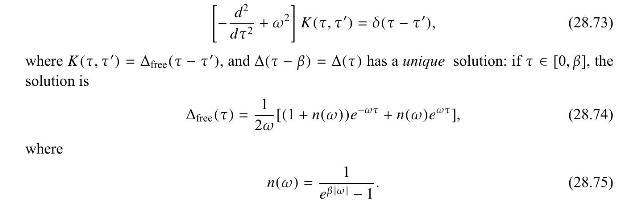
Prove that d dr +wK(T,T) = d(7- T'), (28.73) = where K(T. T') Afree (TT'), and A(TB) = A(7) has a unique solution: if x = [0,3], the solution is where Afree (T) = [(1+n(w))e+n(w)e], 2w (28.74) 1 n(w) = (28.75) ew-1
Wick-rotate the formula I(EE)= = S dE1,E dE2,E 1 2 2 (E+w)(E+w)[(EE + E2E - EE) + w] (28.76)
For the driven harmonic oscillator, Wick-rotated to Euclidean space, calculate the four-point function \(G_{4, E}\left(t_{1}, t_{2}, t_{3}, t_{4}\right)\).
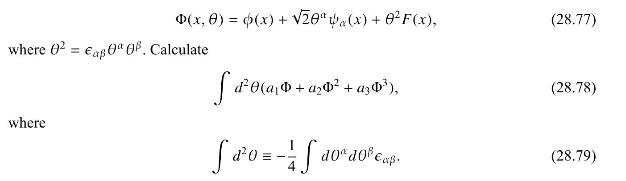
Consider Grassmann variables \(\theta^{\alpha}, \alpha=1,2\), and the even function where 02 = a00. Calculate where D(x, 0) = (x) + 20 a(x) +8 F(x), (28.77) S & (a + a + az), (28.78) d20=- doa doap. (28.79)
Fill in the details omitted in the text for the calculation of Z[nn] Z[0, 0] exp = dT xp(-if dr f dr' (T)DF (T, T')n(x)). (1,7') (28.80)
Consider the Lagrangianand the (primary) constraint \(q_{1}+\beta q_{2}=0\). Calculate the secondary constraints, and find out which of the constraints is first class and which is second class. L = (q + ) a (q + q) - (29.70)
Consider a particle of mass \(m\) in an (approximately) constant gravitational field (such as that of the Earth), but constrained to move on a circle within a vertical plane. Using Cartesian coordinates and the constraint formalism, write down the Lagrangian and the primary constraint and calculate
Consider the LagrangianFind the constraints of the system, write down the total Hamiltonian, and solve for \(U_{m}, v_{a}\). L || 1 +9291 - 9192. (29.71)
Use Dirac quantization to quantize the system in exercise 3.Data From Exercise 3:-Consider the LagrangianFind the constraints of the system, write down the total Hamiltonian, and solve for \(U_{m}, v_{a}\). L || 1 +9291 - 9192. (29.71)
Consider the Born-Infeld action for nonlinear eletromagnetism,where \(L\) is a constant length.Calculate the Hamiltonians \(H, H^{\prime}, H_{T}, H_{E}\) in a similar way to the Maxwell electromagnetism case in the text, and find the Dirac brackets. S = -L-4 dx dt 1+ L4. FvFv 2 - 87 8 (29.72)
Consider the action for a (Dirac) spinor,written in terms of independent variables \(\psi\) and \(\psi^{*}\). Calculate the primary constraints and the total Hamiltonian \(H_{T}\). Check that there are no secondary constraints, and then fromsolve for \(U_{m}, v_{A}\). Note that classical fermions
(Continuation of exercise 6) Show that all constraints are second class, thus writing also \(H^{\prime}\) and \(H_{E}\). Write down the Dirac brackets, and find a (potentially!) new expression for \(H_{T}\) and the resulting Dirac quantization relations.Data From Exercise 6:-Consider the action for
Consider the state \(\left|\chi_{1,2}^{a}\rightangle=\left|\psi_{1,2}\rightangle+a\left|\phi_{1,2}\rightangle\), for an arbitrary \(a \in \mathbb{R}\). When is it separable? Calculate \(ho_{A}\) and \(ho_{B}\) to check that you find the correct results.
Apply Schmidt decomposition to the general case in exercise 1.Data From Exercise 1:-Consider the state \(\left|\chi_{1,2}^{a}\rightangle=\left|\psi_{1,2}\rightangle+a\left|\phi_{1,2}\rightangle\), for an arbitrary \(a \in \mathbb{R}\). When is it separable? Calculate \(ho_{A}\) and \(ho_{B}\) to
Consider the same general state as that in exercise 1, in the generic entangled case. What is the unitary matrix that disentangles them?Data From Exercise 1:-Consider the state \(\left|\chi_{1,2}^{a}\rightangle=\left|\psi_{1,2}\rightangle+a\left|\phi_{1,2}\rightangle\), for an arbitrary \(a \in
Consider the density matrixwhere \(|1angle,|2angle,|3angle\) are orthonormal states. Calculate \(C\), and thus the von Neumann entropy of this mixed state. p = C(11)2]+|2)(1 + a12)2]+|2)(3|+|3)(21), (30.59)
For the generic state in exercise 1, calculate the entanglement entropy.Data From Exercise 1:-Consider the state \(\left|\chi_{1,2}^{a}\rightangle=\left|\psi_{1,2}\rightangle+a\left|\phi_{1,2}\rightangle\), for an arbitrary \(a \in \mathbb{R}\). When is it separable? Calculate \(ho_{A}\) and
Consider three spin \(1 / 2\) systems, \(A, B\), and \(C\), and a stateCheck that the strong subadditivity condition is satisfied. C(I) + |) + IT)). (30.60)
Consider an EPR state \(|\phiangle_{A B}\); Alice measures the spin on \(z\), then Bob measures it on \(x\), and then Alice measures it again on \(z\). Classify the possible answers for the second measurement of Alice, with their probabilities, depending on the initial measurement of Alice (and
Explore whether the original Bell inequality can be violated at large angles as well.
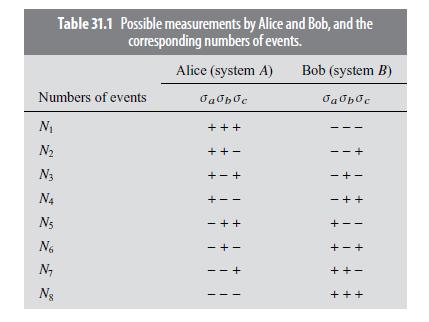
Analyzing Table 1, find another example of a Bell-Wigner inequality that is violated in quantum mechanics.Data From Table 1:- Table 31.1 Possible measurements by Alice and Bob, and the corresponding numbers of events. Alice (system A) Bob (system B) Numbers of events M N +++ - N ++- --+ N3 +-+ N4
Find an example of (angles corresponding to) another violation of the Bell-CHSH inequality by quantum mechanics, which is not maximal but is more generic.
Instead of the Bell-CHSH inequality in the text, consider an inequality obtained in the same way from \(\tilde{M}=\left(A+A^{\prime}\right) B^{\prime}+\left(A-A^{\prime}\right) B\) instead of \(M\). Is it still violated by quantum mechanics?
If we consider five measurements instead of the four in the Bell-CHSH inequality, namely \(a, a^{\prime}, a^{\prime \prime}\) for Alice and \(b, b^{\prime}\) for Bob, can we extend the Bell-CHSH inequality to include this case, such that the inequality is still violated by quantum mechanics?
In quantum cosmology, one can define a "wave function of the Universe" \(\Psi[a(t)]\), whose variable is the expanding scale factor of the Universe, \(a(t)\), and which satisfies a general relativity (Einstein) version of the Schrödinger equation, called the Wheeler-DeWitt equation. Yet in the
In some TV shows, instigated by the "many worlds interpretation" of quantum mechanics, one sees an "evil parallel Universe", where things have gone very bad in some sense, and the same characters behave in an evil way. Leaving aside philosophical speculations on good and evil, and the possibility
Consider the symmetric traceless operatorwhere \(\hat{X}_{i}\) corresponds to the position of a particle. Is it a tensor operator? Justify your answer with a calculation. 1 XX-3 (16.73)
Consider a free particle. Rewrite the matrix elementsin terms of Clebsch-Gordan coefficients and other quantities. E', I'm ( P }) \E, |E, lm) (16.74)
Write down the differential equation satisfied by the reduced spherical harmonic \(y_{l m}(\theta)\).
Express the Schrödinger equation of the free particle in polar coordinates \((r, \theta, z)\), making use of \(L_{z}\).
Write down the relevant separation of variables for exercise 4.Data From Exercise 4:-Express the Schrödinger equation of the free particle in polar coordinates \((r, \theta, z)\), making use of \(L_{z}\).
Consider two free particles, and write down the wave function (in coordinate space) of this system (of distinguishable particles) for the case where the two particles coincide, in terms of the total angular momentum \(\vec{L}_{1}+\vec{L}_{2}\).
Find the normalization condition for orthonormal free particle solutions \(A j_{l}(k r) Y_{l m}(\theta, \phi)\).
For an electron inside an atom, with angular momentum \(l=1\) (and spin \(1 / 2\) ), in a magnetic field, how many energy levels (from spectral lines) do we see? Assume there is a single energy level for \(l, s\) fixed.
Write down the wave function for a free oscillating neutrino (using general parameters) in Cartesian coordinates.
Write down the wave function for a free oscillating neutrino (using general parameters) in spherical coordinates.
Prove the addition formula for spherical harmonics, (17.47).Data From Equation 17.47:- m=-1 (lm)(lm ') = Ym(n)Y(')= -P( '). 21+1 4 (17.47) m=-1
Consider an electron (with spin 1/2) in a magnetic field \(\vec{B}\). Classically, the spin has a precession motion around \(\vec{B}\) (Larmor precession). Prove this. Then calculate the quantum mechanical wave function \(|\psi(t)angle\) corresponding to this classical motion.
Consider an electron with orbital angular momentum \(l=2\). Write down its possible states in the \(\vec{J}\) basis.
Prove that the time-reversal operator can be written as \(T=e^{-i \pi S_{y} / \hbar} K_{0}\).
Consider the three-body problem, with the same two-body potential \(V_{i j}\left(r_{i j}\right)\) for all three pairs. Can we separate variables to factor out anything in this general case?
Set up the problem for the same hydrogenoid atom, but living in two spatial dimensions instead of three (yet with the \(1 / r\) potential of three dimensions).
Use the same Sommerfeld polynomial method to solve the problem in exercise 2.Data From Exercise 2:-Set up the problem for the same hydrogenoid atom, but living in two spatial dimensions instead of three (yet with the \(1 / r\) potential of three dimensions).
Prove that the normalization constant \(N_{n l}\) is given by equation (18.61).Data From Equation 18.61:- Nnl = (2n) 3/2 1 (21+1)! (n+1)! (n-1-1)! 2n (18.61)
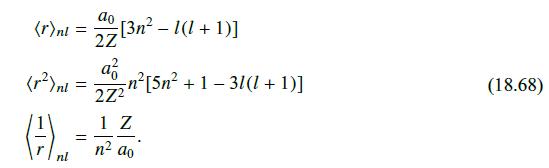
Prove the relations (18.68).Data From Equation 18.68:- ao (r)nt = [3n - 1(1+1)]
Calculate the average radial momentum of the reduced orbiting particle in the state \(n, l\) of the hydrogenoid atom.
If we introduce a small constant magnetic field \(\vec{B}\) for the hydrogenoid atom, what happens to the energy levels \(E_{n}\) ? Give an approximate quantitative description of how this happens, based on the quantization of energy at \(\vec{B}=0\).
Consider the central potential \(V(r)=\alpha / r \cos \beta r\). How many bound states are there?
Consider the central potential \(V(r)=|\alpha| / r^{2} \ln r / r_{*}\). In what region of space are the bound states confined?
Consider the attractive Yukawa central potential, \(V(r)=-|\alpha| / r e^{-m r}\). Is the bound state spectrum finite or infinite? Can we use the same approximation as that used for the diatomic molecule, and if so, under what conditions?
For the free particle in spherical coordinates, prove relation (19.53).Data From Equation 19.53:- c = (21+ 1)ico, (19.53)
Complete the proof of the fact that the number of bound states of the spherical square well is finite.
Show that the normalization constant for the isotropic harmonic oscillator in spherical coordinates is given by (19.93).Data From Equation 19.93:- Nn.= = F(+3/2) n,! (n, +1 + 3/2) 1/2 (19.93)
Solve the isotropic harmonic oscillator in two spatial dimensions, using polar coordinates.
Write down an antisymmetric (fermionic) state for three particles, the energy eigenstates \(E_{1}, E_{2}, E_{3}\), and the corresponding Slater determinant.
Consider a three-body problem with two-body interactions, i.e., with the potentialIs this quantum potential suitable for indistinguishable particles? - V = Vint (1 2) + Vint (|1 3]) + Vint (2-3). - (20.63)
Consider a state with \(N\) indistinguishable particles. What is the phase that relates \(|12 \ldots Nangle\) with \(|N \ldots 21angle\) ?
Write down a general state for fermionic harmonic oscillator. Also write down general state for \(N\) identical fermionic harmonic oscillators.
We saw in the text that \([\phi(\vec{x}, t), \phi(\vec{y}, t)]=0\) for a bosonic field. Show also that \(\{\psi(\vec{x}, t), \psi(\vec{y}, t)\}=0\) for a fermion. What relation will we have for the product \(\phi(\vec{x}, t) \psi(\vec{y}, t)\) ?
Consider three particles of spin \(1 / 2\). Write the possible spin wave functions for the three-particle states, and construct the possible total wave functions, for the spatial wave function times the spin wave function.
Showing 200 - 300
of 404
1
2
3
4
5
Step by Step Answers

 Get 50% OFF
Claim Now
Get 50% OFF
Claim Now