







Question: Suppose that has a positive derivative for all values of x and that (1) = 0. Which of the following statements must be true
Suppose that ƒ has a positive derivative for all values of x and that ƒ(1) = 0. Which of the following statements must be true of the function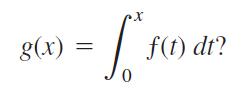
Give reasons for your answers.
a. g is a differentiable function of x.
b. g is a continuous function of x.
c. The graph of g has a horizontal tangent at x = 1.
d. g has a local maximum at x = 1.
e. g has a local minimum at x = 1.
f. The graph of g has an inflection point at x = 1.
g. The graph of dg/dx crosses the x-axis at x = 1.
g(x) = Xu 0 f(t) dt?
Step by Step Solution
3.48 Rating (155 Votes )
There are 3 Steps involved in it
a True Since is continuous g is differentiable by Part 1 of the Fund... View full answer

Get step-by-step solutions from verified subject matter experts
 Study Help