



Question: 1. (20 points) Consider a reform that changed welfare benefits in North Dakota and suppose that at the same time there was no change
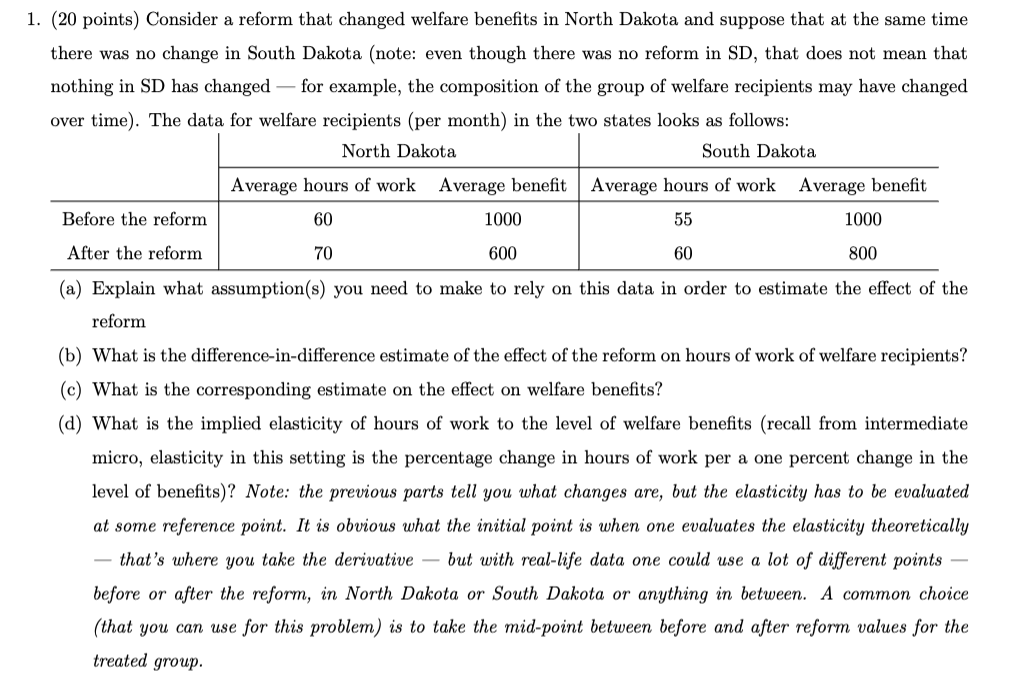
1. (20 points) Consider a reform that changed welfare benefits in North Dakota and suppose that at the same time there was no change in South Dakota (note: even though there was no reform in SD, that does not mean that nothing in SD has changed-for example, the composition of the group of welfare recipients may have changed over time). The data for welfare recipients (per month) in the two states looks as follows: North Dakota South Dakota Average hours of work Average benefit Average hours of work Average benefit Before the reform After the reform 60 70 1000 600 55 60 1000 800 (a) Explain what assumption(s) you need to make to rely on this data in order to estimate the effect of the reform (b) What is the difference-in-difference estimate of the effect of the reform on hours of work of welfare recipients? (c) What is the corresponding estimate on the effect on welfare benefits? (d) What is the implied elasticity of hours of work to the level of welfare benefits (recall from intermediate micro, elasticity in this setting is the percentage change in hours of work per a one percent change in the level of benefits)? Note: the previous parts tell you what changes are, but the elasticity has to be evaluated at some reference point. It is obvious what the initial point is when one evaluates the elasticity theoretically that's where you take the derivative but with real-life data one could use a lot of different points before or after the reform, in North Dakota or South Dakota or anything in between. A common choice (that you can use for this problem) is to take the mid-point between before and after reform values for the treated group.
Step by Step Solution
There are 3 Steps involved in it

Get step-by-step solutions from verified subject matter experts