Question: 1. (60 points) Consider the manufacturing flowchart and data given below: Product P S9O/Unit 100 Units/Week Product R $70/Unit 25 Units Week Product S100/Unit 50
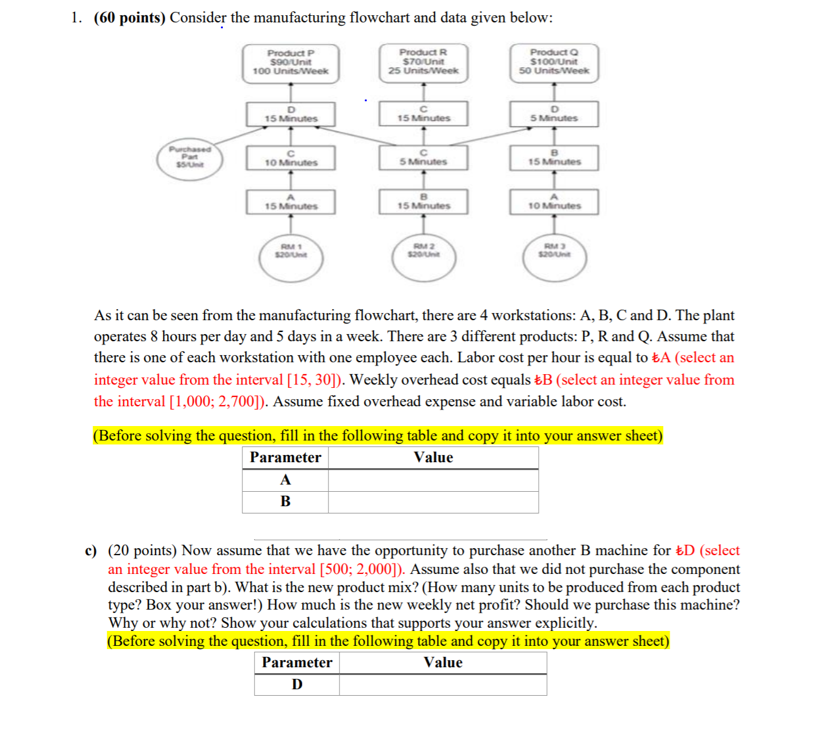
1. (60 points) Consider the manufacturing flowchart and data given below: Product P S9O/Unit 100 Units/Week Product R $70/Unit 25 Units Week Product S100/Unit 50 Units Week D 15 Minutes 15 Minutes D 5 Minutes Par 10 Minutes 5 Minutes 15 Minutes HH 14- 4-1410 15 Minutes 15 Minutes 10 Minutes RM 2 RM> 520 As it can be seen from the manufacturing flowchart, there are 4 workstations: A, B, C and D. The plant operates 8 hours per day and 5 days in a week. There are 3 different products: P, R and Q. Assume that there is one of each workstation with one employee each. Labor cost per hour is equal to A (select an integer value from the interval [15, 30]). Weekly overhead cost equals &B (select an integer value from the interval [1,000; 2,700]). Assume fixed overhead expense and variable labor cost. (Before solving the question, fill in the following table and copy it into your answer sheet) Parameter Value A B c) (20 points) Now assume that we have the opportunity to purchase another B machine for $D (select an integer value from the interval [500; 2,000]). Assume also that we did not purchase the component described in part b). What is the new product mix? (How many units to be produced from each product type? Box your answer!) How much is the new weekly net profit? Should we purchase this machine? Why or why not? Show your calculations that supports your answer explicitly. (Before solving the question, fill in the following table and copy it into your answer sheet) Parameter Value D 1. (60 points) Consider the manufacturing flowchart and data given below: Product P S9O/Unit 100 Units/Week Product R $70/Unit 25 Units Week Product S100/Unit 50 Units Week D 15 Minutes 15 Minutes D 5 Minutes Par 10 Minutes 5 Minutes 15 Minutes HH 14- 4-1410 15 Minutes 15 Minutes 10 Minutes RM 2 RM> 520 As it can be seen from the manufacturing flowchart, there are 4 workstations: A, B, C and D. The plant operates 8 hours per day and 5 days in a week. There are 3 different products: P, R and Q. Assume that there is one of each workstation with one employee each. Labor cost per hour is equal to A (select an integer value from the interval [15, 30]). Weekly overhead cost equals &B (select an integer value from the interval [1,000; 2,700]). Assume fixed overhead expense and variable labor cost. (Before solving the question, fill in the following table and copy it into your answer sheet) Parameter Value A B c) (20 points) Now assume that we have the opportunity to purchase another B machine for $D (select an integer value from the interval [500; 2,000]). Assume also that we did not purchase the component described in part b). What is the new product mix? (How many units to be produced from each product type? Box your answer!) How much is the new weekly net profit? Should we purchase this machine? Why or why not? Show your calculations that supports your answer explicitly. (Before solving the question, fill in the following table and copy it into your answer sheet) Parameter Value D









 Study Help