



Question: 1. Below are four graphs, each of which is defined by the sets of nodes, initial nodes, final nodes, edges, and defs and uses.
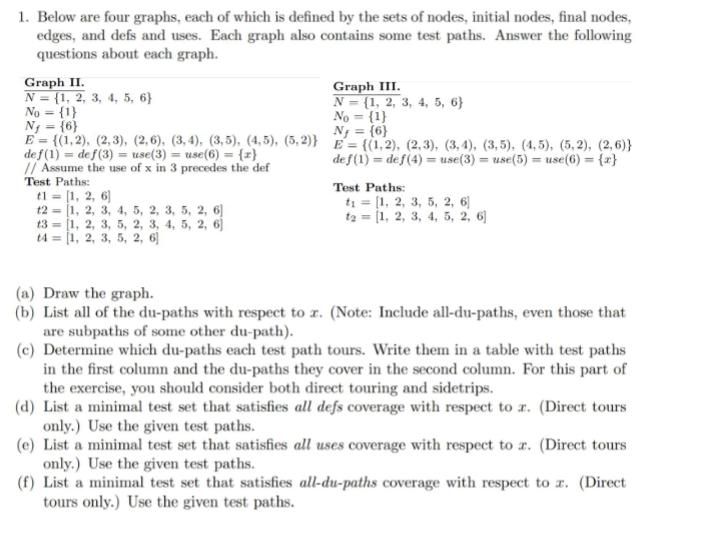
1. Below are four graphs, each of which is defined by the sets of nodes, initial nodes, final nodes, edges, and defs and uses. Each graph also contains some test paths. Answer the following questions about each graph. Graph II. N= {1, 2, 3, 4, 5, 6} No = {1} N = {6} E=((1,2), (2,3), (2.6), (3,4), (3,5), (4,5), (5,2)) def(1) = def (3) use(3) = use(6) = {z} // Assume the use of x in 3 precedes the def Test Paths: t1 = [1, 2, 6] 12 13 [1, 2, 3, 4, 5, 2, 3, 5, 2, 6] 1, 2, 3, 5, 2, 3, 4, 5, 2, 6] 14 [1, 2, 3, 5, 2, 6] Graph III. N (1, 2, 3, 4, 5, 6} No = {1} Ny = {6} = {(1,2), (2,3), (3,4), (3,5), (4,5), (5,2), (2,6)} def(1) = def(4) = use(3) = use (5) = use(6) = {x} Test Paths: t = [1, 2, 3, 5, 2, 6] 12 [1, 2, 3, 4, 5, 2, 6] (a) Draw the graph. (b) List all of the du-paths with respect to r. (Note: Include all-du-paths, even those that are subpaths of some other du-path). (c) Determine which du-paths each test path tours. Write them in a table with test paths in the first column and the du-paths they cover in the second column. For this part of the exercise, you should consider both direct touring and sidetrips. (d) List a minimal test set that satisfies all defs coverage with respect to r. (Direct tours only.) Use the given test paths. (e) List a minimal test set that satisfies all uses coverage with respect to r. (Direct tours only.) Use the given test paths. (f) List a minimal test set that satisfies all-du-paths coverage with respect to x. (Direct tours only.) Use the given test paths.
Step by Step Solution
There are 3 Steps involved in it

Get step-by-step solutions from verified subject matter experts