







Question: 1. Consider the pattern of squares within squares shown below. Diagram 1 Diagram 2 Diagram 3 a) Draw the next diagram in the pattern
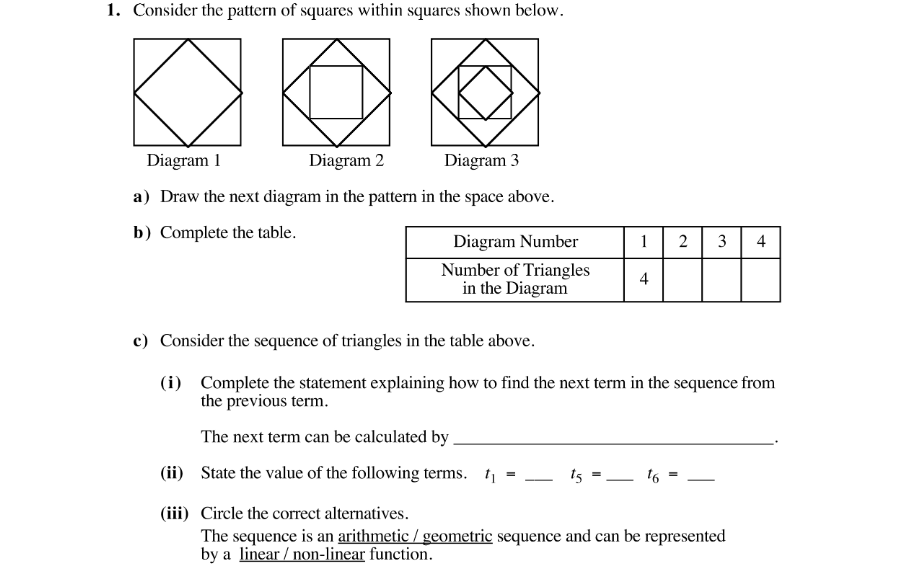
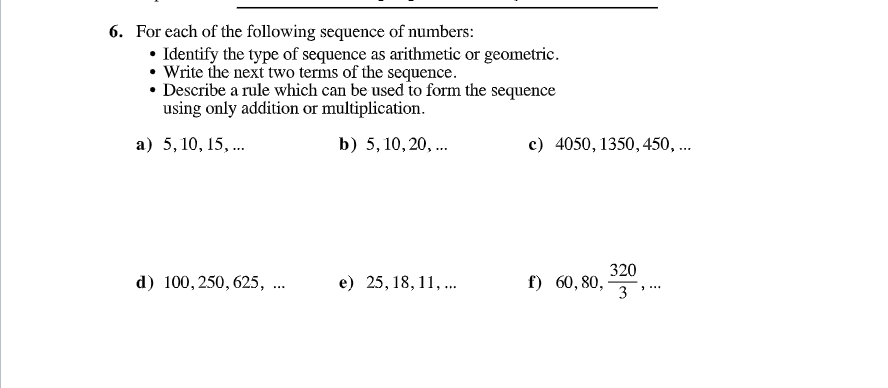
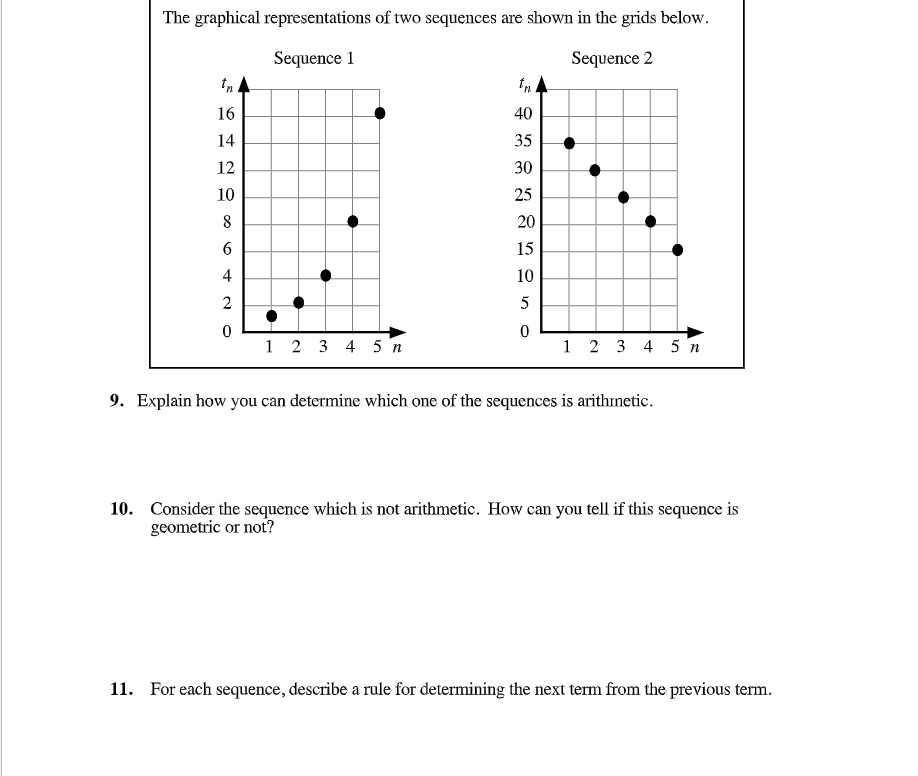
1. Consider the pattern of squares within squares shown below. Diagram 1 Diagram 2 Diagram 3 a) Draw the next diagram in the pattern in the space above. b) Complete the table. Diagram Number 1 2 3 4 Number of Triangles in the Diagram 4 c) Consider the sequence of triangles in the table above. (i) Complete the statement explaining how to find the next term in the sequence from the previous term. The next term can be calculated by (ii) State the value of the following terms. (iii) Circle the correct alternatives. = 16 The sequence is an arithmetic / geometric sequence and can be represented by a linear/non-linear function. 6. For each of the following sequence of numbers: Identify the type of sequence as arithmetic or geometric. Write the next two terms of the sequence. Describe a rule which can be used to form the sequence using only addition or multiplication. a) 5, 10, 15, ... b) 5, 10,20,... c) 4050, 1350, 450, ... d) 100,250, 625, ... 320 e) 25, 18, 11, ... f) 60,80, 3' The graphical representations of two sequences are shown in the grids below. Sequence 1 tn 16 14 12 10 8 6 4 2 0 1 2 3 4 5 n Sequence 2 tn 40 35 30 25 20 15 10 5 0 1 2 3 4 5 n 9. Explain how you can determine which one of the sequences is arithmetic. 10. Consider the sequence which is not arithmetic. How can you tell if this sequence is geometric or not? 11. For each sequence, describe a rule for determining the next term from the previous term.
Step by Step Solution
There are 3 Steps involved in it

Get step-by-step solutions from verified subject matter experts
 Study Help