







Question: 1. Consider the single object allocation problem discussed in the class. A single object needs to be allocated to one of n agents. Each agent
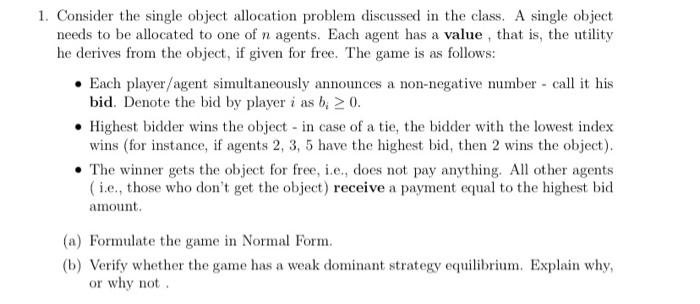
1. Consider the single object allocation problem discussed in the class. A single object needs to be allocated to one of n agents. Each agent has a value , that is, the utility he derives from the object, if given for free. The game is as follows: . Each player/agent simultaneously announces a non-negative number - call it his bid. Denote the bid by player i as b, 2 0. . Highest bidder wins the object - in case of a tie, the bidder with the lowest index wins (for instance, if agents 2, 3, 5 have the highest bid, then 2 wins the object). . The winner gets the object for free, i.e., does not pay anything. All other agents (i.e., those who don't get the object) receive a payment equal to the highest bid amount. (a) Formulate the game in Normal Form. (b) Verify whether the game has a weak dominant strategy equilibrium. Explain why, or why not
Step by Step Solution
There are 3 Steps involved in it

Get step-by-step solutions from verified subject matter experts
 Study Help