







Question: 1. Consider the single object allocation problem discussed in the class. A single object needs to be allocated to one of n agents. Each agent
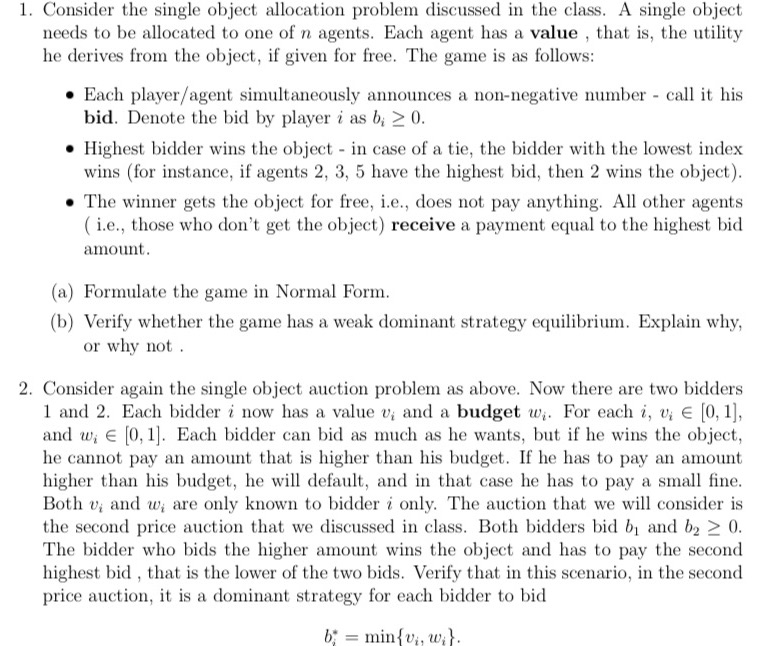
1. Consider the single object allocation problem discussed in the class. A single object needs to be allocated to one of n agents. Each agent has a value , that is, the utility he derives from the object, if given for free. The game is as follows: . Each player/ agent simultaneously announces a non-negative number - call it his bid. Denote the bid by player i as b; 2 0. . Highest bidder wins the object - in case of a tie, the bidder with the lowest index wins (for instance, if agents 2, 3, 5 have the highest bid, then 2 wins the object). . The winner gets the object for free, i.e., does not pay anything. All other agents ( i.e., those who don't get the object) receive a payment equal to the highest bid amount. (a) Formulate the game in Normal Form. (b) Verify whether the game has a weak dominant strategy equilibrium. Explain why, or why not . 2. Consider again the single object auction problem as above. Now there are two bidders 1 and 2. Each bidder i now has a value v; and a budget w. For each i, v; E [0, 1], and w; E [0, 1). Each bidder can bid as much as he wants, but if he wins the object, he cannot pay an amount that is higher than his budget. If he has to pay an amount higher than his budget, he will default, and in that case he has to pay a small fine. Both v; and w, are only known to bidder i only. The auction that we will consider is the second price auction that we discussed in class. Both bidders bid b, and b2 2 0. The bidder who bids the higher amount wins the object and has to pay the second highest bid , that is the lower of the two bids. Verify that in this scenario, in the second price auction, it is a dominant strategy for each bidder to bid b; = min{vi, wil
Step by Step Solution
There are 3 Steps involved in it

Get step-by-step solutions from verified subject matter experts
 Study Help