







Question: 1. Coordinates for the IE Matrix are calculated by considering: A. Financial strength variables B. Economic stability variables C. IFE & EFE summated weighted scores
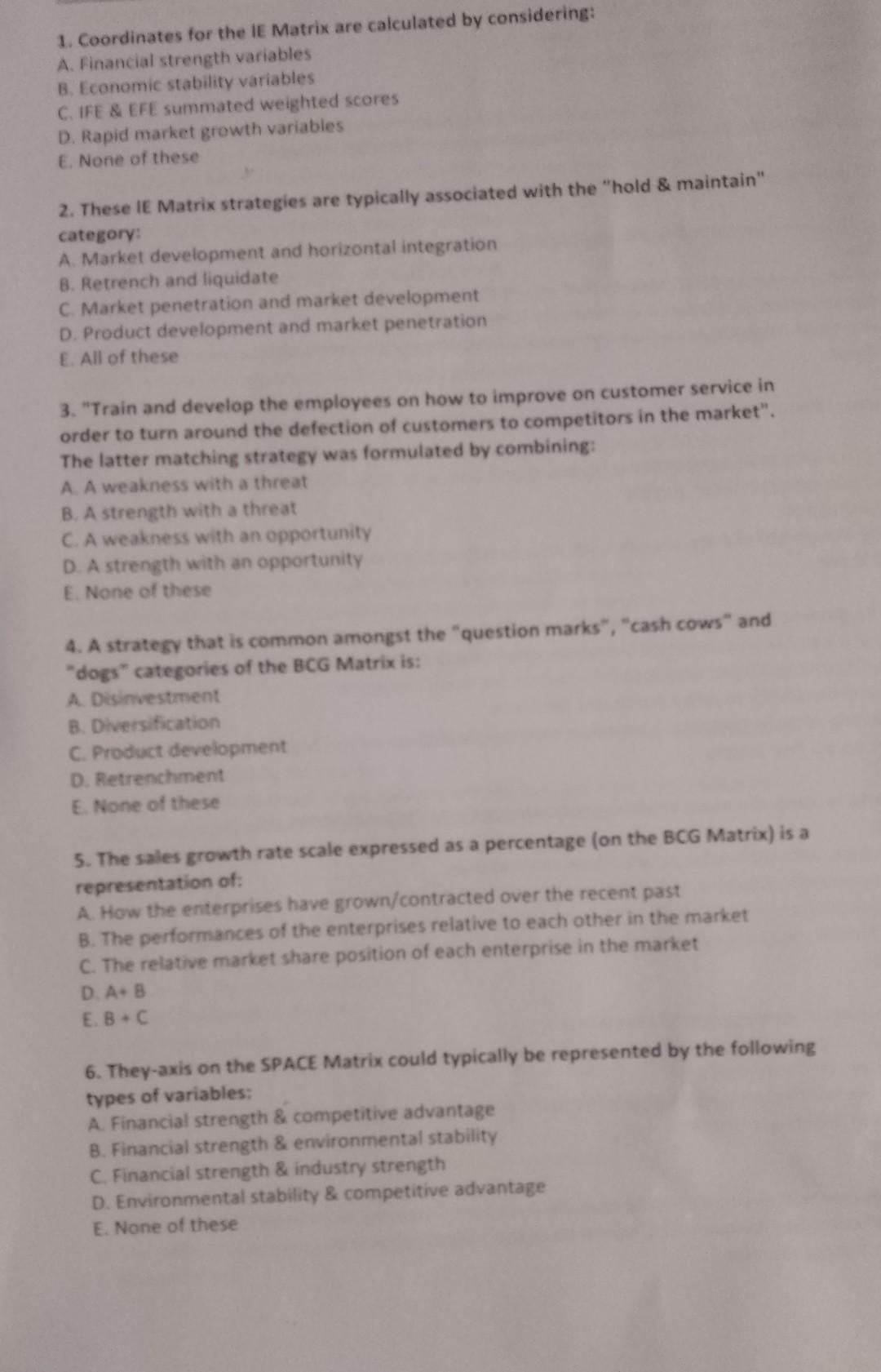
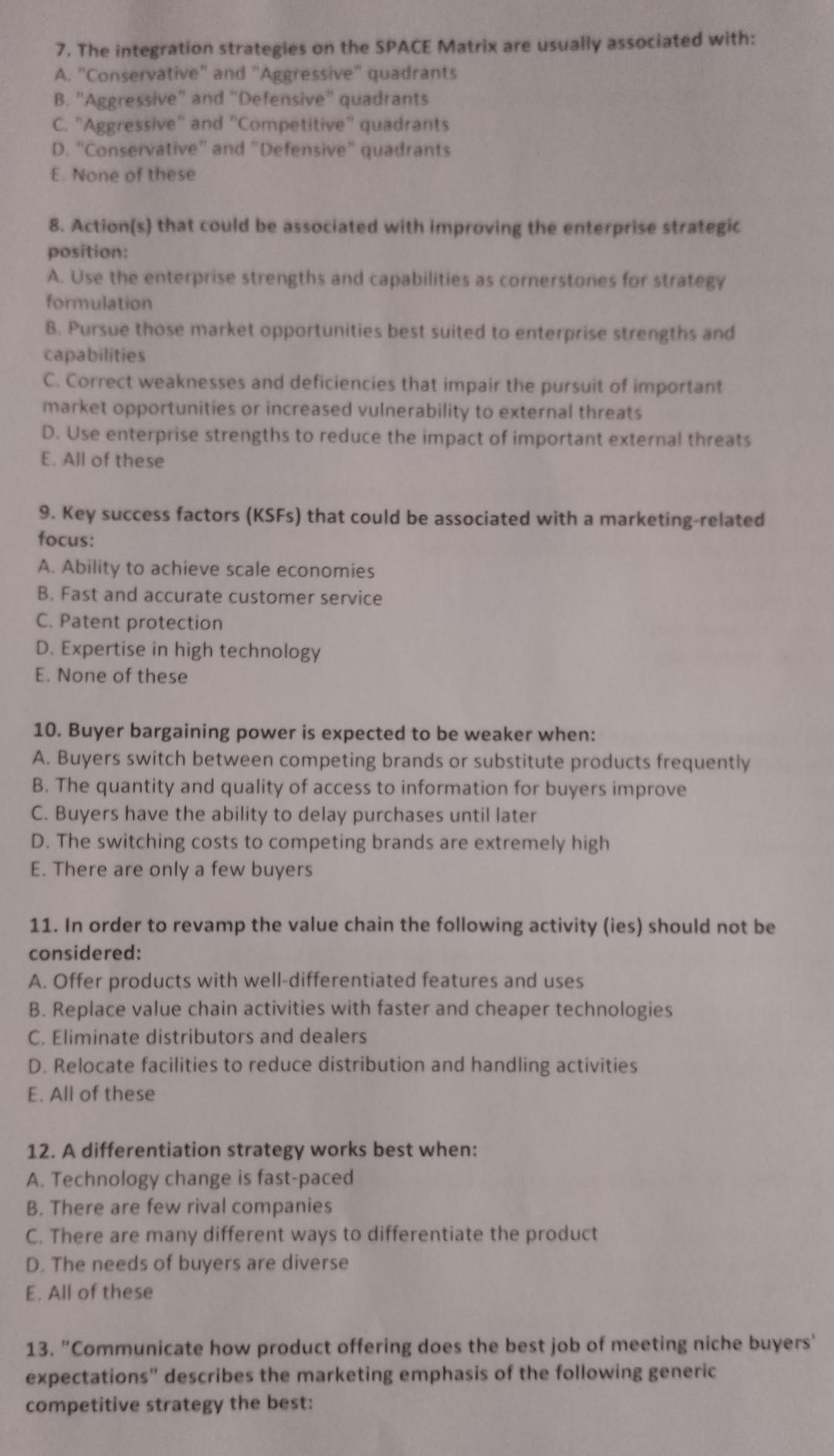
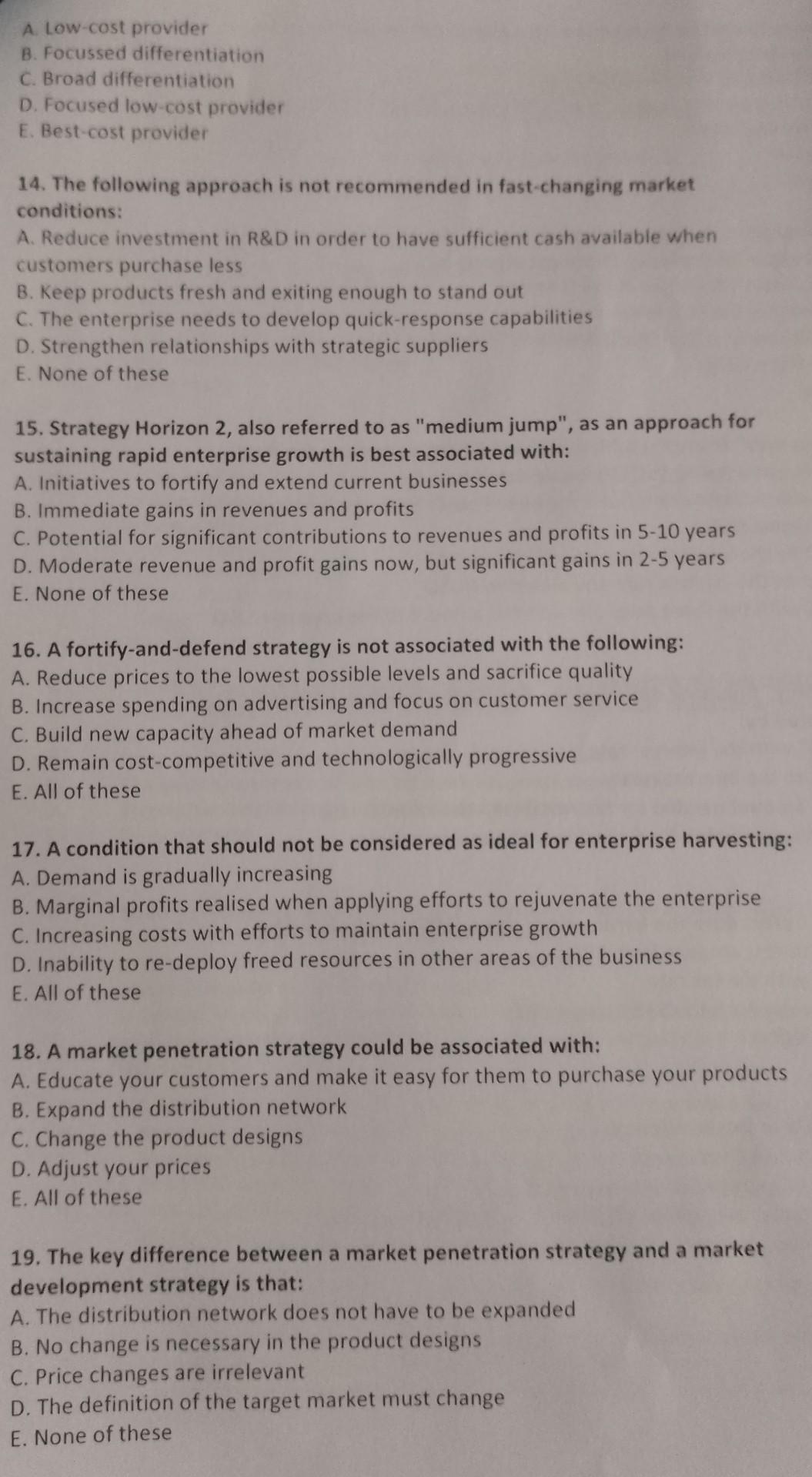
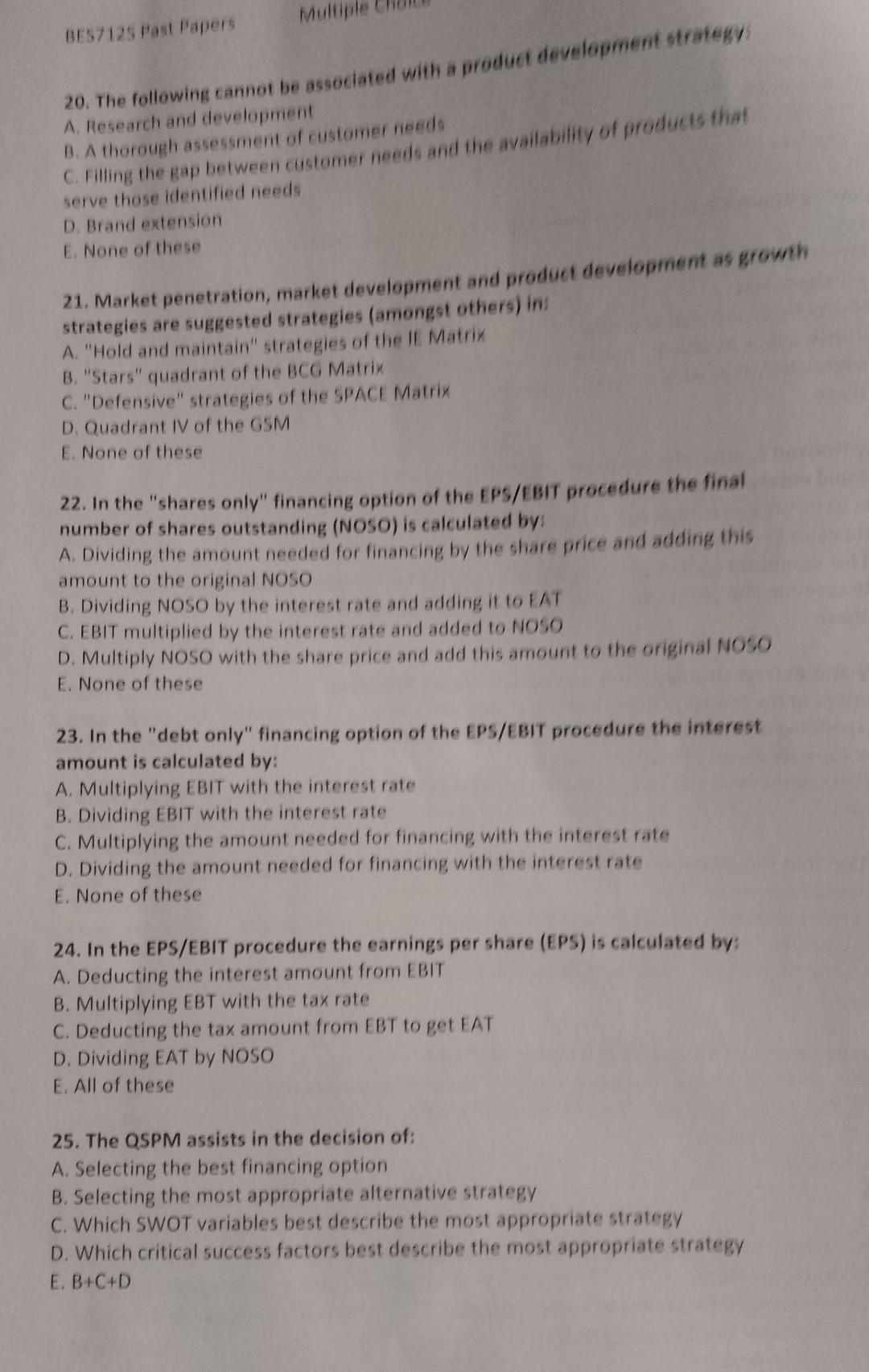
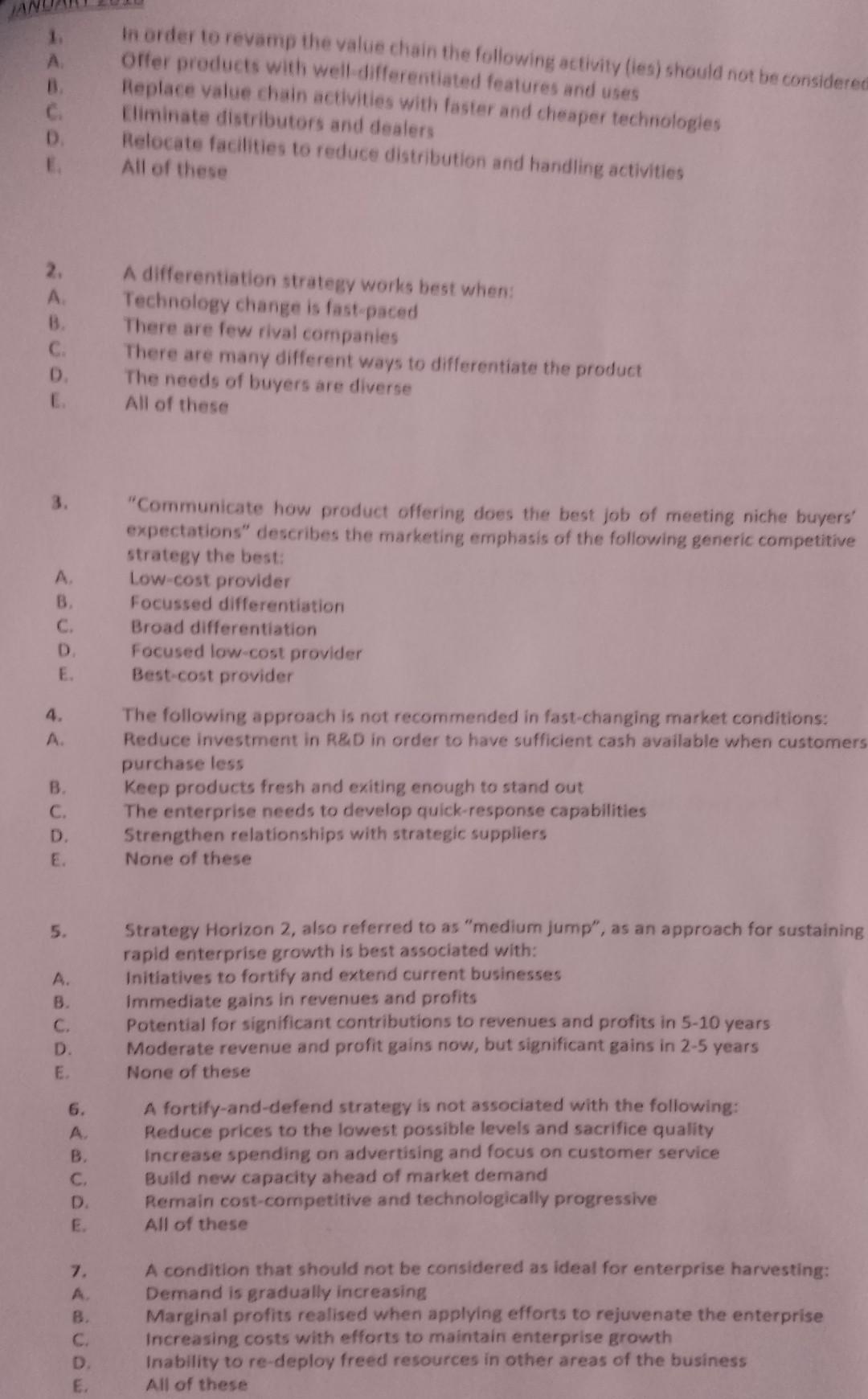
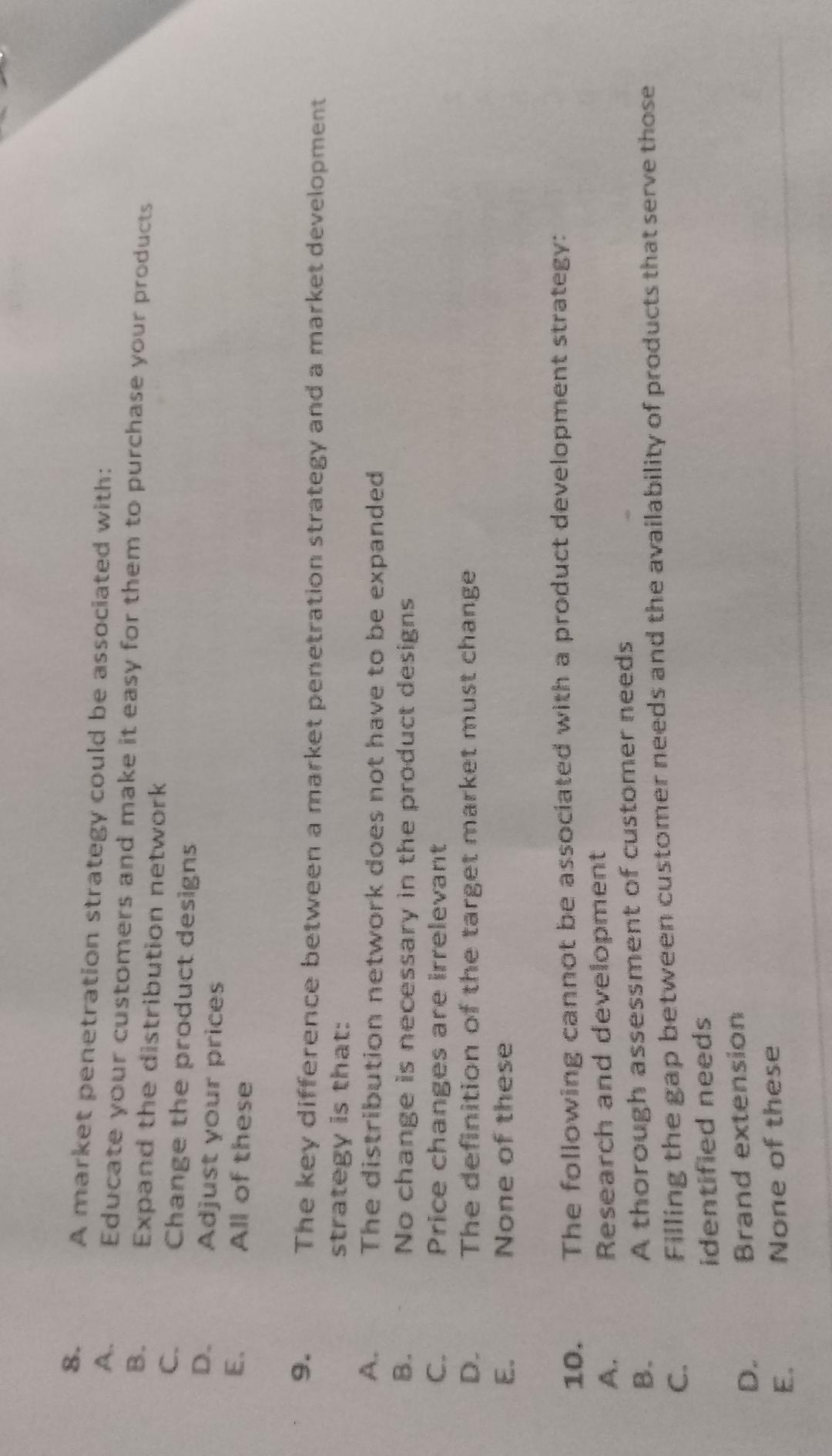
1. Coordinates for the IE Matrix are calculated by considering: A. Financial strength variables B. Economic stability variables C. IFE \& EFE summated weighted scores D. Rapid market growth variables E. None of these 2. These IE Matrix strategies are typically associated with the "hold \& maintain" category: A. Market development and horizontal integration B. Retrench and liquidate C. Market penetration and market development D. Product development and market penetration E. All of these 3. "Train and develop the employees on how to improve on customer service in order to turn around the defection of customers to competitors in the market". The latter matching strategy was formulated by combining: A. A weakness with a threat B. A strength with a threat C. A weakness with an opportunity D. A strength with an opportunity E. None of these 4. A strategr that is common amongst the "question marks", "cash cows" and "dogs" categories of the BCG Matrix is: A. Disimestment B. Diversification C. Product development D. Retrenchment E. None of these 5. The sales growth rate scale expressed as a percentage (on the BCG Matrix) is a representation of: A. How the enterprises have grown/contracted over the recent past B. The performances of the enterprises relative to each other in the market C. The relative market share position of each enterprise in the market D. A+B E. B+C 6. They-axis on the SPACE Matrix could typically be represented by the following types of variables: A. Financial strength & competitive advantage B. Financial strength & environmental stability C. Financial strength & industry strength D. Environmental stability \& competitive advantage E. None of these 7. The integration strategies on the SPACE Matrix are usually associated with: A. "Conservative" and "Aggressive quadrants B. "Aggressive" and "Defensive" quadrants C. "Aggressive" and "Competitive" quadrants D. "Conservative" and "Defensive" quadrants E. None of these 8. Action(s) that could be associated with improving the enterprise strategic position: A. Use the enterprise strengths and capabilities as cornerstones for strategy formulation B. Pursue those market opportunities best suited to enterprise strengths and capabilities C. Correct weaknesses and deficiencies that impair the pursuit of important market opportunities or increased vulnerability to external threats D. Use enterprise strengths to reduce the impact of important external threats E. All of these 9. Key success factors (KSFs) that could be associated with a marketing-related focus: A. Ability to achieve scale economies B. Fast and accurate customer service C. Patent protection D. Expertise in high technology E. None of these 10. Buyer bargaining power is expected to be weaker when: A. Buyers switch between competing brands or substitute products frequently B. The quantity and quality of access to information for buyers improve C. Buyers have the ability to delay purchases until later D. The switching costs to competing brands are extremely high E. There are only a few buyers 11. In order to revamp the value chain the following activity (ies) should not be considered: A. Offer products with well-differentiated features and uses B. Replace value chain activities with faster and cheaper technologies C. Eliminate distributors and dealers D. Relocate facilities to reduce distribution and handling activities E. All of these 12. A differentiation strategy works best when: A. Technology change is fast-paced B. There are few rival companies C. There are many different ways to differentiate the product D. The needs of buyers are diverse E. All of these 13. "Communicate how product offering does the best job of meeting niche buyers' expectations" describes the marketing emphasis of the following generic competitive strategy the best: A. Low-cost provider B. Focussed differentiation C. Broad differentiation D. Focused low-cost provider E. Best-cost provider 14. The following approach is not recommended in fast-changing market conditions: A. Reduce investment in R\&D in order to have sufficient cash available when customers purchase less B. Keep products fresh and exiting enough to stand out C. The enterprise needs to develop quick-response capabilities D. Strengthen relationships with strategic suppliers E. None of these 15. Strategy Horizon 2, also referred to as "medium jump", as an approach for sustaining rapid enterprise growth is best associated with: A. Initiatives to fortify and extend current businesses B. Immediate gains in revenues and profits C. Potential for significant contributions to revenues and profits in 5-10 years D. Moderate revenue and profit gains now, but significant gains in 2-5 years E. None of these 16. A fortify-and-defend strategy is not associated with the following: A. Reduce prices to the lowest possible levels and sacrifice quality B. Increase spending on advertising and focus on customer service C. Build new capacity ahead of market demand D. Remain cost-competitive and technologically progressive E. All of these 17. A condition that should not be considered as ideal for enterprise harvesting: A. Demand is gradually increasing B. Marginal profits realised when applying efforts to rejuvenate the enterprise C. Increasing costs with efforts to maintain enterprise growth D. Inability to re-deploy freed resources in other areas of the business E. All of these 18. A market penetration strategy could be associated with: A. Educate your customers and make it easy for them to purchase your products B. Expand the distribution network C. Change the product designs D. Adjust your prices E. All of these 19. The key difference between a market penetration strategy and a market development strategy is that: A. The distribution network does not have to be expanded B. No change is necessary in the product designs c. Price changes are irrelevant D. The definition of the target market must change E. None of these 20. The following cannot be associated with a product development strategy A. Hesearch and development B. A thorough assessment of customer needs C. Filling the gap between customer needs and the availability of products that serve those identified needs D. Brand extension E. None of these 21. Market penetration, market development and product development as growth strategies are suggested strategies (amongst others) ins A. "Hold and maintain" strategies of the II Matrix B. "Stars" quadrant of the BCG Matrix C. "Defensive" strategies of the SPACE Matrix D. Quadrant IV of the GSM E. None of these 22. In the "shares only" financing option of the EPS/EBIT procedure the final number of shares outstanding (NOSO) is calculated by: A. Dividing the amount needed for financing by the share price and adding this amount to the original NOSO B. Dividing NOSO by the interest rate and adding it to EAT C. EBIT multiplied by the interest rate and added to NOSO D. Multiply NOSO with the share price and add this amount to the original NOSO E. None of these 23. In the "debt only" financing option of the EPS/EBIT procedure the interest amount is calculated by: A. Multiplying EBIT with the interest rate B. Dividing EBIT with the interest rate C. Multiplying the amount needed for financing with the interest rate D. Dividing the amount needed for financing with the interest rate E. None of these 24. In the EPS/EBIT procedure the earnings per share (EPS) is calculated by: A. Deducting the interest amount from EBIT B. Multiplying EBT with the tax rate C. Deducting the tax amount from EBT to get EAT D. Dividing EAT by NOSO E. All of these 25. The QSPM assists in the decision of: A. Selecting the best financing option B. Selecting the most appropriate alternative strategy C. Which SWOT variables best describe the most appropriate strategy D. Which critical success factors best describe the most appropriate strategy E. B+C+D 1. In order to revamp the value chain the following activity (ies) should not be considerec A. Orfer products with well-differentiated features and uses 1. Heplace value chain activities with faster and cheaper technologies C. Lliminate distributors and dealers D. Helocate facilities to reduce distribution and handling activities 1. All of these 2. A differentiation strategy works best when: A. Technology change is fast-paced B. There are few rival companies C. There are many different ways to differentiate the product D. The needs of buyers are diverse L. All of these 3. "Communicate how product offering does the best job of meeting niche buyers' expectations" describes the marketing emphasis of the following generic competitive strategy the best: A. Low-cost provider B. Focussed differentiation C. Broad differentiation D. Focused low-cost provider E. Best-cost provider 4. The following approach is not recommended in fast-changing market conditions: A. Reduce investment in R\&D in order to have sufficient cash available when customers purchase less B. Keep products fresh and exiting enough to stand out C. The enterprise needs to develop quick-response capabilities D. Strengthen relationships with strategic suppliers E. Nane of these 5. Strategy Horizon 2 , also referred to as "medium jump", as an approach for sustaining rapid enterprise growth is best associated with: A. Initiatives to fortify and extend current businesses B. Immediate gains in revenues and profits C. Potential for significant contributions to revenues and profits in 5-10 years D. Moderate revenue and profit gains now, but significant gains in 25 years E. None of these 6. A fortify-and-defend strategy is not associated with the following: A. Reduce prices to the lowest possible levels and sacrifice quality B. Increase spending on advertising and focus on customer service C. Build new capacity ahead of market demand D. Remain cost-competitive and technologically progressive E. All of these 7. A condition that should not be considered as ideal for enterprise harvesting: A. Demand is gradually increasing B. Marginal profits realised when applying efforts to rejuvenate the enterprise C. Increasing costs with efforts to maintain enterprise growth D. Inability to re-deploy freed resources in other areas of the business E. All of these 8. A market penetration strategy could be associated with: A. Educate your customers and make it easy for them to purchase your products B. Expand the distribution network C. Change the product designs D. Adjust your prices E. All of these 9. The key difference between a market penetration strategy and a market development strategy is that: A. The distribution network does not have to be expanded B. No change is necessary in the product designs C. Price changes are irrelevant D. The definition of the target market must change E. None of these 10. The following cannot be associated with a product development strategy: A. Research and development B. A thorough assessment of customer needs C. Filling the gap between customer needs and the availability of products that serve those identified needs D. Brand extension E. None of these
Step by Step Solution
There are 3 Steps involved in it
1 Expert Approved Answer
Step: 1 Unlock

Question Has Been Solved by an Expert!
Get step-by-step solutions from verified subject matter experts
Step: 2 Unlock
Step: 3 Unlock
 Study Help