



Question: 1. develop a marketing mix that allows burger king to achieve the goal of closing the gap with MCd's and distancing itself from its othef
1. develop a marketing mix that allows burger king to achieve the goal of closing the gap with MCd's and distancing itself from its othef competitors 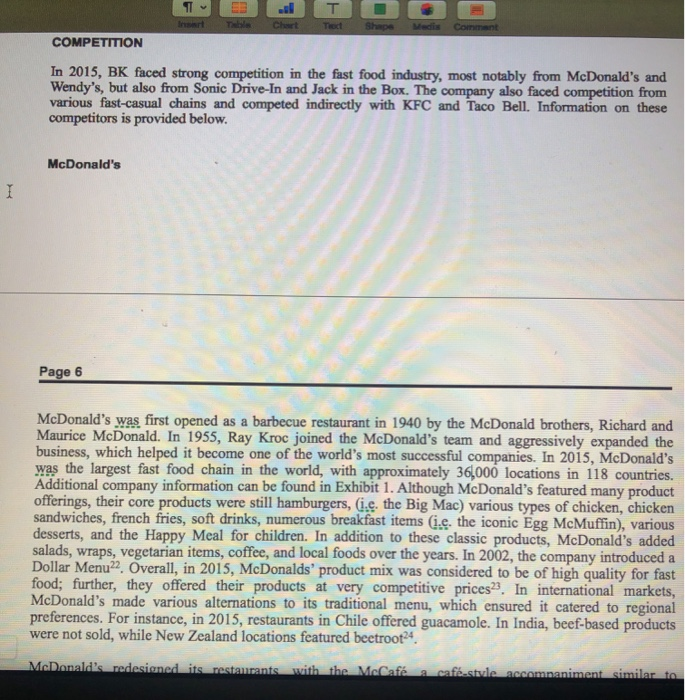
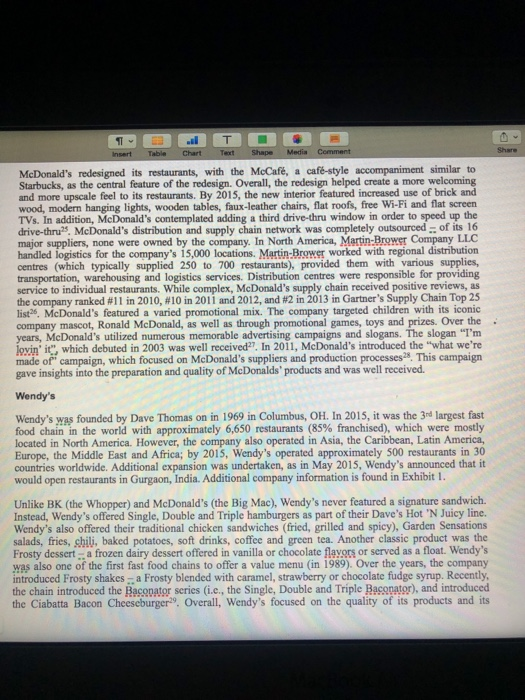
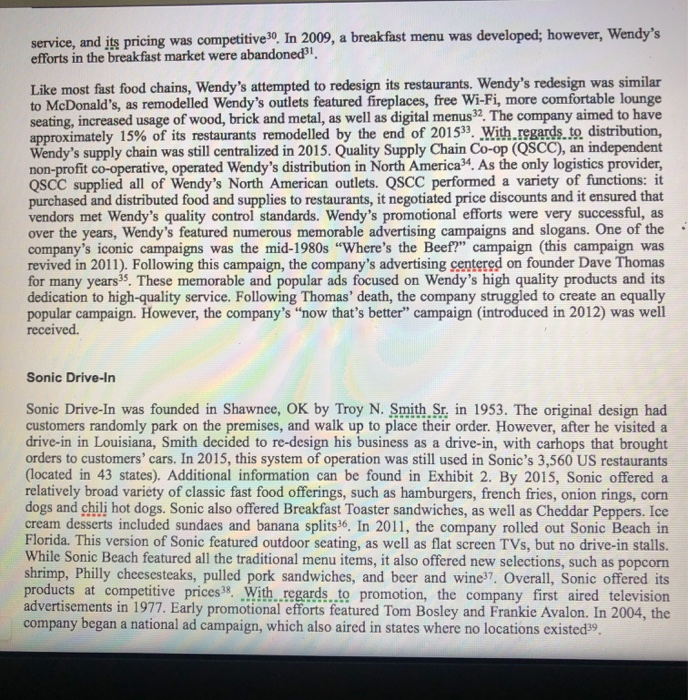
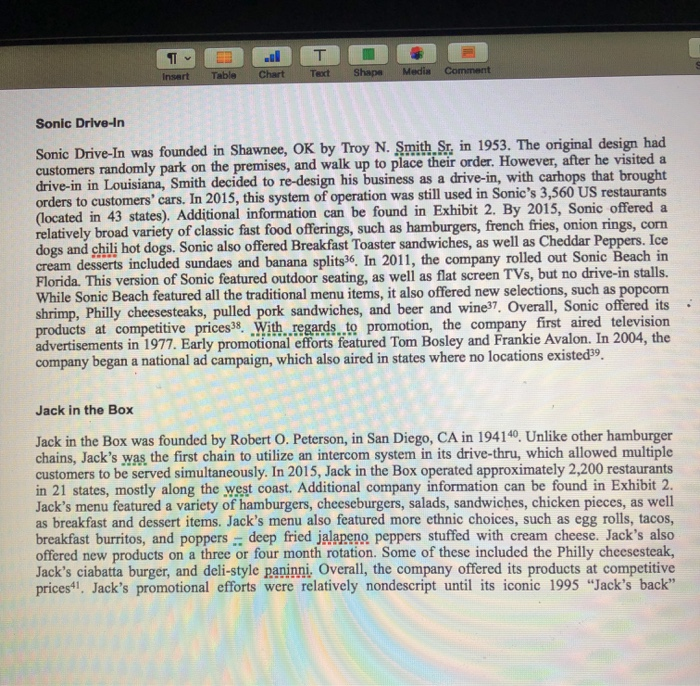
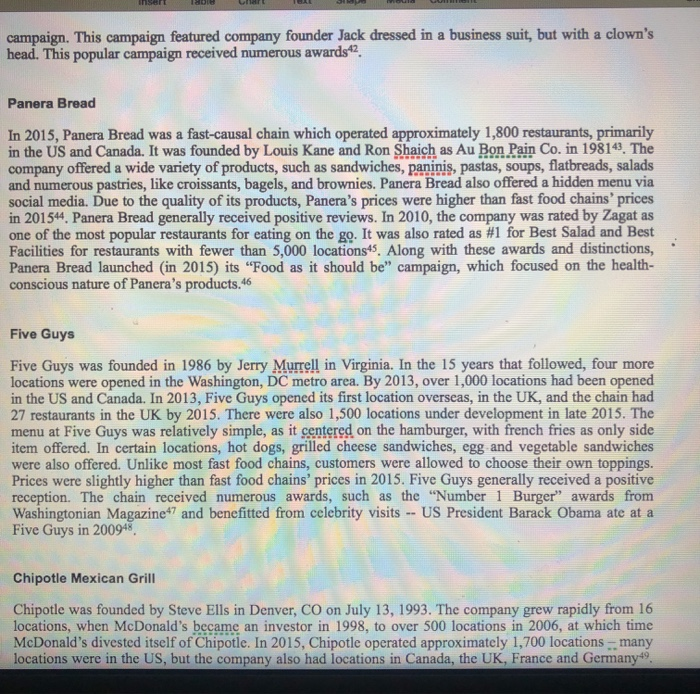
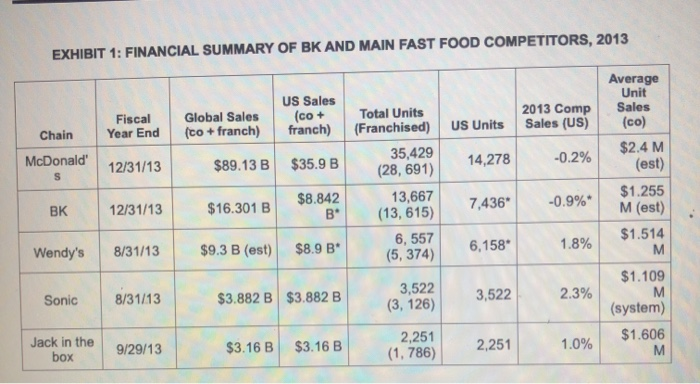
Shape Media Commant COMPETITION In 2015, BK faced strong competition in the fast food industry, most notably from McDonald's and Wendy's, but also from Sonic Drive-In and Jack in the Box. The company also faced competition from various fast-casual chains and competed indirectly with KFC and Taco Bell. Information on these competitors is provided below. McDonald's Page 6 McDonald's was first opened as a barbecue restaurant in 1940 by the McDonald brothers, Richard and Maurice McDonald. In 1955, Ray Kroc joined the McDonald's team and aggressively expanded the business, which helped it become one of the world's most successful companies. In 2015, McDonald's was the largest fast food chain in the world, with approximately 36,000 locations in 118 countries. Additional company information can be found in Exhibit 1. Although McDonald's featured many product offerings, their core products were still hamburgers, (.e. the Big Mac) various types of chicken, chicken sandwiches, french fries, soft drinks, numerous breakfast items (.e. the iconic Egg McMuffin), various desserts, and the Happy Meal for children. In addition to these classic products, McDonald's added salads, wraps, vegetarian items, coffee, and local foods over the years. In 2002, the company introduced a Dollar Menu. Overall, in 2015, McDonalds' product mix was considered to be of high quality for fast food; further, they offered their products at very competitive prices. In international markets, McDonald's made various alternations to its traditional menu, which ensured it catered to regional preferences. For instance, in 2015, restaurants in Chile offered guacamole. In India, beef-based products were not sold, while New Zealand locations featured beetroot24 McDonald's redesigned its restaurants with the McCaf a caf.stule accomnaniment similar to T Insert . Chart T Teart . Shape Table Media Comment McDonald's redesigned its restaurants, with the McCaf, a cafe-style accompaniment similar to Starbucks, as the central feature of the redesign. Overall, the redesign helped create a more welcoming and more upscale feel to its restaurants. By 2015, the new interior featured increased use of brick and wood, modern hanging lights, wooden tables, faux-leather chairs, flat roofs, free Wi-Fi and flat screen TVs. In addition, MeDonald's contemplated adding a third drive-thru window in order to speed up the drive-thrus, McDonald's distribution and supply chain network was completely outsourced of its 16 major suppliers, none were owned by the company. In North America, Martin-Brower Company LLC handled logistics for the company's 15,000 locations. Martin-Brower worked with regional distribution centres (which typically supplied 250 to 700 restaurants), provided them with various supplies, transportation, warehousing and logistics services. Distribution centres were responsible for providing service to individual restaurants. While complex, McDonald's supply chain received positive reviews, as the company ranked #11 in 2010, #10 in 2011 and 2012, and #2 in 2013 in Gartner's Supply Chain Top 25 listas. McDonald's featured a varied promotional mix. The company targeted children with its iconic company mascot, Ronald McDonald, as well as through promotional games, toys and prizes. Over the years, McDonald's utilized numerous memorable advertising campaigns and slogans. The slogan "I'm lovin' it", which debuted in 2003 was well received?7. In 2011, McDonald's introduced the "what we're made of" campaign, which focused on McDonald's suppliers and production processes. This campaign gave insights into the preparation and quality of McDonalds products and was well received Wendy's Wendy's was founded by Dave Thomas on in 1969 in Columbus, OH. In 2015, it was the 3rd largest fast food chain in the world with approximately 6,650 restaurants (85% franchised), which were mostly located in North America. However, the company also operated in Asia, the Caribbean, Latin America, Europe, the Middle East and Africa; by 2015, Wendy's operated approximately 500 restaurants in 30 countries worldwide. Additional expansion was undertaken, as in May 2015, Wendy's announced that it would open restaurants in Gurgaon, India. Additional company information is found in Exhibit 1. Unlike BK (the Whopper) and McDonald's (the Big Mac), Wendy's never featured a signature sandwich. Instead, Wendy's offered Single, Double and Triple hamburgers as part of their Dave's Hot 'N Juicy line. Wendy's also offered their traditional chicken sandwiches (fried, grilled and spicy), Garden Sensations salads, fries, chili, baked potatoes, soft drinks, coffee and green tea. Another classic product was the Frosty dessert a frozen dairy dessert offered in vanilla or chocolate flavors or served as a float. Wendy's was also one of the first fast food chains to offer a value menu (in 1989). Over the years, the company introduced Frosty shakes - a Frosty blended with caramel, strawberry or chocolate fudge syrup. Recently, the chain introduced the Baconator series (i.c., the Single, Double and Triple Baconator), and introduced the Ciabatta Bacon Cheeseburger. Overall, Wendy's focused on the quality of its products and its service, and its pricing was competitive30. In 2009, a breakfast menu was developed; however, Wendy's efforts in the breakfast market were abandoned Like most fast food chains, Wendy's attempted to redesign its restaurants. Wendy's redesign was similar to McDonald's, as remodelled Wendy's outlets featured fireplaces, free Wi-Fi, more comfortable lounge seating, increased usage of wood, brick and metal, as well as digital menus 32. The company aimed to have approximately 15% of its restaurants remodelled by the end of 201533. With regards to distribution, Wendy's supply chain was still centralized in 2015. Quality Supply Chain Co-op (QSCC), an independent non-profit co-operative, operated Wendy's distribution in North America34. As the only logistics provider, QSCC supplied all of Wendy's North American outlets. QSCC performed a variety of functions: it purchased and distributed food and supplies to restaurants, it negotiated price discounts and it ensured that vendors met Wendy's quality control standards. Wendy's promotional efforts were very successful, as over the years, Wendy's featured numerous memorable advertising campaigns and slogans. One of the company's iconic campaigns was the mid-1980s "Where's the Beef?" campaign (this campaign was revived in 2011). Following this campaign, the company's advertising centered on founder Dave Thomas for many years35. These memorable and popular ads focused on Wendy's high quality products and its dedication to high-quality service. Following Thomas' death, the company struggled to create an equally popular campaign. However, the company's "now that's better campaign (introduced in 2012) was well received : Sonic Drive-In Sonic Drive-In was founded in Shawnee, OK by Troy N. Smith Sr. in 1953. The original design had customers randomly park on the premises, and walk up to place their order. However, after he visited a drive-in in Louisiana, Smith decided to re-design his business as a drive-in, with carhops that brought orders to customers' cars. In 2015, this system of operation was still used in Sonic's 3,560 US restaurants (located in 43 states). Additional information can be found in Exhibit 2. By 2015, Sonic offered a relatively broad variety of classic fast food offerings, such as hamburgers, french fries, onion rings, corn dogs and chili hot dogs. Sonic also offered Breakfast Toaster sandwiches, as well as Cheddar Peppers. Ice cream desserts included sundaes and banana splits36. In 2011, the company rolled out Sonic Beach in Florida. This version of Sonic featured outdoor seating, as well as flat screen TVs, but no drive-in stalls. While Sonic Beach featured all the traditional menu items, it also offered new selections, such as popcorn shrimp, Philly cheesesteaks, pulled pork sandwiches, and beer and wine37. Overall, Sonic offered its products at competitive prices38 With regards to promotion, the company first aired television advertisements in 1977. Early promotional efforts featured Tom Bosley and Frankie Avalon. In 2004, the company began a national ad campaign, which also aired in states where no locations existed, 1 BGTOOB Insart Table Chart Shane Media Comment Sonic Drive-In Sonic Drive-In was founded in Shawnee, OK by Troy N. Smith St, in 1953. The original design had customers randomly park on the premises, and walk up to place their order. However, after he visited a drive-in in Louisiana, Smith decided to re-design his business as a drive-in, with carhops that brought orders to customers' cars. In 2015, this system of operation was still used in Sonic's 3,560 US restaurants (located in 43 states). Additional information can be found in Exhibit 2. By 2015, Sonic offered a relatively broad variety of classic fast food offerings, such as hamburgers, french fries, onion rings, corn dogs and chili hot dogs. Sonic also offered Breakfast Toaster sandwiches, as well as Cheddar Peppers. Ice cream desserts included sundaes and banana splits36. In 2011, the company rolled out Sonic Beach in Florida. This version of Sonic featured outdoor seating, as well as flat screen TVs, but no drive-in stalls. While Sonic Beach featured all the traditional menu items, it also offered new selections, such as popcorn shrimp, Philly cheesesteaks, pulled pork sandwiches, and beer and wine37. Overall, Sonic offered its products at competitive prices38 With regards to promotion, the company first aired television advertisements in 1977. Early promotional efforts featured Tom Bosley and Frankie Avalon. In 2004, the company began a national ad campaign, which also aired in states where no locations existed Jack in the Box Jack in the Box was founded by Robert O. Peterson, in San Diego, CA in 1941". Unlike other hamburger chains, Jack's was the first chain to utilize an intercom system in its drive-thru, which allowed multiple customers to be served simultaneously. In 2015, Jack in the Box operated approximately 2,200 restaurants in 21 states, mostly along the west coast. Additional company information can be found in Exhibit 2. Jack's menu featured a variety of hamburgers, cheeseburgers, salads, sandwiches, chicken pieces, as well as breakfast and dessert items. Jack's menu also featured more ethnic choices, such as egg rolls, tacos, breakfast burritos, and poppers - deep fried jalapeno peppers stuffed with cream cheese. Jack's also offered new products on a three or four month rotation. Some of these included the Philly cheesesteak, Jack's ciabatta burger, and deli-style paninni. Overall, the company offered its products at competitive prices4l, Jack's promotional efforts were relatively nondescript until its iconic 1995 "Jack's back" campaign. This campaign featured company founder Jack dressed in a business suit, but with a clown's head. This popular campaign received numerous awards2 Panera Bread In 2015, Panera Bread was a fast-causal chain which operated approximately 1,800 restaurants, primarily in the US and Canada. It was founded by Louis Kane and Ron Shaich as Au Bon Pain Co. in 19814. The company offered a wide variety of products, such as sandwiches, paninis, pastas, soups, flatbreads, salads and numerous pastries, like croissants, bagels, and brownies. Panera Bread also offered a hidden menu via social media. Due to the quality of its products, Panera's prices were higher than fast food chains' prices in 201544. Panera Bread generally received positive reviews. In 2010, the company was rated by Zagat as one of the most popular restaurants for eating on the go. It was also rated as #1 for Best Salad and Best Facilities for restaurants with fewer than 5,000 locations45. Along with these awards and distinctions, Panera Bread launched in 2015) its "Food as it should be campaign, which focused on the health- conscious nature of Panera's products. 46 Five Guys Five Guys was founded in 1986 by Jerry Murrell in Virginia. In the 15 years that followed, four more locations were opened in the Washington, DC metro area. By 2013, over 1,000 locations had been opened in the US and Canada. In 2013, Five Guys opened its first location overseas, in the UK, and the chain had 27 restaurants in the UK by 2015. There were also 1,500 locations under development in late 2015. The menu at Five Guys was relatively simple, as it centered on the hamburger, with french fries as only side item offered. In certain locations, hot dogs, grilled cheese sandwiches, egg and vegetable sandwiches were also offered. Unlike most fast food chains, customers were allowed to choose their own toppings. Prices were slightly higher than fast food chains' prices in 2015. Five Guys generally received a positive reception. The chain received numerous awards, such as the "Number 1 Burger" awards from Washingtonian Magazine7 and benefitted from celebrity visits -- US President Barack Obama ate at a Five Guys in 200945 Chipotle Mexican Grill Chipotle was founded by Steve Ells in Denver, CO on July 13, 1993. The company grew rapidly from 16 locations, when McDonald's became an investor in 1998, to over 500 locations in 2006, at which time McDonald's divested itself of Chipotle. In 2015, Chipotle operated approximately 1,700 locations - many locations were in the US, but the company also had locations in Canada, the UK, France and Germany 49 EXHIBIT 1: FINANCIAL SUMMARY OF BK AND MAIN FAST FOOD COMPETITORS, 2013 Fiscal Year End Global Sales (co +franch) US Sales (co + franch) Average Unit Sales (co) 2013 Comp Sales (US) US Units Chain McDonald' 12/31/13 $89.13 B $35.9 B 14,278 -0.2% $2.4 M (est) Total Units (Franchised) 35,429 (28, 691) 13,667 (13, 615) 6, 557 (5, 374) BK 12/31/13 $16.301 B $8.842 7,436 -0.9% $1.255 M (est) $1.514 Wendy's 8/31/13 $9.3 B (est) $8.9 B* 6,158 1.8% M $1.109 Sonic 8/31/13 $3.882 B $3.882 B 3,522 (3, 126) 3,522 2.3% Jack in the (system) $1.606 box 9/29/13 $3.16 B $3.16 B 2,251 (1,786) 2,251 1.0%
2. consider the marketing mix created. what percentage of Bk resources would u allocate to the US market and what percentage would you allocate to international markets
Step by Step Solution
There are 3 Steps involved in it
1 Expert Approved Answer
Step: 1 Unlock

Question Has Been Solved by an Expert!
Get step-by-step solutions from verified subject matter experts
Step: 2 Unlock
Step: 3 Unlock