Question: #1 e rapidly evolving ow do you know if ts full value? egy linking metrics or trying out change your omnichannel Zurn on investment ditures?
#1
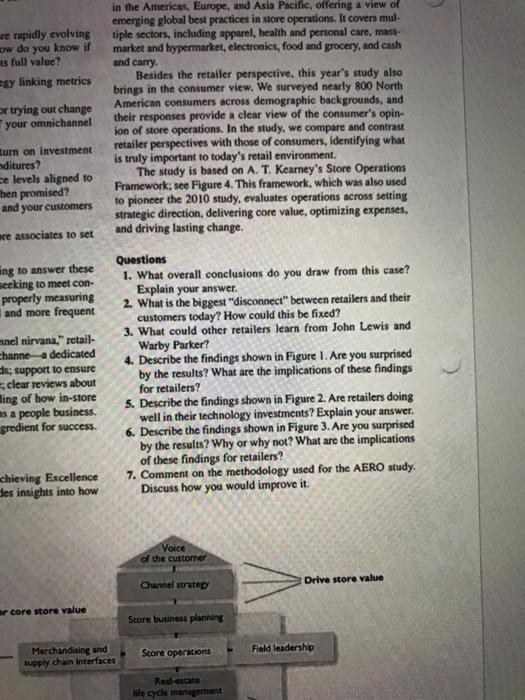
e rapidly evolving ow do you know if ts full value? egy linking metrics or trying out change your omnichannel Zurn on investment ditures? ce levels aligned to hen promised? and your customers in the Americas, Europe, and Asia Pacific, offering a view of emerging global best practices in store operations. It covers mul- tiple sectors, including apparel, health and personal care, mass- market and hypermarket, electronics, food and grocery, and cash and cany Besides the retailer perspective, this year's study also brings in the consumer view. We surveyed nearly 800 North American consumers across demographic backgrounds, and their responses provide a clear view of the consumer's opin- ion of store operations. In the study, we compare and contrast retailer perspectives with those of consumers, identifying what is truly important to today's retail environment. The study is based on A. T. Kearney's Store Operations Framework: see Figure 4. This framework, which was also used to pioneer the 2010 study, evaluates operations across setting strategic direction, delivering core value, optimizing expenses. and driving lasting change. are associates to set ing to answer these seeking to meet con- properly measuring and more frequent minel nirvana." retail- Channe a dedicated s; support to ensure clear reviews about Hing of how in-store as a people business gredient for success Questions 1. What overall conclusions do you draw from this case? Explain your answer. 2. What is the biggest "disconnect" between retailers and their customers today? How could this be fixed? 3. What could other retailers learn from John Lewis and Warby Parker? 4. Describe the findings shown in Figure 1. Are you surprised by the results? What are the implications of these findings for retailers? 5. Describe the findings shown in Figure 2. Are retailers doing well in their technology investments? Explain your answer. 6. Describe the findings shown in Figure 3. Are you surprised by the results? Why or why not? What are the implications of these findings for retailers? 7. Comment on the methodology used for the AERO study Discuss how you would improve it. chieving Excellence Des insights into how Voice of the customer Channel strategy Drive score value or core store value Store business planning Merchandising and supply chain Interfaces Score operations Field leadership Real estate life cycle management e rapidly evolving ow do you know if ts full value? egy linking metrics or trying out change your omnichannel Zurn on investment ditures? ce levels aligned to hen promised? and your customers in the Americas, Europe, and Asia Pacific, offering a view of emerging global best practices in store operations. It covers mul- tiple sectors, including apparel, health and personal care, mass- market and hypermarket, electronics, food and grocery, and cash and cany Besides the retailer perspective, this year's study also brings in the consumer view. We surveyed nearly 800 North American consumers across demographic backgrounds, and their responses provide a clear view of the consumer's opin- ion of store operations. In the study, we compare and contrast retailer perspectives with those of consumers, identifying what is truly important to today's retail environment. The study is based on A. T. Kearney's Store Operations Framework: see Figure 4. This framework, which was also used to pioneer the 2010 study, evaluates operations across setting strategic direction, delivering core value, optimizing expenses. and driving lasting change. are associates to set ing to answer these seeking to meet con- properly measuring and more frequent minel nirvana." retail- Channe a dedicated s; support to ensure clear reviews about Hing of how in-store as a people business gredient for success Questions 1. What overall conclusions do you draw from this case? Explain your answer. 2. What is the biggest "disconnect" between retailers and their customers today? How could this be fixed? 3. What could other retailers learn from John Lewis and Warby Parker? 4. Describe the findings shown in Figure 1. Are you surprised by the results? What are the implications of these findings for retailers? 5. Describe the findings shown in Figure 2. Are retailers doing well in their technology investments? Explain your answer. 6. Describe the findings shown in Figure 3. Are you surprised by the results? Why or why not? What are the implications of these findings for retailers? 7. Comment on the methodology used for the AERO study Discuss how you would improve it. chieving Excellence Des insights into how Voice of the customer Channel strategy Drive score value or core store value Store business planning Merchandising and supply chain Interfaces Score operations Field leadership Real estate life cycle management









 Study Help