Question: 1. Identify and explain TWO 'structural dilemmas' that Beth Israel Hospital was attempting to address or rebalance through its restructuring process. Please first DEFINE/DESCRIBE each
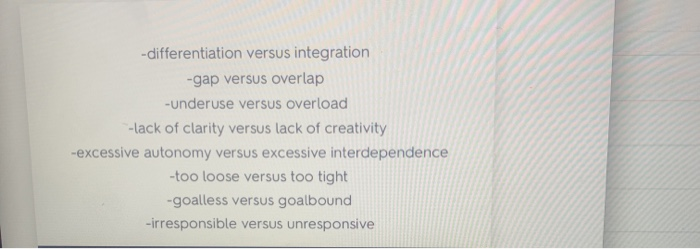
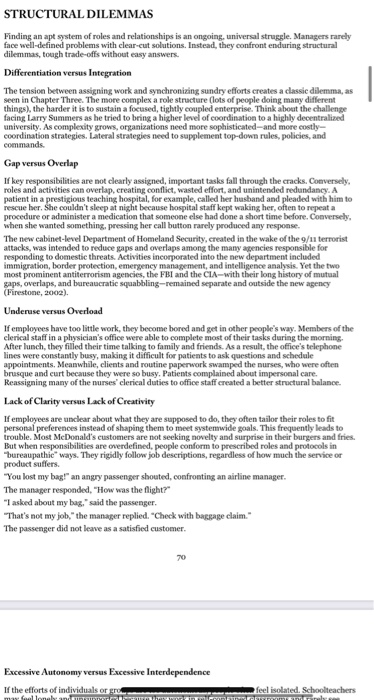
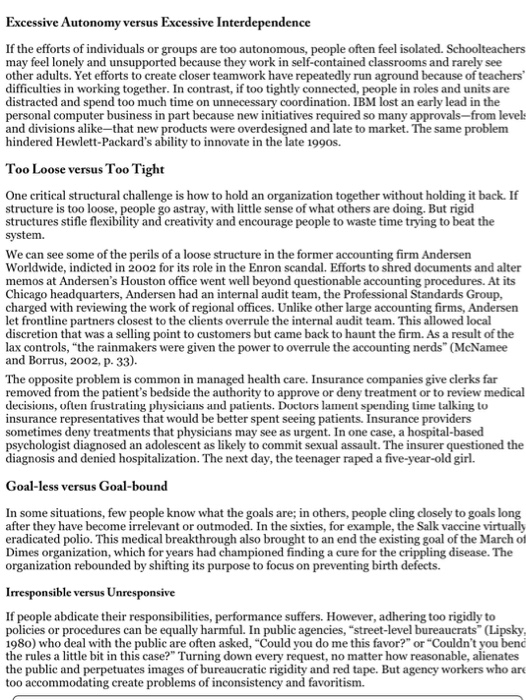
1. Identify and explain TWO 'structural dilemmas' that Beth Israel Hospital was attempting to address or rebalance through its restructuring process. Please first DEFINE/DESCRIBE each of your chosen structural dilemmas before applying it to the example from the case (Note: refer to hardcopy textbook pages 70-73 for the different structural dilemmas). When applying to the structural dilemmas, make sure that you reference examples from the case to show how these dilemmas are illustrated/what they look like in practical terms. 2. What were the consequences of the restructuring effort? Do you believe the new structure aligned with the organization's goals? Why or why not? Please fully explain. -differentiation versus integration -gap versus overlap -Underuse versus overload ---Lack of clarity versus lack of creativity -excessive autonomy versus excessive interdependence -too loose versus too tight -goalless versus goalbound -irresponsible versus unresponsive Beth Israel Hospital Boston's Beth Israel Hospital illustrates a health care restructuring effort that sought to move toward greater autonomy and teamwork. When Joyce Clifford became Beth Israel's director of nursing, she found a top-down pyramid common in many hospitals: The nursing aides, who had the least preparation, had the most contact with the patients. But they had no authority of any kind. They had to go to their supervisor to ask if a patient could have an aspirin. The supervisor would then ask the head nurse, who would then ask a doctor. The doctor would ask how long the patient had been in pain. Of course, the head nurse had absolutely no idea, so she'd have to track down the aide to ask her, and then relay that information back to the doctor. It was ridiculous, a ludicrous and dissatisfying situation, and one in which it was impossible for the nurse to feel any satisfaction at all. The system was hierarchical, fragmented, impersonal, and (overmanaged] [Helgesen, 1995, p. 134) Within units, responsibilities of nurses were highly specialized: some were assigned to handling medications, others to monitoring vital signs, still others to taking blood pressure readings. Add to the list specialized housekeeping roles-bedpan, bed making, and food services. A patient received repeated interruptions from virtual strangers. No one really knew what was going on with any individual patient. Clifford instituted a major structural revamp, changing a pyramid with nurses at the bottom to an inclusive web with nurses at the center. The concept, called primary nursing, places each patient in the charge of a primary nurse. The nurse takes information upon admission, develops a comprehensive care plan, assembles a team to provide round-the-clock care, and lets the family know what to expect. A nurse manager sets goals for the unit, deals with budget and administrative matters, and makes sure that primary nurses have ample resources to provide quality care. As the primary nurses assumed more responsibility, connections with physicians and other hospital workers needed reworking. Instead of simply carrying out physicians' orders, primary nurses became professional partners, attending rounds and participating as equals in treatment decisions. Housekeepers reported to primary nurses rather than to housekeeping supervisors. Housekeepers assigned to specific patients made the patient's bed, attended to the patient's hygiene, and delivered food trays. Laundry workers brought in clean items on demand rather than making a once-a-day delivery. Sophisticated technology gave all personnel easy access to patient information and administrative data. Primary nurses learned from performing a variety of heretofore menial tasks. Bed making, for example, became an opportunity to evaluate a patient's condition and assess how well treatment plan was working. Joyce Clifford's role also transformed, from top-down supervisor to web-centered coordinator: "A big part of my job is to keep nurses informed on a regular basis of what's going on out there-what the board is doing what decisions are confronting the hospital as a whole, what the issues are in health care in this country. I also let them know that I'm trying to represent what the nurses here are doing-to our vice-presidents, to our board, and people in the outside world...to the nursing profession and the health care field as a whole [Helgesen, 1995. p. 1581 Beth Israel's primary nursing concept, Initiated in the mid-1970s, produced significant Improvement in both patient care and nursing morale Nursing turnover declined dramatically Springer, 18)and the model's success made is highly influential and widely copied both in changes in the health care systems put Beth Israel's model under increasing pressure, More patients with more problem but shorter hospital says made sure jobs much harder at the approach by creating interdisciplinary care teams instead of sing an ad hoc collection uplate its provided interdisciplinary support to primary mures (Randall Sarther, and Norrish, STRUCTURAL DILEMMAS Finding an apt system of roles and relationships is an ongoing, universal ste Managers rarely face well-defined problems with clear-cut solutions. Instead, they confronteering structural dilemmas, tough trade-offs without easy Differentiation vers Integration The tension between assigning work and synchronizing sundry efforts creates a desse dilemma, as seen in Chapter Three. The more complex a role structure lots of people doing many different things the harder it is to sustain a focused, tightly coupled enterprise. Think about the challenge facing Lan Summers as he tried to bring a higher level of coordination to a highly decentralised coordination strategies. Lateral strategies need to supplement top down rules, policies, and commands Gap versus Overlap If y responsibilities are not clearly and important asil through the cracks. Conversely, roles and stivities an overlap, creating conflict, wasted effort, and unintended redundancy. A patient in a prestigious teaching hospital, for example, called husband and pleaded with him to red her. She couldn't sleep at night because hospital staff lept waking here to repeat procedure or administer medication that someone else had done a short time before Comedy, when she wanted something, presting her call button rarely produced any response The new cabinet-level Department of Homeland Security, created in the wake of the terrorist attacles, was tended to reduces and overlaps among the many agencies responsible for responding to domestic threats. Activities incorporated into the new department included Immigration, border protection, emergency management, and internalysis. Yet the two most prominent errorism agencies, the FBI and the CIA-with their long history of mutual overlaps, and breactic squabbling-remained separate and outside the new (Firestone, oa) Unders vers Overload If employees have to the work, they become bed and get in other people's way. Members of the derical stafin a physician's hoe were able to complete most of their tasks during the main After lunch, they led the time being to family and friends. As a result, the telephone Tines were constantly by making it difficult for patients to as questions and schedule appointments Mem, clients and routine paperwork wamped the nurses, who were brandeurt because they were so busy. Patients complained about impersonal care Reasiging many of the use cerealities to office staff created a better structural balance Lack of Clary Lack of Creativity If employees are clear about what they are supposed to do they often their roles to personal perference of shaping them to meet sted goals. This frequently leads to tro. Most McDonald's customers are seeking novelty and surprise in their burgers and fries But when reprened, people conform to prescribed roles and process "bur way. They pay follow job description regardless of how much the service or You lost my bata ang pag shouted, confronting an eman Ece Autonomie etendependence If the efforts of individuals or groups are open Shoes may feel lonely and supported because they works.com domandaly other adults. Yet efforts to create closer to be repeatedly podle difficulties in working together. In contrast, itoy come people in mod distracted and spend too much time on the personal computer business in part because its regalos para in divisions like that products were deadline tort Theme Mindered Hewlett-Packardt's alty to loves the late Too Looseves To The Operical structural challenge is how to hold sorgt gether without holding it back in structure is too loose people go astray, with little one of what others are doing But rigid stile flexidity and creativity and encourage people to time trying to beat the ystem We can some of the persoane structure in the former og for Andersen Wer indicted in soos for its role in the model forts to see and memos al Andersen's Houston went well beyond questionable acting procedures. Ali Chiesgo headquarters, Andersen hade intemal odit team, the Profil Standard Gros charged with viewing the work of regional of the largeting firms Andersen let frontline parte dosest to the clients overnie the internal team. This allowed local discretion that point to customers but came back to them. As are of the lexcontrol the rainmakers were given the power over the gende and B202, p.al The opposite problem is common mand health care. In companies predela removed from the patient's bedade theory to approve order or to decisions of frestrating physicians and paint Doctors lamest spending time being to Insurance representatives that would be better penting point in providers sometimes de treatments that plays hospital-based prychologist and an adolescentas Bely to commit se. The name gestioned the diagnosis and denied hospitalition. The next day, the teamspeda Goal les vers Goal-bound In some sitio, few people know what therethenspeeg we go after they have become event in the forcomple, the Silver eradicated pole. This medicaletrh boleto and the signal of the March Dimecration, which had championed finding them. The organisation rebounded by thing is purpose of protegit dels pode en If people at the responsibles performances where poliese procedures an equally harmler there it in the Tudose the band pepohort or where The NMCWHL MM STRUCTURAL DILEMMAS Finding an apt system of roles and relationships is an ongoing, universal struggle. Managers rarely face well-defined problems with clear-cut solutions. Instead, they confront enduring structural dilemmas, tough trade-offs without easy answers. Differentiation versus Integration The tension between assigning work and synchronizing sundry efforts creates a classic dilemma, as seen in Chapter Three. The more complex a role structure lots of people doing many different things), the harder it is to sustain a focused, tightly coupled enterprise. Think about the challenge facing Larry Summers as he tried to bring a higher level of coordination to a highly decentralized university. As complexity grows, organizations need more sophisticated and more costly coordination strategies. Lateral strategies need to supplement top-down rules, policies, and commands Gap versus Overlap If key responsibilities are not clearly assigned, important tasks fall through the cracks. Conversely, roles and activities can overlap, creating conflict, wasted effort, and unintended redundancy. A patient in a prestigious teaching hospital, for example, called her husband and pleaded with him to rescue her. She couldn't sleep at night because hospital staff kept waking her, often to repeat a procedure or administer a medication that someone else had done a short time before. Conversely, when she wanted something, pressing her call button rarely produced any response. The new cabinet-level Department of Homeland Security, created in the wake of the 9/11 terrorist attacks, was intended to reduce gaps and overlaps among the many apencies responsible for responding to domestic threats. Activities incorporated into the new department included immigration, border protection, emergency management, and intelligence analysis. Yet the two most prominent antiterrorism agencies, the FBI and the CIA-with their long history of mutual saps, overlaps, and bureaucratic squabbling-remained separate and outside the new agency (Firestone, 2002), Underuse versus Overload If employees have too little work, they become bored and get in other people's way. Members of the clerical staff in a physician's office were able to complete most of their tasks during the morning, After lunch, they filled their time talking to family and friends. As a result, the office's telephone lines were constantly busy, making it difficult for patients to ask questions and schedule appointments. Meanwhile, clients and routine paperwork swamped the nurses, who were often brusque and curt because they were so busy. Patients complained about impersonal care Reassigning many of the nurses' clerical duties to office staff created a better structural balance. Lack of Clarity versus Lack of Creativity If employees are unclear about what they are supposed to do, they often tailor their roles to fit personal preferences instead of shaping them to meet systemwide goals. This frequently leads to trouble. Most McDonald's customers are not seeking novelty and surprise in their burgers and fries. But when responsibilities are overdefined, people conform to prescribed roles and protocols in "bureaupathic ways. They rigidly follow job descriptions, regardless of how much the service or product suffers. "You lost my bag!" an angry passenger shouted, confronting an airline manager. The manager responded, "How was the flight? "I asked about my bag," said the passenger. "That's not my job," the manager replied. "Check with baggage claim." The passenger did not leave as a satisfied customer. 70 Excessive Autonomy versus Excessive Interdependence If the efforts of individuals or groc my follonely unel feel isolated Schoolteachers Excessive Autonomy versus Excessive Interdependence If the efforts of individuals or groups are too autonomous, people often feel isolated. Schoolteachers may feel lonely and unsupported because they work in self-contained classrooms and rarely see other adults. Yet efforts to create closer teamwork have repeatedly run aground because of teachers difficulties in working together. In contrast, if too tightly connected, people in roles and units are distracted and spend too much time on unnecessary coordination. IBM lost an early lead in the personal computer business in part because new initiatives required so many approvals-from levels and divisions alike-that new products were overdesigned and late to market. The same problem hindered Hewlett-Packard's ability to innovate in the late 1990s. Too Loose versus Too Tight One critical structural challenge is how to hold an organization together without holding it back. If structure is too loose, people go astray, with little sense of what others are doing. But rigid structures stifle flexibility and creativity and encourage people to waste time trying to beat the system. We can see some of the perils of a loose structure in the former accounting firm Andersen Worldwide, indicted in 2002 for its role in the Enron scandal. Efforts to shred documents and alter memos at Andersen's Houston office went well beyond questionable accounting procedures. At its Chicago headquarters, Andersen had an internal audit team, the Professional Standards Group, charged with reviewing the work of regional offices. Unlike other large accounting firms, Andersen let frontline partners closest to the clients overrule the internal audit team. This allowed local discretion that was a selling point to customers but came back to haunt the firm. As a result of the lax controls, "the rainmakers were given the power to overrule the accounting nerds (McNamee and Borrus, 2002, p. 33). The opposite problem is common in managed health care. Insurance companies give clerks far removed from the patient's bedside the authority to approve or deny treatment or to review medical decisions, often frustrating physicians and patients. Doctors lament spending time talking to insurance representatives that would be better spent seeing patients. Insurance providers sometimes deny treatments that physicians may see as urgent. In one case, a hospital-based psychologist diagnosed an adolescent as likely to commit sexual assault. The insurer questioned the diagnosis and denied hospitalization. The next day, the teenager raped a five-year-old girl. Goal-less versus Goal-bound In some situations, few people know what the goals are; in others, people cling closely to goals long after they have become irrelevant or outmoded. In the sixties, for example, the Salk vaccine virtually eradicated polio. This medical breakthrough also brought to an end the existing goal of the March of Dimes organization, which for years had championed finding a cure for the crippling disease. The organization rebounded by shifting its purpose to focus on preventing birth defects. Irresponsible versus Unresponsive If people abdicate their responsibilities, performance suffers. However, adhering too rigidly to policies or procedures can be equally harmful. In public agencies, street-level bureaucrats" (Lipsky, 1980) who deal with the public are often asked, "Could you do me this favor?" or "Couldn't you bend the rules a little bit in this case?" Turning down every request, no matter how reasonable, alienates the public and perpetuates images of bureaucratic rigidity and red tape. But agency workers who are too accommodating create problems of inconsistency and favoritism