







Question: 1. In this problem, let If - gl = If() - g(1)|2dr where f : [-7, #] -> R and g : [-7, #] ->
![g(1)|2dr where f : [-7, #] -> R and g : [-7,](https://s3.amazonaws.com/si.experts.images/answers/2024/06/666643b28edde_034666643b26ae60.jpg)
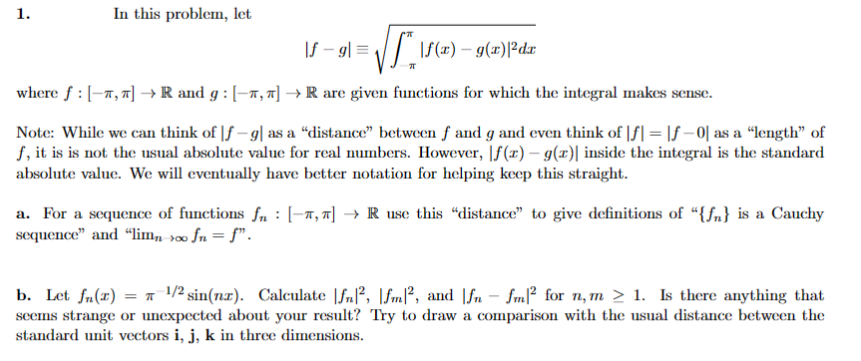
1. In this problem, let If - gl = If() - g(1)|2dr where f : [-7, #] -> R and g : [-7, #] -> R are given functions for which the integral makes sense. Note: While we can think of If -g| as a "distance" between f and g and even think of If| = If -O| as a "length" of f, it is is not the usual absolute value for real numbers. However, If(x) - g(x)| inside the integral is the standard absolute value. We will eventually have better notation for helping keep this straight. a. For a sequence of functions f : [-7, x] -> R use this "distance" to give definitions of "{f, } is a Cauchy sequence" and "lim, >co fn = f". b. Let fn(x) = * 1/2 sin(nr). Calculate fal, Ifml, and Ifn - fm] for n, m 2 1. Is there anything that seems strange or unexpected about your result? Try to draw a comparison with the usual distance between the standard unit vectors i, j, k in three dimensions
Step by Step Solution
There are 3 Steps involved in it

Get step-by-step solutions from verified subject matter experts
 Study Help