







Question: 1. Let T = 24 be total available hours (note that T = 24, not T = 12), L be hours of leisure, and n
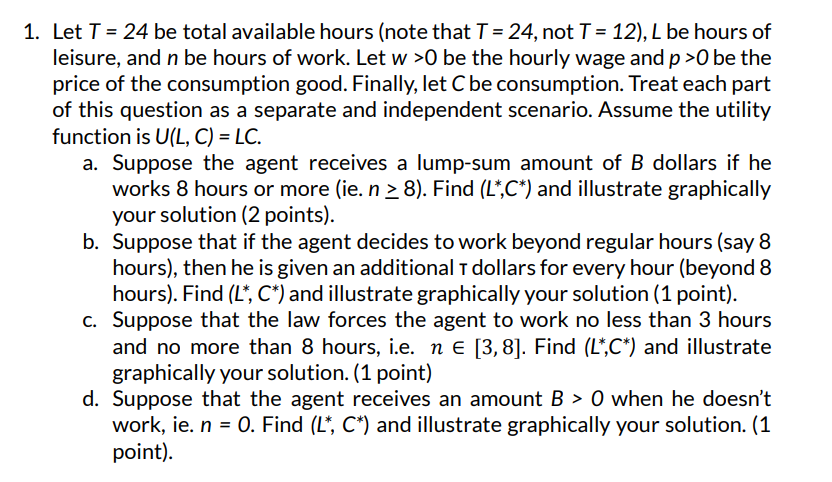
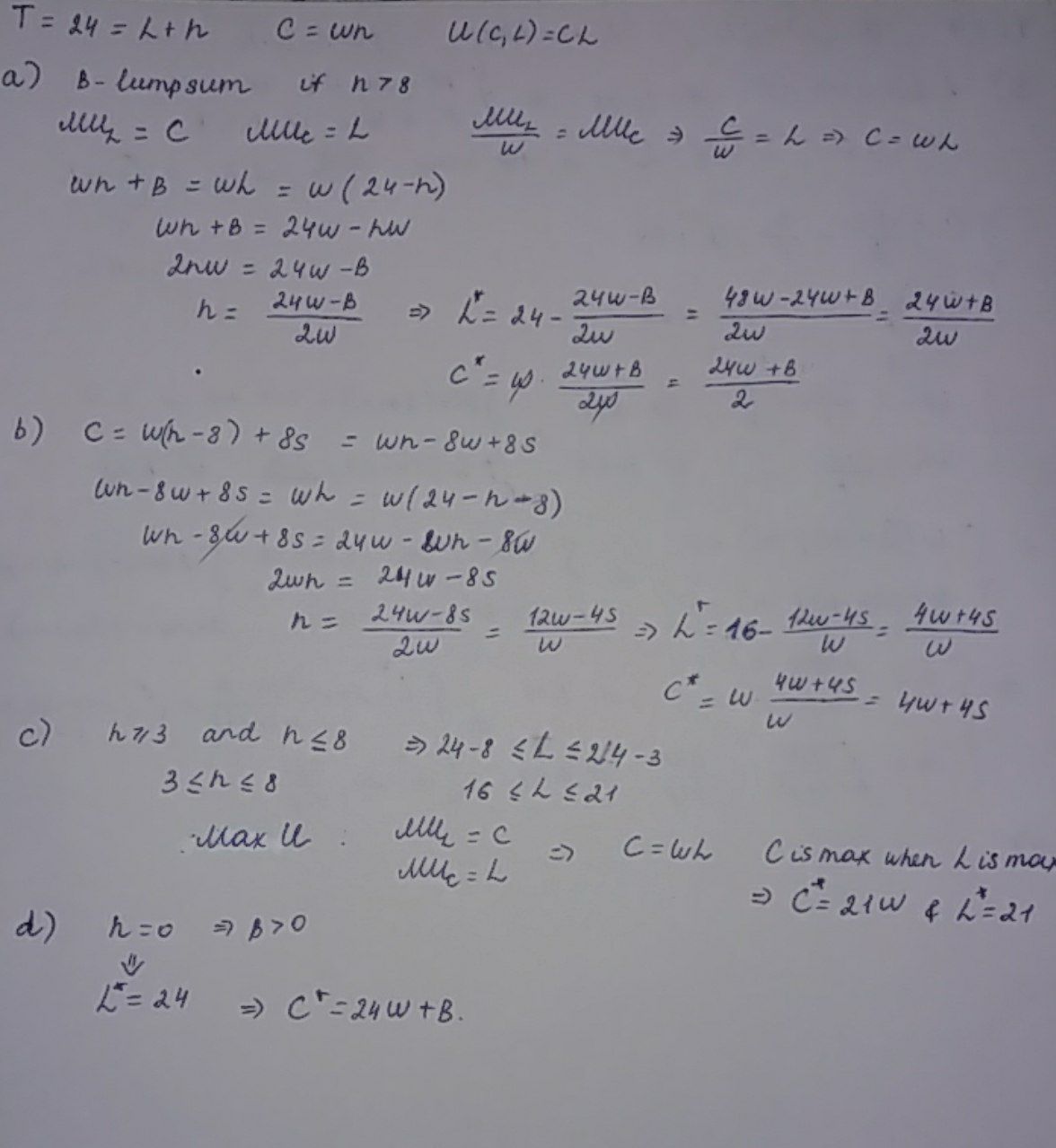
1. Let T = 24 be total available hours (note that T = 24, not T = 12), L be hours of leisure, and n be hours of work. Let w >0 be the hourly wage and p >0 be the price of the consumption good. Finally, let C be consumption. Treat each part of this question as a separate and independent scenario. Assume the utility functionis U(L, C) = LC. a. Suppose the agent receives a lump-sum amount of B dollars if he works 8 hours or more (ie. n > 8). Find (L*,C*) and illustrate graphically your solution (2 points). b. Suppose that if the agent decides to work beyond regular hours (say 8 hours), then he is given an additional T dollars for every hour (beyond 8 hours). Find (L*, C*) and illustrate graphically your solution (1 point). c. Suppose that the law forces the agent to work no less than 3 hours and no more than 8 hours, i.e. n [3,8]. Find (L',C*) and illustrate graphically your solution. (1 point) d. Suppose that the agent receives an amount B > O when he doesn't work, ie. n = 0. Find (L%, C*) and illustrate graphically your solution. (1 point). T= 24 = 4th C = wn U ( C, L ) = CL a) B- lumpsum if 178 lly = c lille = L w wh +B = wh = w ( 24 - h ) Wh + B = 24w- HW 2nw = 24W -B 24W-B 40 W - 24W + B 24 WtB h = 24 W - B 2w =) 1= 24 - ZW 2 w 2w C = W. 24 + 8 24w + 8 2 b ) C = W/h - 8 ) + 8s = wh- 8w+ 8s Wh - 8 w + 85 = wh = w / 24 - h -8 ) Wh - 8w + 8s = 24w - wn - 8w 2un = 24W - 85 h = 24w-85_ 12w-45 6- 15- 120-45 40+ 45 2w w w C_ w ww+45 = yw+ 45 w C ) h73 and h28 = 24-8 5L = 214 - 3 3 she8 16 s L = 21 Mile = C C= Wh Cismax when his may Me = L C=LAW & L= 21 d ) h =0 =$70 W L" = 24 =) CT= 24W + B
Step by Step Solution
There are 3 Steps involved in it

Get step-by-step solutions from verified subject matter experts
 Study Help