







Question: 3. Let T 12 be total available hours, L be hours of leisure, and n be hours of work. Let w> 0 be the
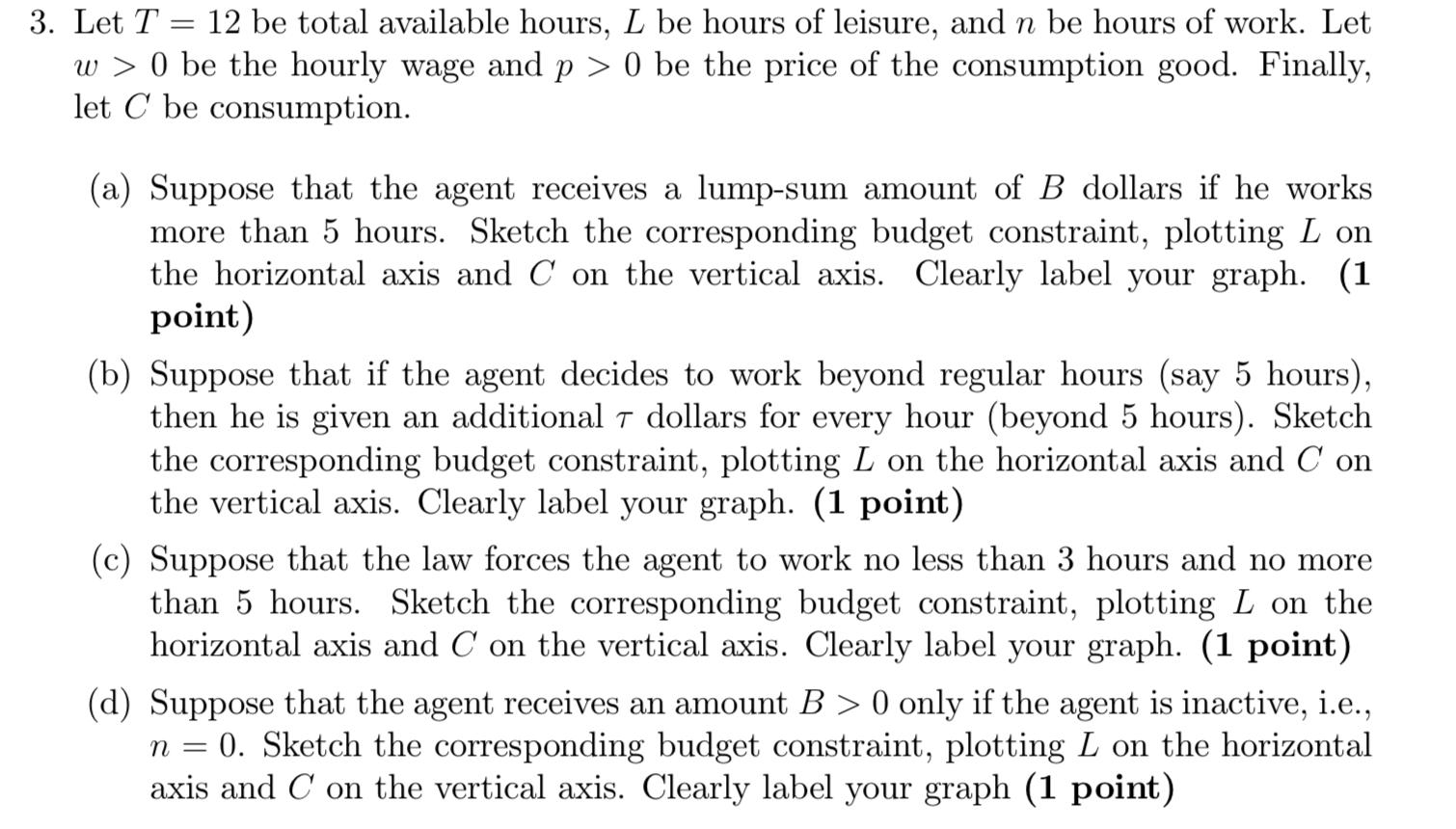
3. Let T 12 be total available hours, L be hours of leisure, and n be hours of work. Let w> 0 be the hourly wage and p > 0 be the price of the consumption good. Finally, let C be consumption. = (a) Suppose that the agent receives a lump-sum amount of B dollars if he works more than 5 hours. Sketch the corresponding budget constraint, plotting L on the horizontal axis and C on the vertical axis. Clearly label your graph. (1 point) (b) Suppose that if the agent decides to work beyond regular hours (say 5 hours), then he is given an additional 7 dollars for every hour (beyond 5 hours). Sketch the corresponding budget constraint, plotting L on the horizontal axis and Con the vertical axis. Clearly label your graph. (1 point) (c) Suppose that the law forces the agent to work no less than 3 hours and no more than 5 hours. Sketch the corresponding budget constraint, plotting L on the horizontal axis and C on the vertical axis. Clearly label your graph. (1 point) (d) Suppose that the agent receives an amount B > 0 only if the agent is inactive, i.e., n = 0. Sketch the corresponding budget constraint, plotting L on the horizontal axis and C on the vertical axis. Clearly label your graph (1 point)
Step by Step Solution
3.38 Rating (164 Votes )
There are 3 Steps involved in it
T12 m12 w0 wn is the wage income T... View full answer

Get step-by-step solutions from verified subject matter experts
 Study Help