







Question: 1. Modify the Blink program you did from Chapter 3 (Arduino UNO version on page 85 of the textbook) so that the function MyDelay(mSecondsApx) uses
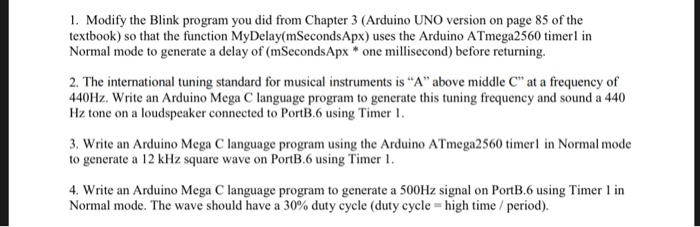
1. Modify the Blink program you did from Chapter 3 (Arduino UNO version on page 85 of the textbook) so that the function MyDelay(mSecondsApx) uses the Arduino ATmega2560 timerl in Normal mode to generate a delay of (mSecondsApx one millisecond) before returning. 2. The international tuning standard for musical instruments is "A" above middle C" at a frequency of 440Hz. Write an Arduino Mega C language program to generate this tuning frequency and sound a 440 Hz tone on a loudspeaker connected to PortB.6 using Timer 1 3. Write an Arduino Mega C language program using the Arduino ATmega2560 timer in Normal mode to generate a 12 kHz square wave on PortB.6 using Timer 1 4. Write an Arduino Mega C language program to generate a 500Hz signal on PortB.6 using Timer 1 in Normal mode. The wave should have a 30% duty cycle (duty cycle-high time / period). 1. Modify the Blink program you did from Chapter 3 (Arduino UNO version on page 85 of the textbook) so that the function MyDelay(mSecondsApx) uses the Arduino ATmega2560 timerl in Normal mode to generate a delay of (mSecondsApx one millisecond) before returning. 2. The international tuning standard for musical instruments is "A" above middle C" at a frequency of 440Hz. Write an Arduino Mega C language program to generate this tuning frequency and sound a 440 Hz tone on a loudspeaker connected to PortB.6 using Timer 1 3. Write an Arduino Mega C language program using the Arduino ATmega2560 timer in Normal mode to generate a 12 kHz square wave on PortB.6 using Timer 1 4. Write an Arduino Mega C language program to generate a 500Hz signal on PortB.6 using Timer 1 in Normal mode. The wave should have a 30% duty cycle (duty cycle-high time / period)
Step by Step Solution
There are 3 Steps involved in it

Get step-by-step solutions from verified subject matter experts
 Study Help