



Question: 1. When two fractions have the same denominator, we add or subtract them by keeping the same denominator and adding or subtracting the numerators.
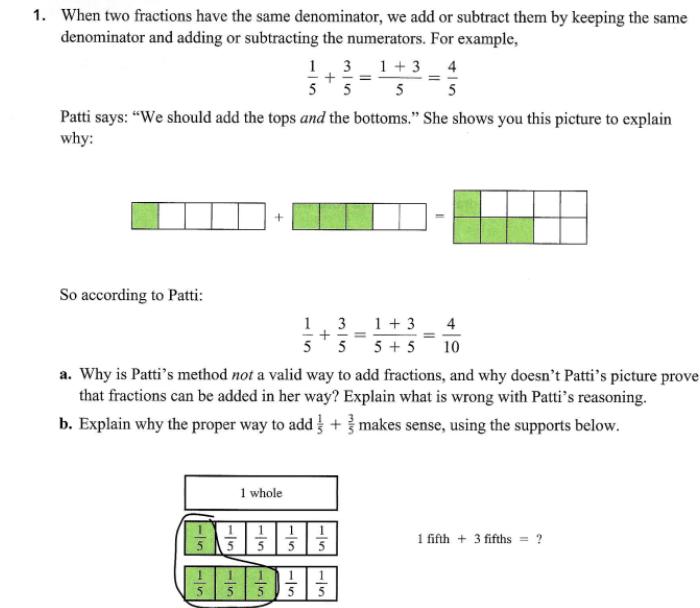
1. When two fractions have the same denominator, we add or subtract them by keeping the same denominator and adding or subtracting the numerators. For example, 15 + 3 = 5 1+34 5 5 Patti says: "We should add the tops and the bottoms." She shows you this picture to explain why: So according to Patti: + 15 + 5 5 35 1+ 3 4 = 5+5 10 a. Why is Patti's method not a valid way to add fractions, and why doesn't Patti's picture prove that fractions can be added in her way? Explain what is wrong with Patti's reasoning. b. Explain why the proper way to add + makes sense, using the supports below. 1 whole 15 15-5 1 1 5 5 -5 15 1 fifth +3 fifths ?
Step by Step Solution
There are 3 Steps involved in it

Get step-by-step solutions from verified subject matter experts