







Question: 10. Solve this problem using the EM algorithm: A sample (11, 12, 13) is observed counts from a multinomial population with probabilities: (-10, 10,
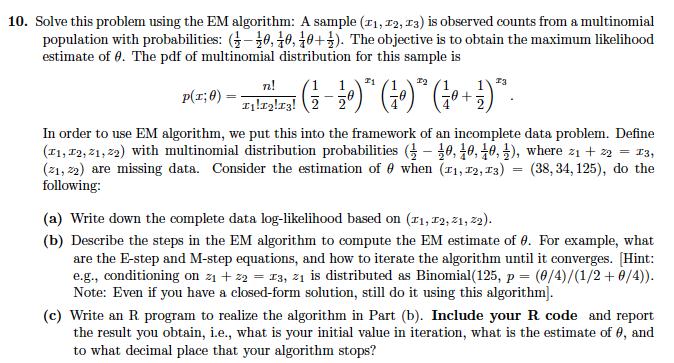
10. Solve this problem using the EM algorithm: A sample (11, 12, 13) is observed counts from a multinomial population with probabilities: (-10, 10, 10+1). The objective is to obtain the maximum likelihood estimate of 0. The pdf of multinomial distribution for this sample is p(1; 0) In order to use EM algorithm, we put this into the framework of an incomplete data problem. Define (11, 12, 21, 22) with multinomial distribution probabilities (-10,10,10,1), where 2 + 22 = 13, (21, 22) are missing data. Consider the estimation of when (11,12,13) (38, 34, 125), do the following: 71 '1 12 n! es!!es! ( 2 30 ) * (10) ** (10 + )* . 1 = (a) Write down the complete data log-likelihood based on (11, 12, 21, 22). (b) Describe the steps in the EM algorithm to compute the EM estimate of 0. For example, what are the E-step and M-step equations, and how to iterate the algorithm until it converges. [Hint: e.g., conditioning on z+z2 = 13, 21 is distributed as Binomial (125, p = (0/4)/(1/2+0/4)). Note: Even if you have a closed-form solution, still do it using this algorithm]. (c) Write an R. program to realize the algorithm in Part (b). Include your R code and report the result you obtain, i.e., what is your initial value in iteration, what is the estimate of 0, and to what decimal place that your algorithm stops?
Step by Step Solution
3.31 Rating (160 Votes )
There are 3 Steps involved in it
a Complete Data LogLikelihood The complete data loglikelihood function denoted by Lc is given ... View full answer

Get step-by-step solutions from verified subject matter experts
 Study Help