







Question: (1.1) An individual has the following utility function: u (w) = w /2. Her initial wealth is 10 and she faces the lottery X :
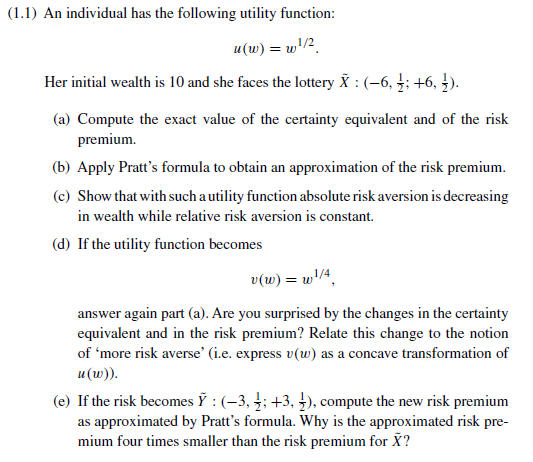
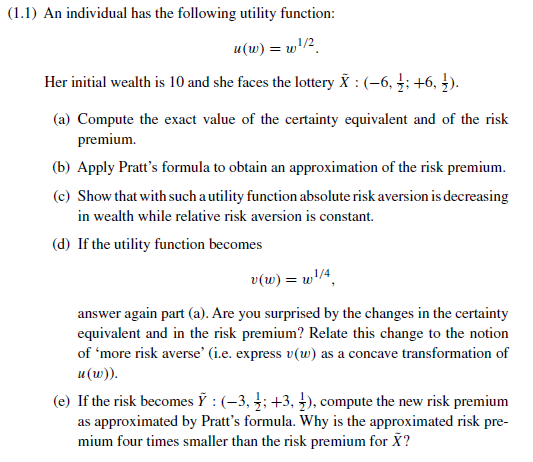
(1.1) An individual has the following utility function: u (w) = w /2. Her initial wealth is 10 and she faces the lottery X : (-6, 7: +6, ;). (a) Compute the exact value of the certainty equivalent and of the risk premium. (b) Apply Pratt's formula to obtain an approximation of the risk premium. (c) Show that with such a utility function absolute risk aversion is decreasing in wealth while relative risk aversion is constant. (d) If the utility function becomes U(w) = w /4 answer again part (a). Are you surprised by the changes in the certainty equivalent and in the risk premium? Relate this change to the notion of 'more risk averse' (i.e. express v(w) as a concave transformation of u (w)). (e) If the risk becomes Y : (-3, -; +3, -), compute the new risk premium as approximated by Pratt's formula. Why is the approximated risk pre- mium four times smaller than the risk premium for X
Step by Step Solution
There are 3 Steps involved in it

Get step-by-step solutions from verified subject matter experts
 Study Help