







Question: 16a.In the previous section of this problem set, explain why the calculated YTM of a bond could be a bad characterization (inaccurate) of the rate
16a.In the previous section of this problem set, explain why the calculated YTM of a bond could be a bad characterization (inaccurate) of the rate of return of a bond investment.
b.If YTM is a potentially bad method of calculation of a bond's rate of return, what other method of calculation is more appropriate? And why is this method always correct (accurate)?
c.,Are there any bad assumptions made in the calculation of the YTM of zero-coupon bonds?
17a.2 years ago, you acquired a 10-year 0% coupon, $1,000 face value bond at a YTM of 8%. Today, you sold this bond at a YTM of 12%. Calculate your annualized Horizon Yield [HY].
a.Assuming annual compounding, show your work below:
b.Assuming sem-annual compounding, show your work below:
18.Bonds of RCY Corporation with a face value of $1,000 sells for $975, mature in 5 years, and have a 8% coupon rate paid semiannually. Calculate the investor's RCY by assuming the following:
| - Bond sold to yield at 7% and the end of the 3-year holding period. |
| - Reinvestment rate 4% APR during this holding period. |
| - PS: state what assumption(s) you need to make in calculating this RCY. |
a. Show your calculations in the space below:
b.Briefly explain in the space below why there are potentially two answers to the RCY calculation?
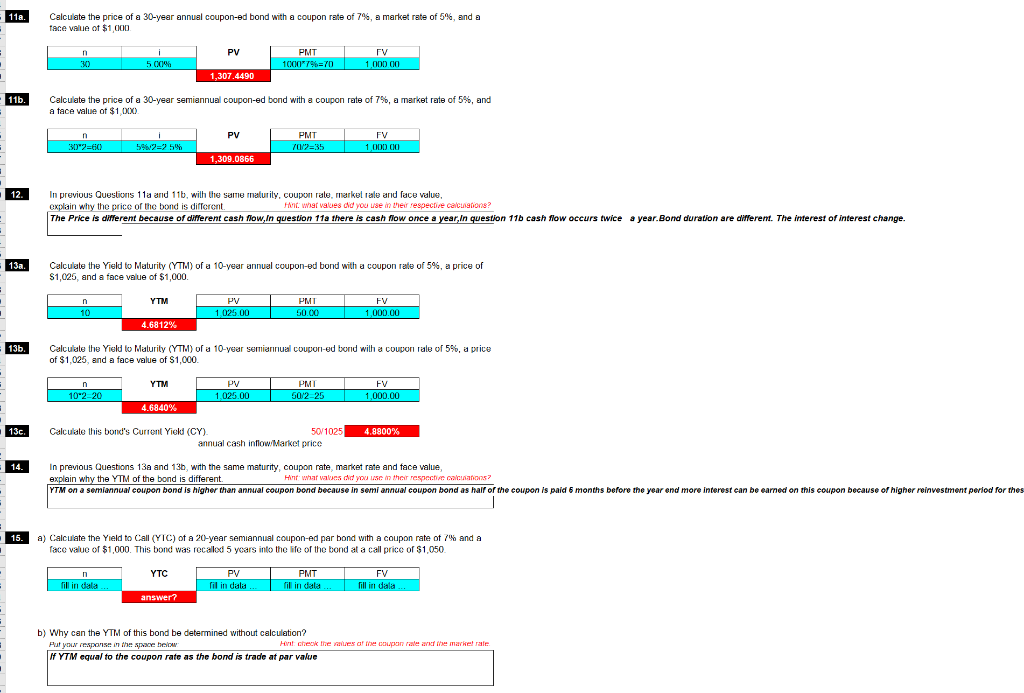
112 Calculate the price of a 30-year annual coupon-ed bond with a coupon rate of 7%, a market rate of 5%, and a face value of $1,000 PVPMT 1000*7%=70 1,307.4490 1 000 00 11b. Calculate the price of a 30-year semiannual coupon-ed bond with a coupon rate of 7%, a market rate of 5%, and a face value of $1,000 PVPMTFV 70/2=35 1.000.00 1.309,0866 12. In previous Questions 11a and 11b, with the same malurily, coupon rale, markerale and face value explain why the price of the bond is different Hintwer values did you use in their respective calculations? The Price is different because of different cash flow in question 11a there is cash flow once a year, in question 11b cash flow occurs twice a year.Bond duration are different. The interest of interest change. 13a. Calculate the Yield to Maturity (YTM) of a 10-year annual coupon-ed bond with a coupon rate of 5%, a price of $1,025, and a face value of $1,000. YTM PYPMI 1.025.00 50.00 PM FV 1.000.00 1.000.00 4.6812% 13b. Calculate the Yield to Maturity (YTM) of a 10-year semiannual coupon-ed bond with a coupon Tale of 5%, a price of $1,025, and a face value of $1,000 YTIM py 1.025.00 PM 50/2-25 10-2-20 FV 1,000.00 4.6840% 13c 4.8800% Calculate this bond's Current Yield (CY). 50/1025 annual cash inflow Market price In previous Questions 13 and 13b, with the same maturity, coupon rate, market rate and face value, explain why the YTM of the bond is different. Hint what wavns did you that I calculations? YTM on a semiannual coupon bond is higher than annual coupon bond because in semiannual coupon bond as half of the coupon is paid 6 months before the year end more interest can be earned on this coupon because of higher reinvestment period for thes 15. a) Calculate the Yield to Call (YTC) of a 20-year semiannual coupon-ed par bond with a coupon rate of 7% and a face value of $1,000. This bond was recalled 5 years into the life of the bond at a call price of $1,050 YTC PVPMT filin dala f il in sala fill in dala . answer? b) Why can the YTM of this bond be determined without calculation? Put you are in the below Hvit check the | 1 YTM equal to the coupon rate as the bond is trade at par value a u pan alan ve market rate 112 Calculate the price of a 30-year annual coupon-ed bond with a coupon rate of 7%, a market rate of 5%, and a face value of $1,000 PVPMT 1000*7%=70 1,307.4490 1 000 00 11b. Calculate the price of a 30-year semiannual coupon-ed bond with a coupon rate of 7%, a market rate of 5%, and a face value of $1,000 PVPMTFV 70/2=35 1.000.00 1.309,0866 12. In previous Questions 11a and 11b, with the same malurily, coupon rale, markerale and face value explain why the price of the bond is different Hintwer values did you use in their respective calculations? The Price is different because of different cash flow in question 11a there is cash flow once a year, in question 11b cash flow occurs twice a year.Bond duration are different. The interest of interest change. 13a. Calculate the Yield to Maturity (YTM) of a 10-year annual coupon-ed bond with a coupon rate of 5%, a price of $1,025, and a face value of $1,000. YTM PYPMI 1.025.00 50.00 PM FV 1.000.00 1.000.00 4.6812% 13b. Calculate the Yield to Maturity (YTM) of a 10-year semiannual coupon-ed bond with a coupon Tale of 5%, a price of $1,025, and a face value of $1,000 YTIM py 1.025.00 PM 50/2-25 10-2-20 FV 1,000.00 4.6840% 13c 4.8800% Calculate this bond's Current Yield (CY). 50/1025 annual cash inflow Market price In previous Questions 13 and 13b, with the same maturity, coupon rate, market rate and face value, explain why the YTM of the bond is different. Hint what wavns did you that I calculations? YTM on a semiannual coupon bond is higher than annual coupon bond because in semiannual coupon bond as half of the coupon is paid 6 months before the year end more interest can be earned on this coupon because of higher reinvestment period for thes 15. a) Calculate the Yield to Call (YTC) of a 20-year semiannual coupon-ed par bond with a coupon rate of 7% and a face value of $1,000. This bond was recalled 5 years into the life of the bond at a call price of $1,050 YTC PVPMT filin dala f il in sala fill in dala . answer? b) Why can the YTM of this bond be determined without calculation? Put you are in the below Hvit check the | 1 YTM equal to the coupon rate as the bond is trade at par value a u pan alan ve market rate
Step by Step Solution
There are 3 Steps involved in it

Get step-by-step solutions from verified subject matter experts
 Study Help