







Question: 2) (30 pts) The liquid-phase reaction A + B C occurs in an adiabatic CSTR with a volume of 10,000 L. The feed contains
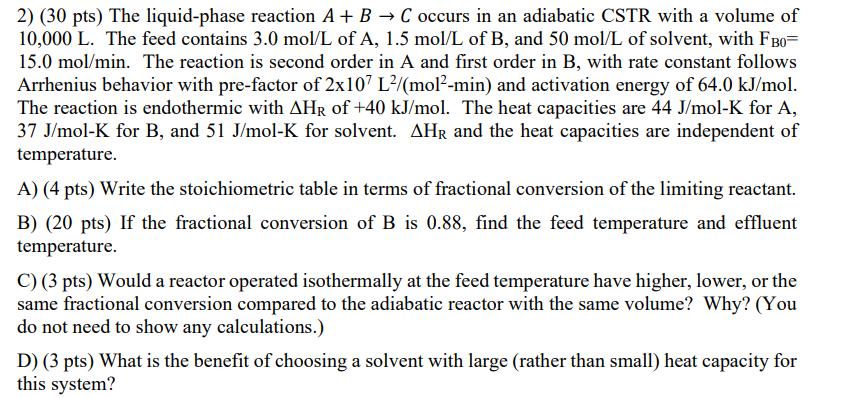
2) (30 pts) The liquid-phase reaction A + B C occurs in an adiabatic CSTR with a volume of 10,000 L. The feed contains 3.0 mol/L of A, 1.5 mol/L of B, and 50 mol/L of solvent, with FB0= 15.0 mol/min. The reaction is second order in A and first order in B, with rate constant follows Arrhenius behavior with pre-factor of 2x10⁷ L/(mol-min) and activation energy of 64.0 kJ/mol. The reaction is endothermic with AHR of +40 kJ/mol. The heat capacities are 44 J/mol-K for A, 37 J/mol-K for B, and 51 J/mol-K for solvent. AHR and the heat capacities are independent of temperature. A) (4 pts) Write the stoichiometric table in terms of fractional conversion of the limiting reactant. B) (20 pts) If the fractional conversion of B is 0.88, find the feed temperature and effluent temperature. C) (3 pts) Would a reactor operated isothermally at the feed temperature have higher, lower, or the same fractional conversion compared to the adiabatic reactor with the same volume? Why? (You do not need to show any calculations.) D) (3 pts) What is the benefit of choosing a solvent with large (rather than small) heat capacity for this system?
Step by Step Solution
3.38 Rating (154 Votes )
There are 3 Steps involved in it
Solution A Stoichiometric Table Species Initial Moles Change in Moles Final Moles A 1 2x 1 2x B 1 x 1 x C 0 2x 2x Solvent 50 0 50 B Finding Feed and Effluent Temperatures Energy Balance Apply the ener... View full answer

Get step-by-step solutions from verified subject matter experts
 Study Help