



Question: 2. a. Derive the formula for the change in concentration on the solvent side as a function of the diffusion flux, J, and time, t.
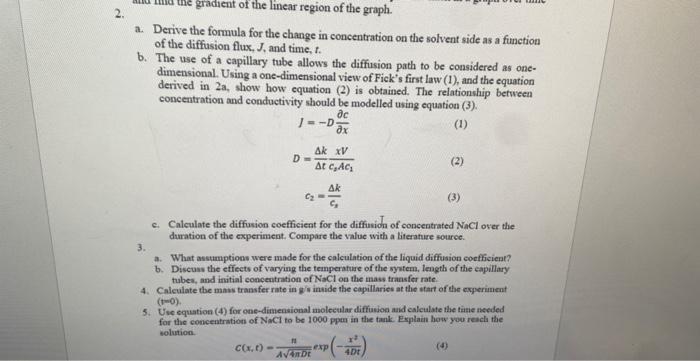
2. a. Derive the formula for the change in concentration on the solvent side as a function of the diffusion flux, J, and time, t. b. The use of a capillary tube allows the diffusion path to be considered as onedimensional. Using a one-dimensional view of Fick's first law (1), and the equation derived in 2a, show how equation (2) is obtained. The relationship between concentration and conductivity should be modelled using equation (3). I=DxcD=tkc2Ac1xVc2=c2k c. Calculate the diffusion coefficient for the diffinion of concentrated NaCl over the duration of the experiment. Compare the value with a literature souree. 3. a. What assumptions were made for the calculation of the liquid diffusion coefficient? b. Discuss the effeets of varying the temperature of the system, length of the eapillary tubes, and initial concentration of NaCl on the mass transfer rate. 4. Caleulate the mass transfer rate in g/v innide the capillaries at the otart of the experinent (t=0). 5. Use equation (4) for one-dimensional molecular diffunion and calculate the tse needed for the concentration of NaCl to be 1000Ppm in the tank. Explain how you reach the solution. c(x,t)=A4DEnexp(4Dtx2)
Step by Step Solution
There are 3 Steps involved in it

Get step-by-step solutions from verified subject matter experts