







Question: 2. Consider a 10-year $1000 face value bond with a 5% coupon rate. The investor buys the bond for $1100 but a liquidity shock forces
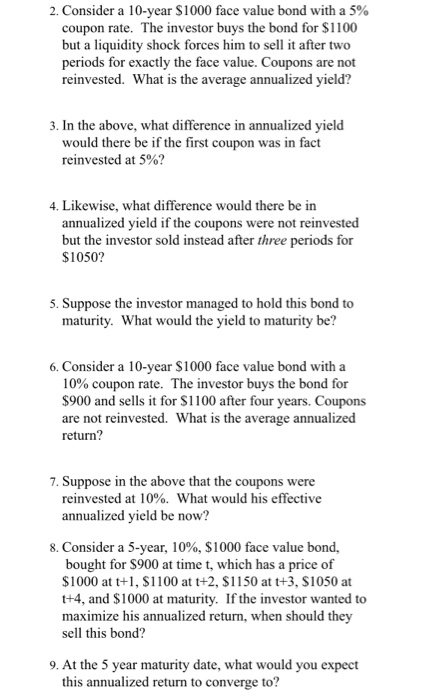
2. Consider a 10-year $1000 face value bond with a 5% coupon rate. The investor buys the bond for $1100 but a liquidity shock forces him to sell it after two periods for exactly the face value. Coupons are not reinvested. What is the average annualized yield? 3. In the above, what difference in annualized yield would there be if the first coupon was in fact reinvested at 5%? 4. Likewise, what difference would there be in not reinvested annualized yield if the coupons were but the investor sold instead after three periods for $1050? 5. Suppose the investor managed to hold this bond to maturity. What would the yield to maturity be? 6. Consider a 10-year S1000 face value bond with a 10% coupon rate. The investor buys the bond for $900 and sells it for S1100 after four years. Coupons are not reinvested. What is the average annualized return? 7. Suppose in the above that the coupons were reinvested at 10%. What would his effective annualized yield be now? 8. Consider a 5-year, 10%, $1000 face value bond. bought for $900 at time t, which has a price of $1000 at t+1, S1100 at t+2, $1150 at t+3, S1050 at t+4, and $1000 at maturity. If the investor wanted to maximize his annualized return, when should they sell this bond? 9. At the 5 year maturity date, what would you expect this annualized return to converge to
Step by Step Solution
There are 3 Steps involved in it

Get step-by-step solutions from verified subject matter experts
 Study Help