







Question: 2. Consider a three period (T = 3) binomial model with initial stock price So = $8, u = 3, d=1/2, r = 1/10, p=
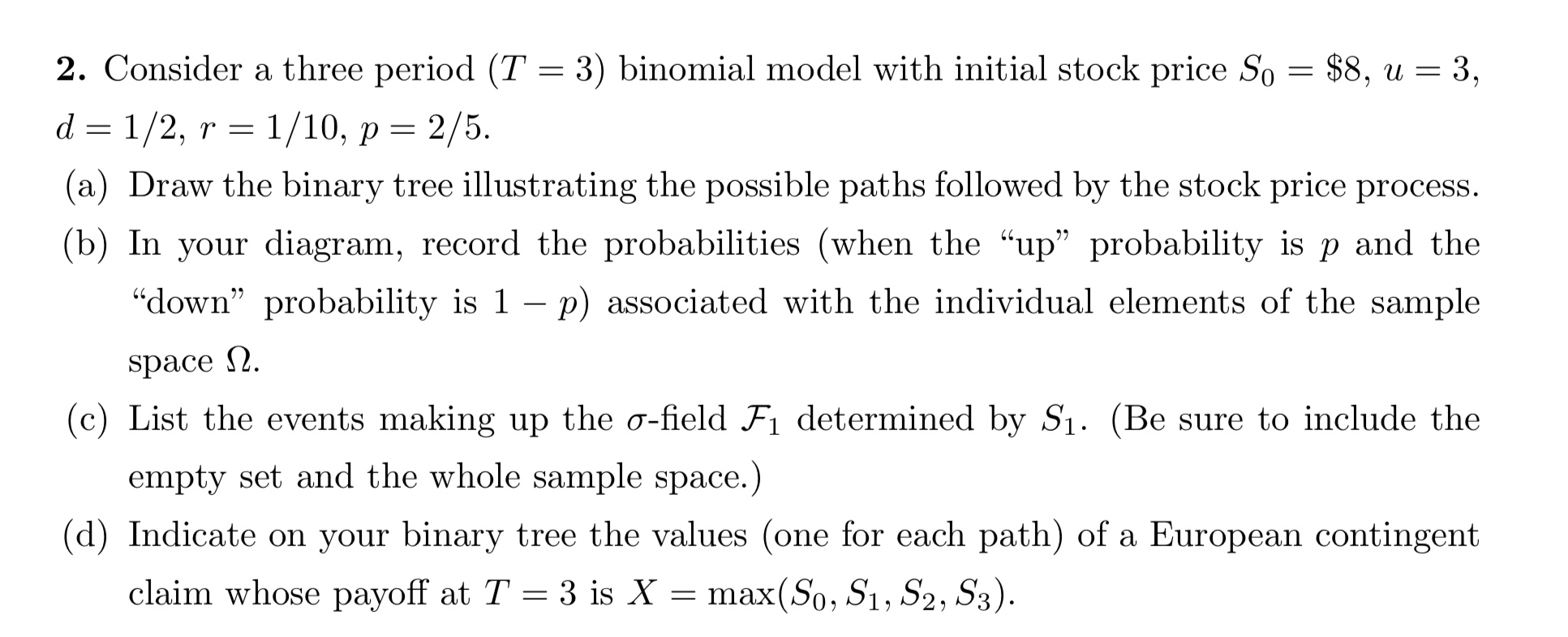
2. Consider a three period (T = 3) binomial model with initial stock price So = $8, u = 3, d=1/2, r = 1/10, p= 2/5. (a) Draw the binary tree illustrating the possible paths followed by the stock price process. (b) In your diagram, record the probabilities (when the up probability is p and the "down probability is 1 p) associated with the individual elements of the sample space 12. (c) List the events making up the o-field Fi determined by Si. (Be sure to include the empty set and the whole sample space.) (d) Indicate on your binary tree the values (one for each path) of a European contingent claim whose payoff at T = 3 is X = max(S0, S1, S2, S3). 2. Consider a three period (T = 3) binomial model with initial stock price So = $8, u = 3, d=1/2, r = 1/10, p= 2/5. (a) Draw the binary tree illustrating the possible paths followed by the stock price process. (b) In your diagram, record the probabilities (when the up probability is p and the "down probability is 1 p) associated with the individual elements of the sample space 12. (c) List the events making up the o-field Fi determined by Si. (Be sure to include the empty set and the whole sample space.) (d) Indicate on your binary tree the values (one for each path) of a European contingent claim whose payoff at T = 3 is X = max(S0, S1, S2, S3)
Step by Step Solution
There are 3 Steps involved in it

Get step-by-step solutions from verified subject matter experts
 Study Help