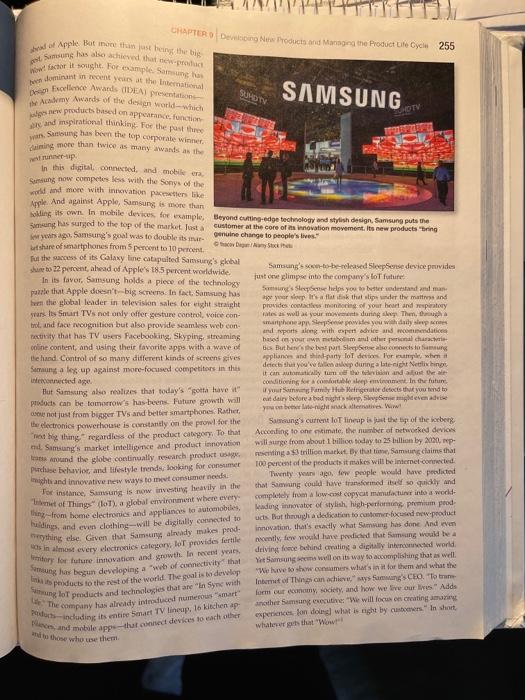
2. How does Samsung thrive in its competitive new product development environment? 3. Recall this quote from Samsung's CEO: "We have to show consumers what's in it for them and what the Internet of Things can achieve, to transform our economy, society, and how we live our lives." Do you agree with this business approach? Explain. PART 1: Defining Marketing and the Marketing Process (Chapters T- PART 2: Understanding the Marketplace and Consumer Value (Chapter 3-0) PART 3: Designing a Customer Value-Driven Strategy and Mix PART 4: Extending Marketing (Chapters 18-20) Developing New Products and Managing the Product Life Cycle poses new challenges requiring different marketing strategies and tactics. Finally, we wrap up our product discussion by looking two additional considerations social responsibility in product de sions and international product and services marketing. For openers, consider Samsung, the world's leading com sumer electronics maker and one of the world's most innovat companies. Over the past two decades, Samsung has trans formed itself by creating a culture of customer-focused innovation and a seemingly endless flow of inspired new products that s ture stunning design, innovative technology, life enriching features and a big dose of "Wow!" through New-Product Innovation its entire culture, from copycat to leading-edge. To outsell Som Samsung decided, it first had to out-innovate Sony. Samsung's dramatic shift began with a top-down man- date for reform. Samsung set out to become a premier brand and a trailblazing product leader. It hired a crop of fresh, young designers and managers who unleashed a torrent of new products-not humdrum, me-too products, but sleek, bold, and beautiful products targeted to high-end users. Samsung called them "lifestyle works of art." Every new product had to pass the "Wow!" test: If it didn't get a "Wow!" reaction during market testing, it went straight back to the design studio. Beyond cutting edge technology and stylish de signs, Samsung put the customer at the core of its innovation more ment. Its primary innovation goal was to improve the customer expe rience and bring genuine change to people's lives in everything it did With its fresh customer centered new-product focus, Samsung overtook Sony in less than 10 years. Today, Samsung's annual revenues of $19 billion are more than two and a half times Sony's revenu placing it at number 13 on Fortune's Global 500-two spets 9 in the previous chapter, you learned how marketers manage and develop products and brands. In this chapter, we examine two additional product topics de veloping new products and managing products through ther fe cycles produc are the Meblood an organization. However, new product development is risky, und many new products fall. So, the first part of this chapter lays out a process for tnding and growing successful new products. Once introduced marketers then want their products to enjoy long and happy Ives. In the second part of this chapter, you'll see that every product passes through several ife-cycle stages, and each stage SAMSUNG: Enriching Customers' Lives Y ou're probably familiar with the Samsung brand. Maybe you own one of Samsung's hot new Galaxy smartphones that tracks your eye movements to help you navigate the screen, or maybe you've seen one of Samsung's dazzling new Superior 4k Ultra-High-Definition Senart TVs with a fully immersive curved screen and nano- crystal technology. Samsung, the world's largest consumer electronics manufacturer, produces "gotta-have" electronics in just about every category, from TVs and Blu-ray players, tablets and mobile phones, and smartwatches to smart-home devices and even a full range of home appliances But little more than 20 years ago, Samsung was barely known, and it was anything but cutting- edge. Back then, Samsung was a Korean copycat brand that you bought off a shipping pallet at Costco if you couldn't afford a Sony, then the world's most cov eted consumer electronics brand. However, in 1993 Samsung made an inspired decision. It turned its back on cheap knock- offs and set out to overtake rival Sony. To dethrone the con- sumer electronics giant, however, Samsung first had to change CHAPTER PREVIEW Samsung has become the world's leading consumer electronics company through customer-focused innovation and new products that enrich customers' lives. At Samsung, every new product has to pass the consumer "Wow!" test. CHAPTER 9 Developing New Products and Managing the Product Life Cycle 255 SUNDTY ahead of Apple. But more than just being the big pest Sumsung has also achieved that new-product Wow! factor it sought. For example, Samsung has been dominant in recent years at the International Design Excellence Awards (IDEA) presentations- the Academy Awards of the design world-which judges new products based on appearance, function alty and inspirational thinking. For the past three ya Samsung has been the top corporate winner. daiming more than twice as many awards as the SAMSUNG HOTV west runner-up. 1 In this digital connected, and mobile era, Samsung now competes less with the Sonys of the world and more with innovation pacesetters like Apple. And against Apple, Samsung is more than customer at the core of its innovation movement. Its new products "bring genuine change to people's lives." bokling its own. In mobile devices, for example, Beyond cutting-edge technology and stylish design, Samsung puts the Samsung has surged to the top of the market. Just a er years ago, Samsung's goal was to double its mar- et share of smartphones from 5 percent to 10 percent. fut the success of its Galaxy line catapulted Samsung's global share to 22 percent, ahead of Apple's 18.5 percent worldwide. Samsung's soon-to-be-released SleepSense device provides just one glimpse into the company's loT future. In its favor, Samsung holds a piece of the technology pazzle that Apple doesn't-big screens. In fact, Samsung has hen the global leader in television sales for eight straight years. Its Smart TVs not only offer gesture control, voice con- trol, and face recognition but also provide seamless web con- nectivity that has TV users Facebooking, Skyping, streaming online content, and using their favorite apps with a wave of the hand. Control of so many different kinds of screens gives Samsung a leg up against more-focused competitors in this interconnected age. Samsung's SleepSense helps you to better understand and man age your sleep It's a flat disk that slips under the mattress and provides contactless monitoring of your heart and respiratory rates as well as your movements during sleep Then, though a smartphone app, SleepSense provides you with daily sleep scores and reports along with expert advice and recommendations based on your own metabolism and other personal characteris bis But here's the best part SleepSense also connects to Samsung appliances and third-party lot devices. For example, when a detects that you've fallen asleep during a late-night Netflix hinge it can automatically tum of the television and adjust the air conditioning for a comfortable sleep environment. In the future. if your Samsung Family Hub Refrigerator detects that you tend to et dairy before a bod night's sleep, SleepdSense might even advise you on better late-night snack alternatives. Wow! But Samsung also realizes that today's "gotta have it" products can be tomorrow's has-beens. Future growth will cose not just from bigger TVs and better smartphones. Rather, the electronics powerhouse is constantly on the prowl for the not thing, regardless of the product category. To that end Samsung's market intelligence and product innovation ats around the globe continually research product usage purchase behavior, and lifestyle trends, looking for consumer imights and innovative new ways to meet consumer needs. Samsung's current loT lineup is just the tip of the iceberg. According to one estimate, the number of networked devices will surge from about 1 billion today to 25 billion by 2020, rep resenting a $3 trillion market. By that time, Samsung claims that 100 percent of the products it makes will be internet connected. For instance, Samsung is now investing heavily in the met of Things" (loT), a global environment where every thing-from home electronics and appliances to automobiles, huldings, and even clothing will be digitally connected to verything else. Given that Samsung already makes prod us in almost every electronics category, loT provides fertile mitory for future innovation and growth. In recent years, Twenty years ago, few people would have predicted that Samsung could have transformed itself so quickly and completely from a low-cost copycat manufacturer into a world- leading innovator of stylish, high-performing premium prod ucts. But through a dedication to customer-focused new product innovation, that's exactly what Samsung has done And even recently, few would have predicted that Samsung would be a driving force behind creating a digitally interconnected world. Yet Samsung seems well on its way to accomplishing that as well. "We have to show consumers what's in it for them and what the Internet of Things can achieve," says Samsung's CEO. "To trame form our economy, society, and how we live our lives" Adds another Samsung executive: "We will focus on creating amazing experiences, Jon doing] what is right by customers." In short, whatever gets that "Wow!" Samsung has begun developing a "web of connectivity that Inks its products to the rest of the world. The goal is to develop Samsung loT products and technologies that are "in Sync with The company has already introduced numerous "smart" Products including its entire Smart TV lineup, 16 kitchen ap planon, and mobile apps-that connect devices to each other and to those who use them