







Question: 2. read the text about changes at 3M and answer questions 1-3. 2 How can companies ensure continued progress? 2 Read the text about changes
2. read the text about changes at 3M and answer questions 1-3.
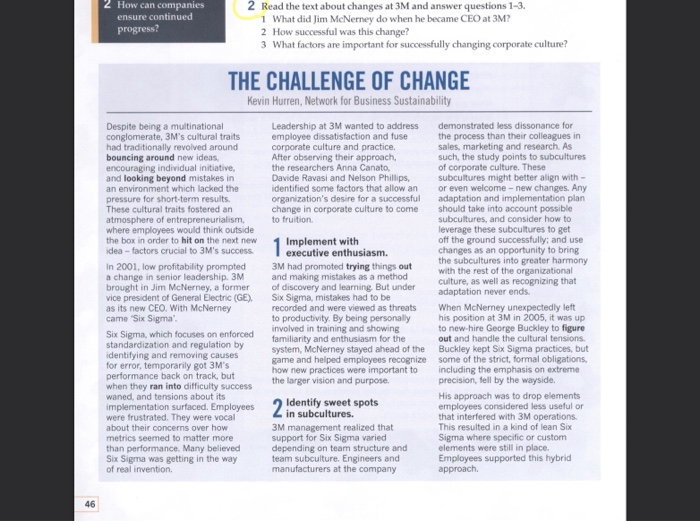
2 How can companies ensure continued progress? 2 Read the text about changes at 3M and answer questions 1-3. 1 What did Jim McNerney do when he became CEO at 3M? 2 How successful was this change? 3 What factors are important for successfully changing corporate culture? THE CHALLENGE OF CHANGE Kevin Hurren, Network for Business Sustainability Leadership at 3M wanted to address employee dissatisfaction and fuse corporate culture and practice. After observing their approach, the researchers Anna Canato Davide Ravasi and Nelson Phillips, identified some factors that allow an organization's desire for a successful change in corporate culture to come to fruition Despite being a multinational conglomerate, 3M's cultural traits had traditionally revolved around bouncing around new ideas, encouraging individual initiative and looking beyond mistakes in an environment which lacked the pressure for short-term results These cultural traits fostered an atmosphere of entrepreneurialism where employees would think outside the box in order to hit on the next new idea-factors crucial to 3M's success. In 2001, low profitability prompted a change in senior leadership. 3M brought in Jim McNerney, a former vice president of General Electric (GE) as its new CEO. With McNerney came "Six Sigma'. Six Sigma, which focuses on enforced standardization and regulation by identifying and removing causes for error, temporarily got 3M's performance back on track, but when they ran into difficulty Success waned, and tensions about its implementation surfaced. Employees were frustrated. They were vocal about their concerns over how metrics seemed to matter more than performance. Many believed Six Sigma was getting in the way of real invention 1 Implement with I executive enthusiasm. 3M had promoted trying things out and making mistakes as a method of discovery and learning. But under Six Sigma, mistakes had to be recorded and were viewed as threats to productivity. By being personally involved in training and showing familiarity and enthusiasm for the system, McNerney stayed ahead of the game and helped employees recognize how new practices were important to the larger vision and purpose. demonstrated less dissonance for the process than their colleagues in sales, marketing and research As such, the study points to subcultures of corporate culture. These subcultures might better align with or even welcome-new changes. Any adaptation and implementation plan should take into account possible subcultures, and consider how to leverage these subcultures to get off the ground successfully: and use changes as an opportunity to bring the subcultures into greater harmony with the rest of the organizational culture, as well as recognizing that adaptation never ends. When McNemey unexpectedly left his position at 3M in 2005, it was up to new-hire George Buckley to figure out and handle the cultural tensions Buckley kept Six Sigma practices, but some of the strict, formal obligations including the emphasis on extreme precision, fell by the wayside. His approach was to drop elements employees considered less useful or that interfered with 3M operations This resulted in a kind of lean Six Sigma where specific or custom elements were still in place. Employees supported this hybrid approach Identify sweet spots in subcultures. 3M management realized that support for Six Sigma varied depending on team structure and team subculture. Engineers and manufacturers at the company Step by Step Solution
There are 3 Steps involved in it
1 Expert Approved Answer
Step: 1 Unlock

Question Has Been Solved by an Expert!
Get step-by-step solutions from verified subject matter experts
Step: 2 Unlock
Step: 3 Unlock
 Study Help