







Question: 2) Working at exactly (0.237, 0.706) does not work in practice because any noise in the voltages, starting position, and starting trajectory of the ions
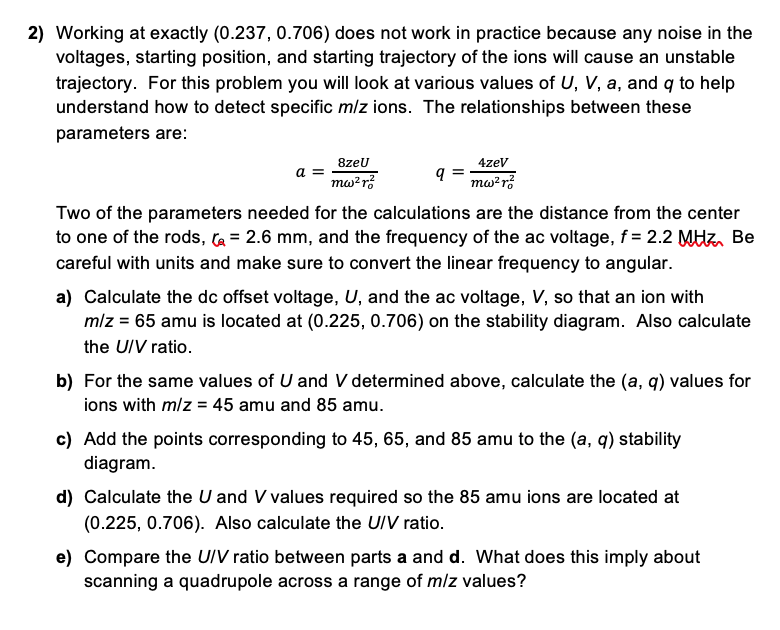
2) Working at exactly (0.237, 0.706) does not work in practice because any noise in the voltages, starting position, and starting trajectory of the ions will cause an unstable trajectory. For this problem you will look at various values of U, V, a, and q to help understand how to detect specific m/z ions. The relationships between these parameters are: 8zeU 4zeV a mwr? q mwr? Two of the parameters needed for the calculations are the distance from the center to one of the rods, C = 2.6 mm, and the frequency of the ac voltage, f = 2.2 MHz Be careful with units and make sure to convert the linear frequency to angular. a) Calculate the dc offset voltage, U, and the ac voltage, V, so that an ion with mlz = 65 amu is located at (0.225, 0.706) on the stability diagram. Also calculate the U/V ratio. b) For the same values of U and V determined above, calculate the (a, q) values for ions with m/z = 45 amu and 85 amu. c) Add the points corresponding to 45, 65, and 85 amu to the (a, q) stability diagram. d) Calculate the U and V values required so the 85 amu ions are located at (0.225, 0.706). Also calculate the U/V ratio. e) Compare the U/V ratio between parts a and d. What does this imply about scanning a quadrupole across a range of m/z values
Step by Step Solution
There are 3 Steps involved in it

Get step-by-step solutions from verified subject matter experts
 Study Help